


*This article is a reprint of an article published by Story Design house in DeepTech Impact on October 23, 2019.
There is a boom in the startup industry.
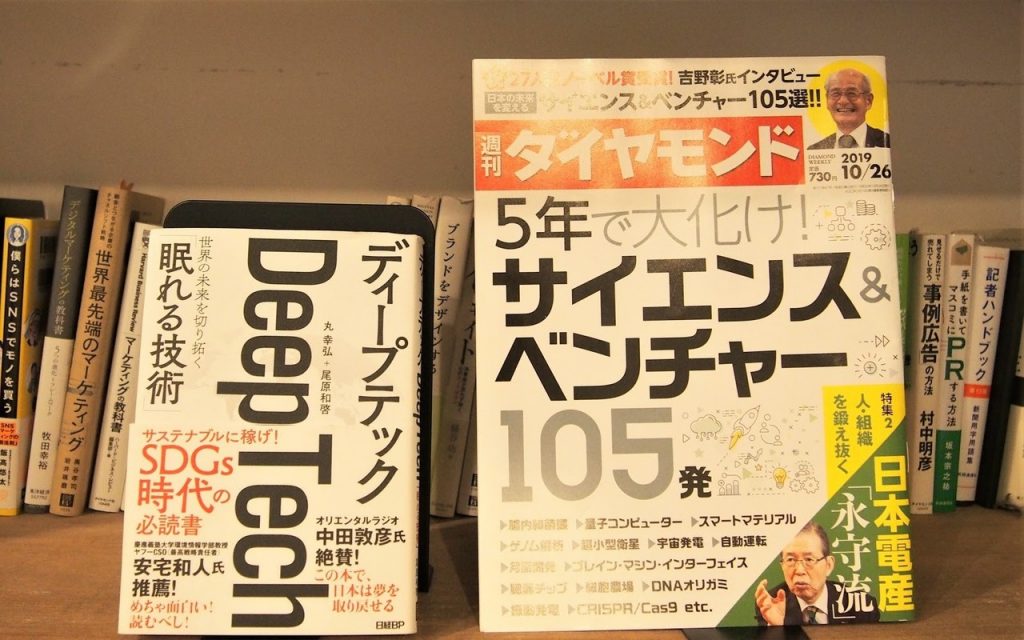
In September, a book titled "Deep Tech: The 'Sleeping Technology' That Will Pioneer the Future of the World" was released and has become a hot topic.
In addition, the October 26, 2019 issue of Weekly Diamond will feature "Five Years of Big Growth! 105 Science & Ventures". The headline language is different, but the content deals squarely with deep tech.
What is deep tech? Although the term has not yet been clearly defined, it can be said to have the following characteristics.
interpoint (interword separation)Technology developed at universities and research institutesBusiness model built around a core of
The company is now in the process of commercializing and marketing the product,Requires a huge investment
When you succeed...,Businesses that could have a significant impact on the world
In the past, the startup industry has been marked by investments in web services with low initial investment and short time to commercialization.
However, the opposite is now true, and more and more venture capitalists (VCs) are establishing funds to invest in the deep-tech sector.
Startups need money and time.
After several venture booms, investment in startups in Japan has finally begun to flourish over the past few years.
According to a report by the Nissay Research Institute, the trend of large companies establishing corporate venture capital (CVC) began to emerge around 2012-13. The amount of money invested by Japanese companies in startups through CVCs and other means exceeded 130 billion yen in 2018, an increase that appears to have nearly doubled from 2017.
It takes money and time for startups, especially deep tech startups, to grow. Take, for example, AXELSPACE, which has made great strides in the nano-satellite business, launching the world's first commercial small satellite in 2013 and a small satellite in partnership with JAXA in 2019. Today, the space business is well known thanks to the success of SpaceX in the U.S. and Interstellar Technologies by Takafumi Horie.
However, when AXELSPACE was founded in 2008, it was not common for start-ups to challenge the space business. One organization that has supported AXELSPACE since shortly after its founding is TEP (TX Entrepreneur Partners). This organization supports deep-tech startups with cutting-edge technologies from universities and research institutes by angel investors.
The Endless Distance Between Research and BusinessThere are No matter how great the technology is, whether it can be implemented as a business is another story.
A mechanism is needed to connect the two distant sides and expand society
Numerous events focused on deep tech
Startup events are held in various parts of the world to bring startups together. Slush, which started in Finland in 2008 and is held annually, VivaTech, which began to be held in France in 2016, and Singapore's Echelon Asia Summit and Tech in Asia are widely known, but they are also held in Japan.
We at Story Design house help with PR and public relations for organizations, companies, and events related to deep tech, including the aforementioned TEP. One example is the Asia Entrepreneurship Awards (AEA), held annually in the Kashiwanoha Campus area. This event brings together deep tech startups from Asia. The event has been held since 2012, when venture support was not so active in Japan.
Garage+, a non-profit incubator organization based in Taiwan, has also been working to connect Japanese companies with deep tech startups around the world through their hub. Startup Express / Asia Startup Express was launched.
Japan in Expectation
Both AEA and Garage+ are events that bring deep tech startups from around the world to Japan. Japan is still attractive as a market. With the increase in CVC investment and Japanese companies becoming more proactive in open innovation, an environment is being fostered that makes it easier for foreign deep tech startups to enter the market. and the environment is becoming more conducive for foreign deep-tech startups to enter the market.
Garage+ representative Josephine said, "Japan's knowledge of manufacturing is deep, and we are also close to Taiwan in terms of distance and psychology. We would like to actively collaborate with them as a long-term business partner for the development of the Asian economy.
Japan has the aspect of being a country with advanced issues. Can deep tech solve the problems that the world will face in the future, such as labor shortages due to the declining birthrate and aging population? We will not know whether the technology will match the market and whether it will be viable as a business until we actually try it out. It is also expected that challenging services will be developed through collaboration with Japanese companies.
Will Deep Tech Change the World?
The Internet has changed the world.And now, Deep Tech is changing the world!With the rapid evolution of all kinds of technologies, such as 5G and other telecommunications infrastructures and AI-based computing, there is a growing trend toward technological innovation, not only in the IT industry, but also in existing industrial structures, which has great potential to create a significant impact. It is.Conventional industry-wide updatesThis will lead to
The time for the creation of an entirely new industry may be just around the corner.
 Story Design houseis a communication strategy partner for companies and organizations with the mission of "creating a path where there is a will".




 JA
 EN
