


Cutting out the coral reef ecosystem as it is! What is the service born from the development of environmental transfer technology?
-Can you tell us about the services that Inoka is developing by taking advantage of the development of environmental transfer technology?
ancient log storehouseWe are proceeding on two main axes: 1.
First,To build coral tanks in different places."is at the heart of our services.
This is what we call an "educational" service that takes advantage of our ability to show the real thing. INNOCA'sWe have installed water tanks in commercial facilities and also open our Kamiyacho facility to the public on holidays. We also open our Kamiyacho facility to the public on weekends and holidays.
Education is not a "let's do something good for the environment" service. As a result, coral must be protected, but first.Coral is funny."That is the starting point.See various living creatures in person and study them with wonder.That's what I'm trying to convey.
The other axis is "research to protect the sea.
Until now, the mainstream of research has been to go to Okinawa and take the time to obtain various permissions. Our technology, on the other hand,The ideal of research and development that enables more detailed quantitative evaluation in a stable, weather-independent environment without the need for any permits, while still being located in Tokyo.The company is a member of the Japan Coral Research Institute (JCI). With the cooperation of various professors and companies that study the ocean, we are conducting research to protect coral.
Looking In! Working with Coral
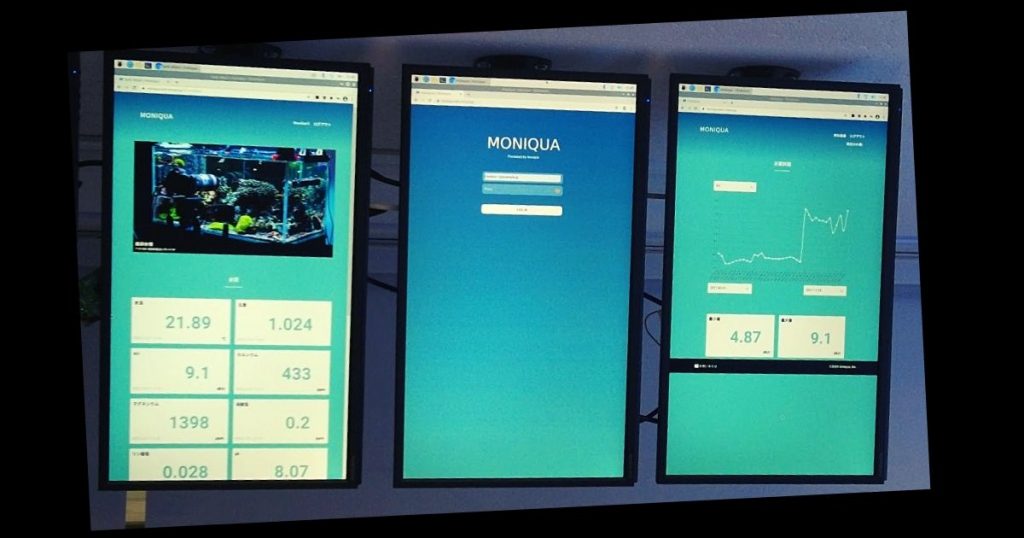
-What are you doing with the monitors that are installed?
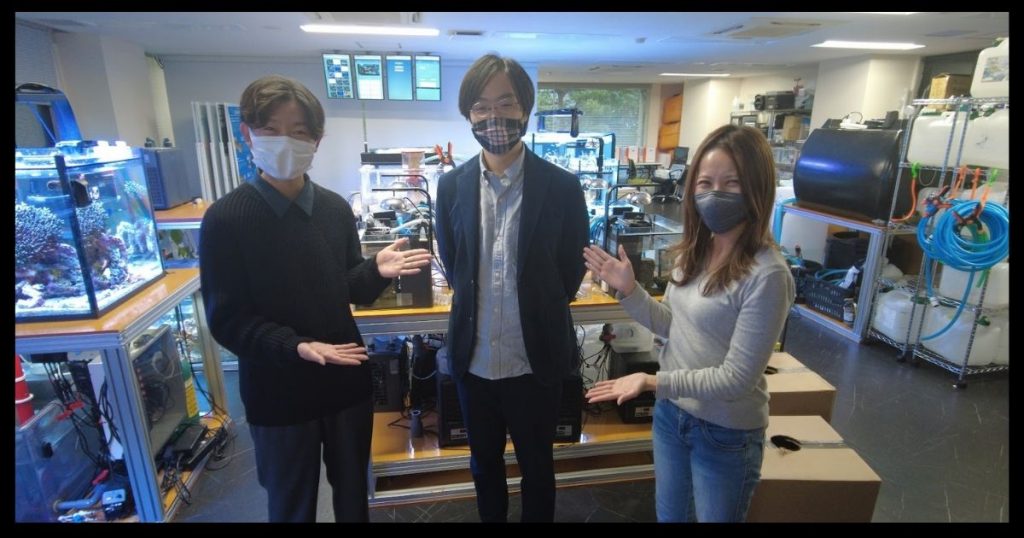
Takakura:This is a monitoring aquarium (Moniqua). Coral rearing is very difficult due to its nature, so we are aiming to systemize the management of corals so that anyone can keep them. This is our core technology.
You are actually working on it now, but what are you working on?
ancient log storehouse: Right now we are doing water quality testing. We are not trying to convert everything to IoT, but we are also considering its cost-effectiveness and focusing our wisdom to figure out only the really necessary values. This kind of muddy work may be what makes us different from ordinary IT startups.
The Mystery of Corals! Why Environmental Transfer Technology is so useful for ocean research!
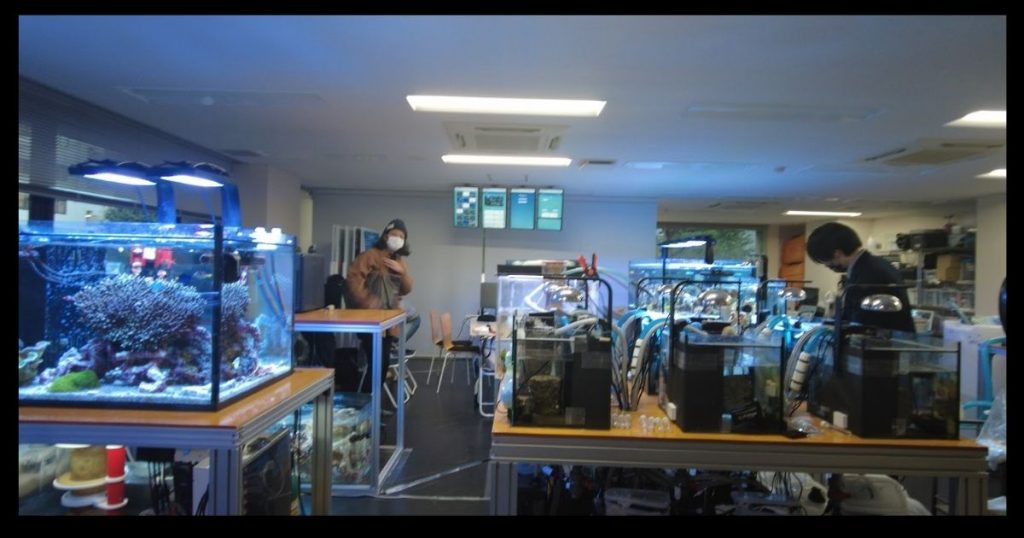
You have several aquariums. How many kinds of fish live there?
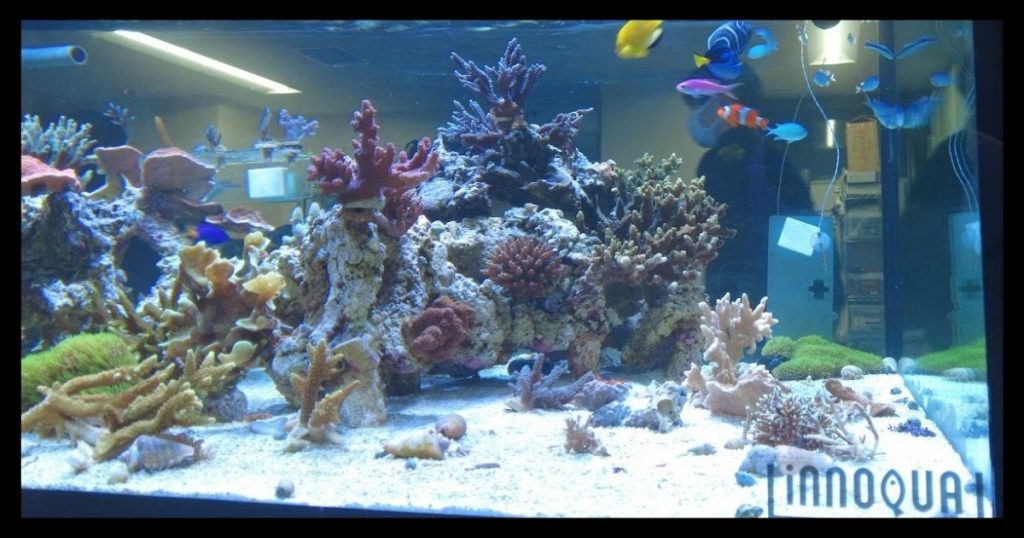
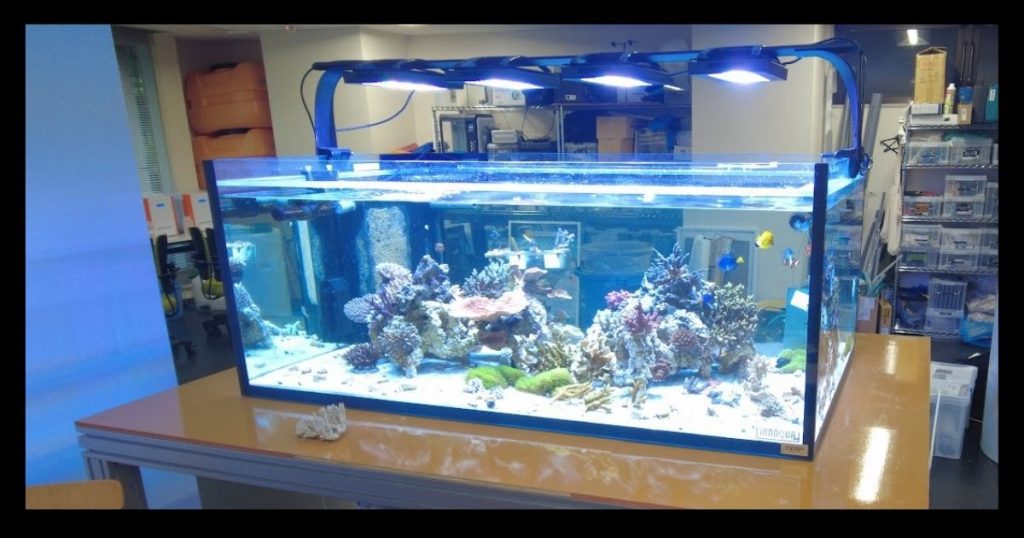
ancient log storehouse: Yes. We have three large tanks and seven smaller ones. The largest tank we have built has about 100 species of creatures, including corals.
So many ecosystems have been reproduced as they are! Can you tell us how you arrived at your current service by utilizing environmental transfer technology?
ancient log storehouseI began my research on artificial spawning of corals in an aquarium that I had made by combining equipment I had at home. Coral is a romantic creature that spawns once a year near the night of a full moon, but because it happens only once a year, it was very difficult to make progress in my research.
This can be done in an artificial environment, where the seasons can be staggered. We started with the idea that this would be a technology that could promote more research on corals" because eggs would be available every month.
Why did you decide to start a business in coral? Also a great explanation of the appeal of coral!
However, I have the impression that coral has no connection with everyday life. Why did you decide to start a business with coral?
Takakura:Corals are very interesting creatures and have actually existed on earth since the Jurassic period.It's a great, great senior life form of the human race, with a variety of properties that have evolved over the course of its survival.I'm not sure.
Even though they are animals, they have phytoplankton in their bodies and can photosynthesize. In other words, as long as they are exposed to sunlight, they can live without eating food. They are also the only animals that can create landforms. Furthermore, coral is being used in research for a cure for human cancer.
The most wonderful thing is,Although coral reefs cover only 0.2% of the ocean's surface area, they are home to approximately 25% of all marine life.It has the highest biodiversity in the sea. It is truly a metropolis of the sea. I am very interested in the corals that are at the center of it all.
On the other hand, 90% of corals will be lost in the next 20 years. That must be stopped firmly. In fact, we are a coral powerhouse.From Japan, we must work to protect coral.I believe that this is a good idea.
The story behind business growth! I want to know how to monetize an environmental startup.
How did you expect to raise the initial funds?
Takakura:I know this is unusual, but we have yet to receive any investment from VC firms. Since we are an environmental startup, we are aiming to go public, but if we make that our goal, we will end up going in a strange direction.... In order to keep a variety of options open, we are currently raising funds from angel investors and running the business based on sales.
I see. Then, what is the point of monetization?
Takakura:One is education.I believe that we are in an era in which we need to develop more human resources to solve environmental issues.Japan, in particular, is hopelessly weak in this area. It is very important for Japan to develop a passion for solving social issues! is very important in Japan in the future. As this understanding grows, we are monetizing the program through in-house corporate events, cram schools, and joint research.
How to utilize INOCA's Accelerator Program?
I think one way to grow a business is through an accelerator program.
ancient log storehouseI have used Creww and others often. Of course, the competition aspect is also important. Also, for companies like ours that come up with new business ideas through discussions, even if we don't win any prizes in the program, we often make good connections.
Specifically, what kind of companies were you working with? Would it be companies related to the sea?
Takakura:It is actually a wide range. The two companies we are working with the most right now are Mitsui Fudosan and Mitsui O.S.K. Lines. With Mitsui Fudosan, we are developing an educational project by building coral reefs in commercial facilities. With Mitsui O.S.K. Lines, we were commissioned to conduct an on-site survey of a fuel oil spill off the coast of Mauritius.
I want you to see the sea." INOCA's desire for collaboration
As for us,You want to pull people who are not involved in the ocean into our world.When we talk about the environment, the first thing that comes to mind is the land side. The land side tends to get the most attention, but 70% of the earth's surface is ocean.The ocean is actually a lot more unknown than the universe.There are only nine species of living creatures used in practical medicine, although it is hard to imagine on land. That much.The ocean is an underutilized resource.The following is a list of the most common problems with the
Many companies still say that they have nothing to do with the oceans or coral, but in order to compete with Europe and the United States in the future, Japan must be aware that it is a maritime power. Japan must lead the Pacific Rim countries in protecting the oceans.
From JapanTo create true innovation, "I want you to look at the ocean. We should see the sea." And so, we are gradually adding more and more people to our ranks.
Yes, that's right. I am very much looking forward to new innovations related to the sea...I am very much looking forward to the future!
Thank you very much for your valuable talk today!
| name of company | Innoqua Inc. |
| Establishment | April 2019 |
| Location | Landic Toranomon Building 2F, 3-7-10 Toranomon, Minato-ku, Tokyo 105-0001, Japan |
| representative | Yota Takakura |
| Business Overview | Environmental Consulting / AI System Development / Service Operation |
| uniform resouce locator | https://corp.innoqua.jp |
 Mr. Yota Takakura Representative Director and CEO, Inoka Co.
Born in 1994. Graduated from Tokyo Graduate School of Rekimoto Laboratory, which produced Yoichi Ochiai. He has been commissioned to develop numerous systems from major companies to startups. 2019 graduated from the graduate school and established Inoka Inc. Combining aquarist know-how with IoT and AI technologies, he developed a system to manage and nurture marine ecosystems. Using environmental transfer technology, he promotes innovation and joint research with companies. At the same time, he educates people about marine living systems that need to be protected and their value.





 JA
 EN
