



Co-creation with startups through the best match of the vision sought
--Why did you organize and participate in the Accelerator Program?
Sasaki The Facility Systems Division, where I work, started as an in-house venture and now has a history of about 35 years. We have been developing our relocation project management business for a long time, but we felt that we needed to find a way to add new value to our business in the future. Under such circumstances, as one of the Phase 3 measures of our mid-term management planWe decided to hold the accelerator program because we thought that co-creation with startups would enable us to obtain new ideas and speed.The following is a list of the most common problems with the
Liu. I first learned about the Accelerator Program when an employee told me about an interesting program like this. I felt that my vision was close to what Sanki Kogyo wanted to achieve among the various openings.We decided to participate in this project because we thought it would be very interesting if we could inject Sanki Kogyo's know-how into the system we offer.The following is a list of the most common problems with the

--What are some of the innovations you have made in your recruiting page?
Sasaki We were conscious of organizing and conveying a concrete image of co-creation. We created and published about four different themes, changing angles and focusing the resources of the divisions and Sanki Kogyo as a whole.
Liu. The second thing it said, "Let's promote business efficiency through technology! was the same as the nat's sales material page. I was struck by the fact that the issues they were aware of and the direction they were aiming for were similar to ours.
--Please tell us why Sankiki Kogyo adopted nat.
Sasaki Among the companies that applied for this program, nat holdsWe felt that our unique expertise in spatial surveying was particularly compatible with the vision that the division was seekingTherefore, we adopted it.
Liu. nat offers an application called "Scanat," which enables accurate measurements by scanning a space with an iPhone or iPad and a 3D model appears. Since our company does not specialize in the office area that Sanki Kogyo has recruited, we feel that our ability to provide technology from a neutral position, or rather from a bird's eye viewpoint, in the office area is one of Sanki Kogyo's unique strengths.
Tackling a new business challenge of automatically creating office layouts
What is the nature of the co-creation project with --nat?
Jimbo As a premise, in office layout design, drawings are generally created using specialized software called CAD. Sanki Kogyo also has CAD operators (a specialized team unit) who specialize in CAD. Until now, we used to create drawings in CAD, taking about one week after receiving a request for a layout plan.
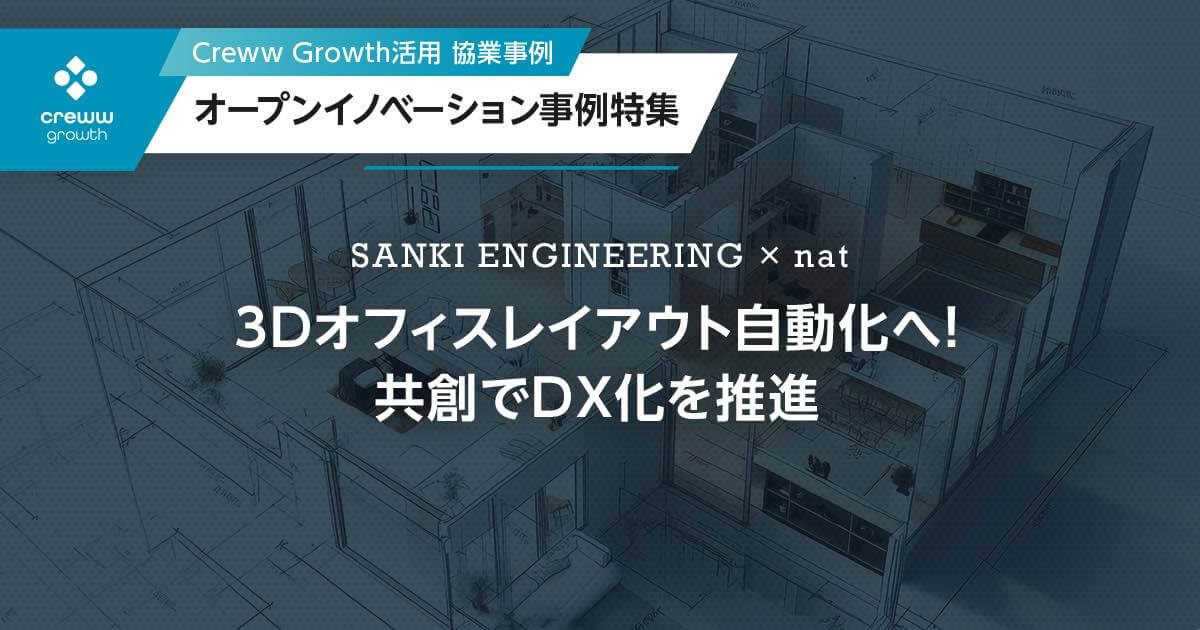
In this new business collaboration with NAT,Building a system that can automatically create an office layout by simply entering (or selecting) the customer's preferences.Our goal is to provide the best possible service. Using the system, we can show the customer the layout on the spot without having to take the customer's request back to our company and ask a CAD operator to create a drawing.
In addition, it is not uncommon for customers to ask us to present construction costs along with layout creation. Therefore, we are in the process of developing a system with NAT that will incorporate a function to calculate not only the layout but also the estimated cost.
We believe that this system is in line with the DX trend because it can reduce the time customers have to wait for us to confirm drawings and construction costs, and it can also reduce the workload within the company. We are developing the system with a view to selling it externally to companies that want to promote DX within their companies as we do.
--This is going to be a massive undertaking.
Jimbo Yes.In the POC (Proof of Concept) experiment, nat's technology was further developed to create a prototype system that can even change the color and material of scanned items.I did.
For example, for a conference room, we verified a system that "enables the visualization and arrangement of tables and chairs for the conference room" and "allows the color and materials of fixtures, walls, and floors to be freely changed.
Verification has also revealed new challenges and concepts. Specifically, the challenge is that depending on the processing power of the equipment, it may not be possible to fully scan a large office space. Also, if we could start up a 3D model or automatically create a layout based on existing CAD or PDF data, we would not have to rely on the scanning function, and we would like to utilize this in future system development.
Although this is a new initiative for our company, we will work even harder to ensure the success of this project.
Liu. NAT is also devoting considerable resources to this project. There are many matters in which we have no expertise or experience, so we are constantly refining our skills, researching, and learning as we consider what is best for the project in light of what Sanki Kogyo has to offer.
The "Scanat" application originally offered by nat was developed rather for use in residential spaces. When purchasing a house, if you do not know the size of the house, you will have trouble placing furniture and appliances, won't you? The idea that it would be useful to be able to scan and simulate a space with a smartphone in such situations was the impetus for the development.
So there are many aspects that are different from the office area.Through collaboration with Sanki Kogyo, we have been able to expand our service offerings to the office domain.The following is a list of the most common problems with the
Promoting open innovation by getting others on your side
--Did you encounter any obstacles in the process of collaboration?
Jimbo Rather than the collaboration itself, it was more difficult to obtain internal approval. A project as large as this one required a lot of time for explanation and preparation of explanatory materials, since there were many people who had to confirm the project with the relevant departments in advance and who had the authority to approve it.
In order to make the process as smooth as possible, we tried to create materials that would make sense even to people not directly involved in the program.
As this was our first accelerator program, we were not well known within the company, so it was difficult to set up a project team and create an internal structure. I also had to work in parallel with my regular duties, so it was a difficult time for me.
Sasaki Since this was our first collaboration with a startup itself, there was a lot of exploration.
By communicating the contents of this program and making sure they understood it, we were able to gain the cooperation of our own department and various related departments within the company. We are still in a situation where we are able to do our best because of the cooperation of those around us.
Jimbo Yes, I was able to maintain my motivation not only with the help of nat's cooperation but also with the support of the people around me, including Mr. Sasaki, the director of the department. I also asked Mr. Sasaki to adjust the balance between my regular work and my work.
One new person was assigned to this project team from the regular operations team, and the atmosphere within the company has become like a team competition in a good way.
The final form of the Accelerator Program is to create a one-step system that is easy for everyone to use.
--Finally, what is your vision for the future of the project?
Jimbo First,Promote internal DX solutionsIt is. While also serving as a POC for external deployment of the system, we would first like to utilize the system with automatic layout within the company to improve operational efficiency.
Ultimately, we have a vision of creating a system that is easy for everyone to use, such as, "With this one system, you can easily create an office in one step.
When I first met with President Liu, he said, "Let's make a system that can stand up to CAD! We were like, "Let's make a system that can compete with CAD! Perhaps that is too idealistic,If we could realize the development as a new system in the form of a social contributionI think that the "I" in "I" is the same as the "I" in "I".
Liu. A CAD drawing is "a 2D representation of a 3D drawing by force. If 3D becomes the norm, there will be no more need to draw up drawings.
Sasaki From a larger perspective, Japan's working-age population is expected to decline rapidly in the future, and I would like to be able to contribute to solving that problem as well.
Liu. Yes, it is.
For my part, I just established a company in China in January of this year. I actually had the experience of renting an office in China. The office market in China is not well organized,If we could work with Sanki Kogyo to look at the Chinese market as well.I think.
Globally, demand for offices, which shrank due to the Corona disaster, is recovering. We believe that our ability to develop new businesses in such areas is very strong.

| name of company | Sanki Kogyo Co. |
| Establishment | April 22, 1925. |
| Location | 8-1 Akashi-cho, Chuo-ku, Tokyo 104-8506, Japan |
| representative | Hirokazu Ishida, President and Representative Director |
| Business Overview | Building Equipment Business, Plant Equipment Business, Real Estate Business |
| uniform resouce locator | https://www.sanki.co.jp/ |
| name of company | nat corporation |
| Establishment | May 20, 2019 |
| Location | Sumitomo Fudosan Toranomon Tower 5F, 2-2-1 Toranomon, Minato-ku, Tokyo 105-0001, Japan |
| representative | President and Representative Director Yongjun Liu |
| Business Overview | Development and operation of Scanat and strategic and system consulting services |
| uniform resouce locator | https://www.natincs.com/ |
He joined Sankiki Kogyo in 1999 and has been engaged in office relocation project management for 15 years. 2014, he became a section manager and has 8 years of experience in related sales and quality control of project management operations. In the Facility Systems Division, he is in charge of new business and business efficiency.
Joined Sanki Kogyo Co., Ltd. in 2012 and has been engaged in relocation and layout change project management related to offices for 12 years. Currently, he is in his 5th year of both project management and new business planning.
 Mr. Yongjun Liu President and Representative Director, NAT Corporation
After graduating from university, he worked for two major foreign firms in finance, corporate integration, strategic management and finance consulting, data modeling, etc. In 2019, he founded nat Inc. and became its representative director.






 JA
 EN
