


In the first part of the interview, we asked about the background of the project's launch, key points in gathering friends, and what was done to promote the project.
What is "Freeat" that creates a mechanism for food loss reduction?
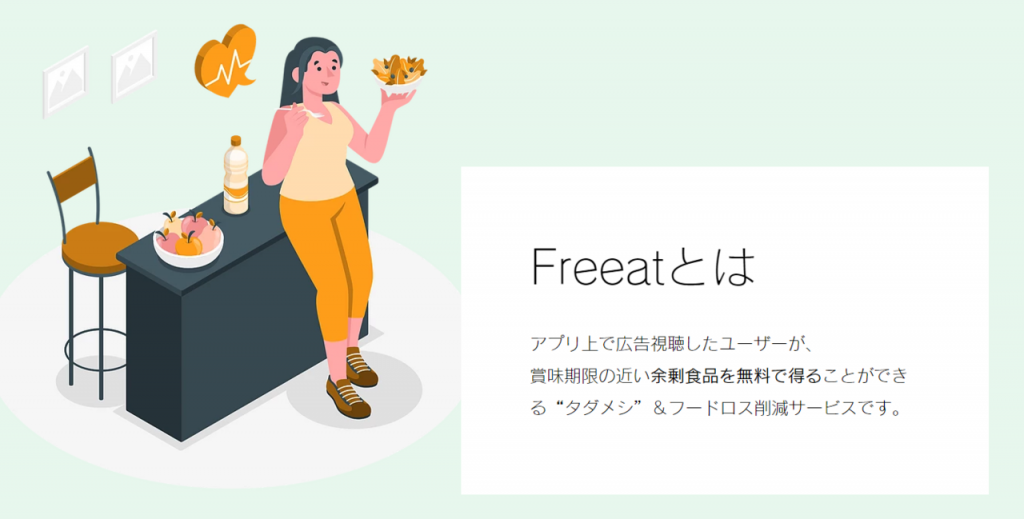
Free valuable surplus food with ~advertising~.
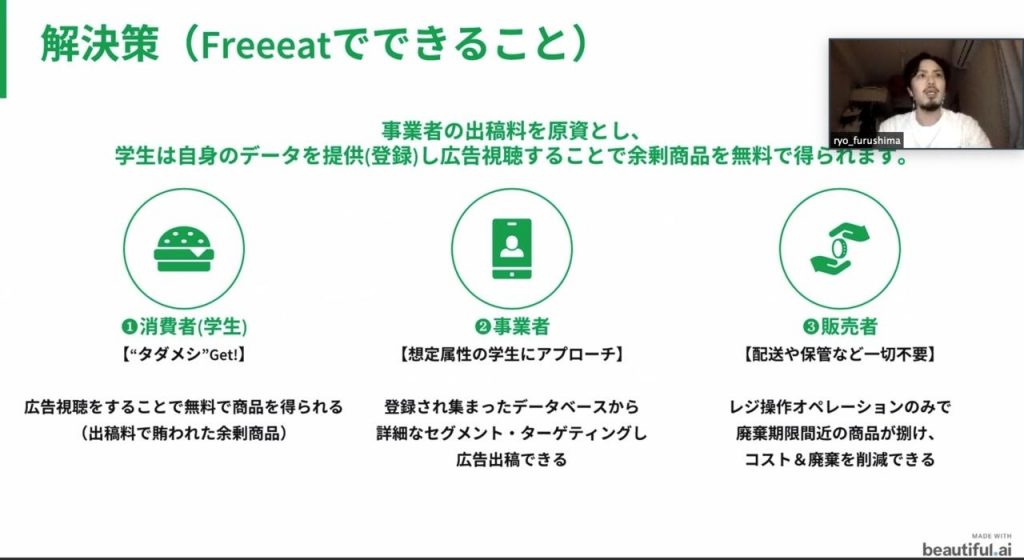
The service allows companies to post advertisements on the service, and consumers who view the advertisements can obtain free products that are about to expire from retail stores, etc., thereby contributing to the reduction of food loss.
This project will conduct a demonstration test for the creation of a 3-sided platform that also solves the issue of sales decrease and loss on the store side.
Why did you decide to apply to Startup Studio this time?
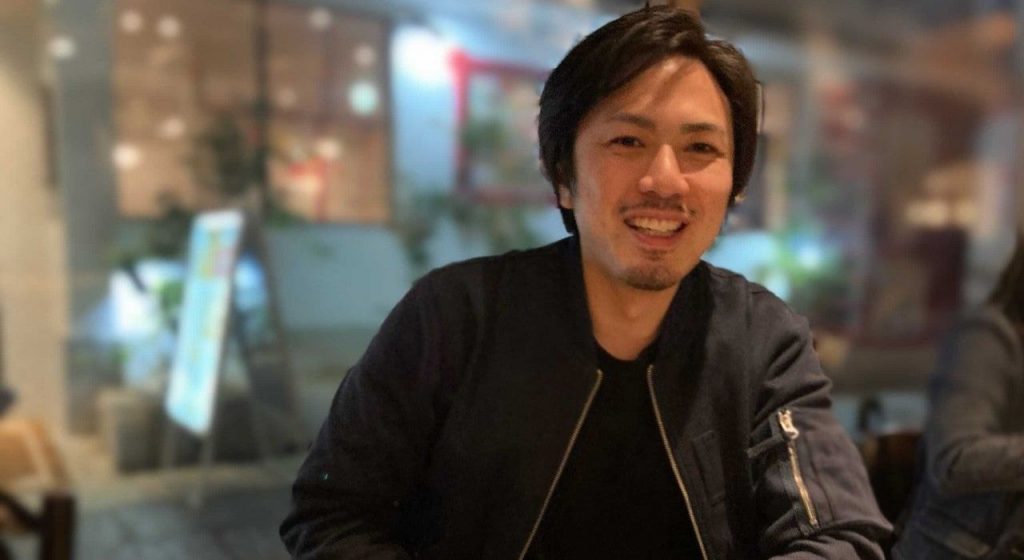
Mr. KojimaI have always had a sense of the theme of "food loss" and wanted to take on the challenge of solving social issues related to food loss.
I have been hearing keywords such as "earth-friendly" and "environmentally conscious" such as SDGs and ethical consumption within the past few years, while there has always been a kind of a blur and a seed fire regarding food loss. I have been experiencing firsthand that there is a growing awareness of this trend in the world.
I was also an old acquaintance of Mr. Nagano, who runs STARTUP STUDIO by Creww, and when I heard that STARTUP STUDIO by Creww would allow me to develop new businesses while continuing my day job, I was thinking of an idea, so I thought now was the time to give it a try and applied.
Why are you so interested in food loss?
Mr. KojimaThe first original experience was when I was a student working part-time at a family restaurant and was confronted with a situation where a large amount of food was being thrown away every day.
I had always wondered if there was something I could do about this, but at the time I had no experience in new businesses and was unable to come up with answers to problems such as how to solve them or how to move in the direction of solutions, so I was left in a state of bewilderment.
Later, when I entered the workforce, I worked in management for an entertainment agency, and even there, I had the opportunity to face situations where large quantities of lunches were ordered and thrown away on the set of a photo shoot or recording session.
The main reason for this is that I have had a continuous desire to do something about food loss since I was a student.
You have a strong awareness of the issue of "food loss." Didn't you go into this area in your main business?
Mr. KojimaI had no idea how best to solve the problem of food loss on my own: I had no idea what form to take.
For example, would I work for some company that is developing a food loss-related business and commit myself to the issue, or would I start my own company and create some new mechanism, or would I get involved from the aspect of new business development like a start-up studio? I was not sure from the outset what path I should take to commit myself to reducing food loss, given the many options available to me.
It was during this time that I was introduced to this start-up studio and learned about the concept of incubation in the first place, as well as the efforts to gradually materialize the seeds of a business idea while continuing with my main job. Therefore, I did not immediately choose the option of changing jobs at a company that was developing such a food loss-related business, but instead decided to try it as a side project while continuing to work at my main job.
The key to gathering friends is vision and enthusiasm.

Gathering a team of people is a very important point in promoting a project.
Mr. KojimaWe were grateful to receive applications from a wide range of job categories, from people as young as 20 years old to those as old as 60 years old. 30 people applied, but after interviewing and listening to all of them, we finally narrowed the field down to 3 members and 15 supporters.
Although they came from completely different backgrounds, such as age, upbringing, and the main business they were in, many of them had a strong sense of the need to do something about "food loss.
We were not doing this as our own company, but as everyone has their own core business, we were going to take on the challenge of this side project and work together to develop it. I chose people who have a vision and desire to solve the core social issue of "food loss" and who have a similar level of passion to myself.
The term "food loss" covers a wide variety of genres, so I chose members who were more sympathetic to the model and system I proposed, and who could offer advice on how to make it better, and who could think of it as their own personal matter.
I think this is the first time for you to gather a group of people like this, but what are your honest impressions of this personnel move from zero to one?
Mr. KojimaI had never done team building completely from scratch before, because in my day job, the team was already structured as the company told me it would be.
I was able to ask them directly why they agreed to participate in the project even though they have their own day jobs, which was very important to me. It was easy to ask questions, give instructions, and request cooperation after talking directly with them and learning about their respective areas of expertise.
In my day job, I'd ask myself, "Where does this person's true motivation lie?" What do they really want to do and how do they want to work?" Compared to this, it is more difficult to start from scratch, but the people are completely facing the same direction, and I think that is a big advantage.
What are some of the cautions for gathering zero-cost friends?
Thank you very much. On the other hand, are there any mistakes or cautions in gathering friends?
Mr. KojimaI personally have no expertise in new business development, but there were people who seemed to be excellent at first glance when I talked to them, and they would say, "Let's do it this way and that way.
As we proceeded, those who did so were a little out of sync with themselves in terms of their motivation, as if they were saying, "I really don't care about food loss, but I applied anyway because I want to have this kind of experience now. Some people just wanted results, while others wanted to make a profit from the sale. It is not that there is anything wrong with those people, but if you act only from the top, you will end up breaking down, dropping out, or leaving the project. It is better to choose members who have the same perspective and motivation regarding the ultimate goal of "food loss reduction.
What is the ingenuity of starting a new business from scratch?
You mentioned that you had no expertise in new business.
Mr. KojimaI would like to say to those who are reading this article and who, like me, have no experience, that I have made it this far even with zero knowledge (laughs).
The reason for this is that the PDCA flow related to new business, from hypothesizing needs, verifying issues, and revising course based on the results,If you follow the program provided at the startup studio, you can experience the flow from 0 to 1 without going too far off track.The following is a list of the most common problems with the
However, in the case of Freeat, some of the members had experience in starting up businesses, so their knowledge of what I would have done in such a situation was very reassuring.
As for what I personally did as a founder, I studied at the very least by reading the web, but anywayI heard from people around me who are working on new projects.The following is a list of the most common problems with the
This was rather surprising, but I was impressed that the same new business people listened to me very kindly.
I wondered if I would be mounted for something I didn't know (laugh), but I realized that people with experience in new businesses and startups have a strong sense of community and mutual support among those with experience, such as sharing experiences of hitting the same wall and how to move forward to meet the challenges. I felt that there is a strong sense of community and mutual support among people who have been through this before. I think it is important to not be shy about asking for help.
As for what I would like to say to those who are going to take on this challenge, you may be concerned that in order to be the originator yourself as a founder, you should have the know-how, minimum information, and the gory ability to promote a new business, but I don't think that is true at all.
I was one of those people before I started, but I found that if I followed the program at the startup studio, it somehow took shape, and the rest was just a matter of getting the people around me involved. I have learned firsthand that there are many people in the startup world who can give you advice on the obstacles you are running into. As I mentioned earlier, it is important not to be shy about asking people around you and asking them to teach you.
If you have an idea or a proposal that you would like to realize, I would like you to try it.
Thank you very much for your valuable talk, Mr. Furushima! We are still waiting to hear more, but please check out the second part of the article for the rest of the story.
~Retailers and restaurants
We are currently accepting applications from retailers and restaurants who are willing to cooperate with us in the demonstration experiment! If you are a restaurant or retailer that is having trouble with food loss and would like to recover some of the sales, please contact us! If you are a restaurant or retailer that has a problem with food loss and would like to recover as much sales as possible, please contact us.
Online Events for Students
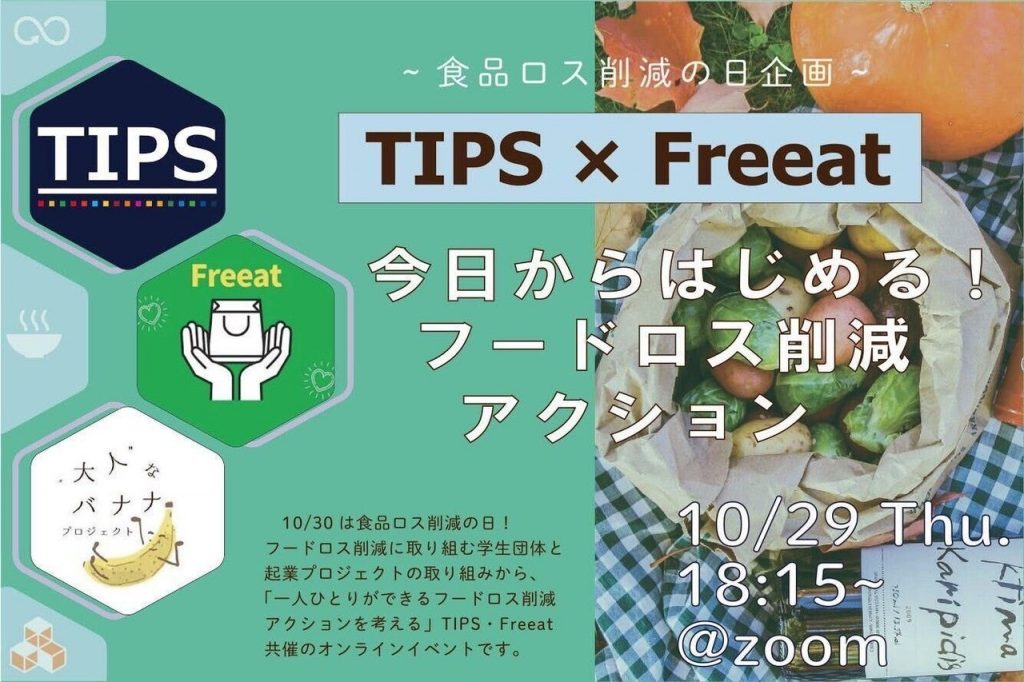
On Thursday, October 29, from 6:15 p.m., we will hold an online event for students on the theme of "Food Loss Reduction" with TIPS, a student organization based at Toyo University that works on SDGs and diversity. If you are interested in this event, please visit the official TIPS page here.
The second part of this article summarizes the benefits of working in a start-up studio, the challenges, the status of the project, and future plans.





 JA
 EN
