


The outbreak of the new coronavirus infection has triggered a major change in the way people work, and location-independent work styles, such as telework and the use of third places, are gaining attention. New trends are also being observed, such as an increase in the number of companies downsizing and relocating their headquarters offices to accommodate telework. As we look ahead to the with/after Corona, what kind of work styles should companies offer to their employees? This release summarizes the office strategies and human resource systems of companies in the Corona disaster, as well as the attitudes of employees regarding work styles.
Data Summary of Survey on "Working Style in Prolonged Corona Disaster
*"Well-being" in the survey is defined as a state in which individuals feel physically, mentally, and socially healthy and continuously happy (e.g., an ideal work-life balance is maintained, there is an environment in which one can maximize one's abilities, and the level of satisfaction and happiness with the current work style is high).
Responses from Management, Human Resources and General Affairs
1. 57% think office strategy influences company growth
2. The top 3 expectations for office strategy are "securing excellent human resources," "healthy working conditions both physically and mentally for employees," and "employees' ability to exercise their abilities. Items related to human capital tended to be selected over cost reduction (financial capital)
3. The top 3 most important roles of an office are "a place to concentrate on work," "a place to deepen teamwork within the company," and "a place where accidental encounters and communication with people inside and outside the company can occur.
4. The top 3 benefits of allowing employees to choose where they work are "flexible work styles through reforms in work styles," "increased employee satisfaction by providing free work styles," and "increased productivity.
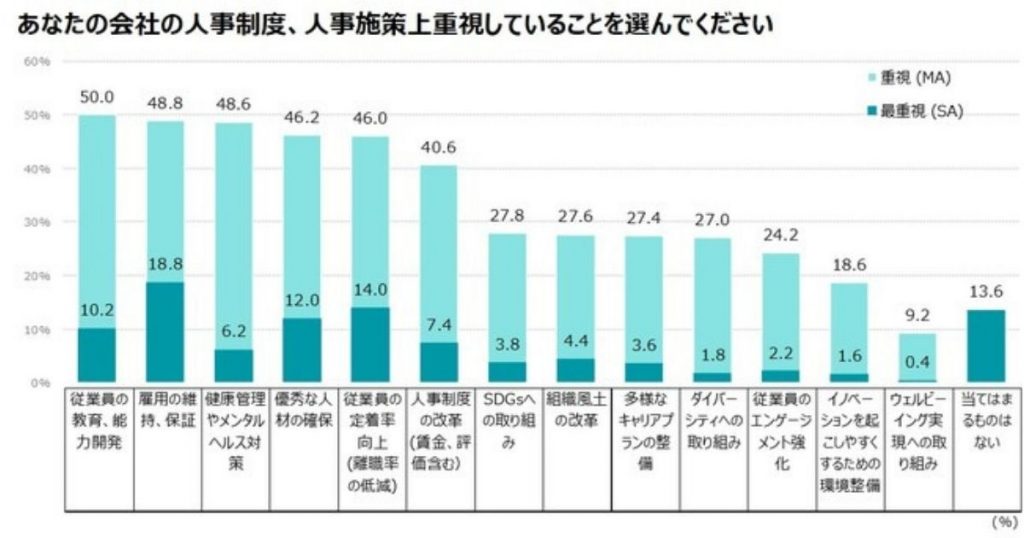
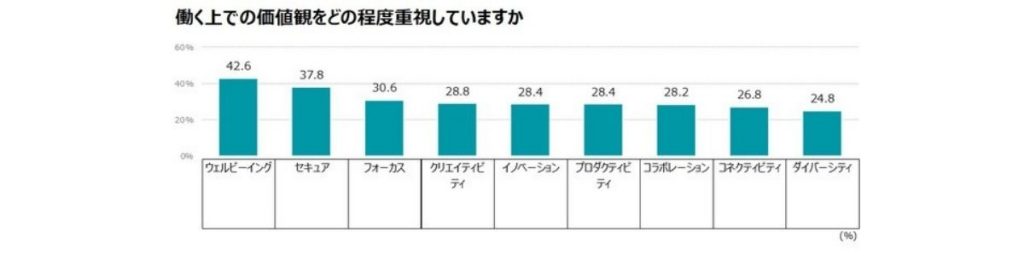
5. The top three most important aspects of HR systems are "employee training and skill development," "maintaining and guaranteeing employment," and "health care and mental health measures," but only 9% of companies are making efforts to realize wellbeing*, which is a discrepancy from "wellbeing*" (42%) selected as the most important value for employees in their workplaces. Wellbeing*" (42%), which was selected as the most important value for employees at work, showed a discrepancy.
Employee Responses
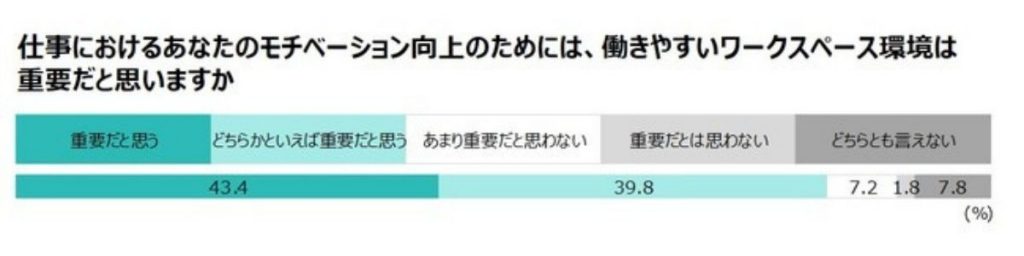
6. I think a comfortable workspace environment is important to improve motivation at work83%
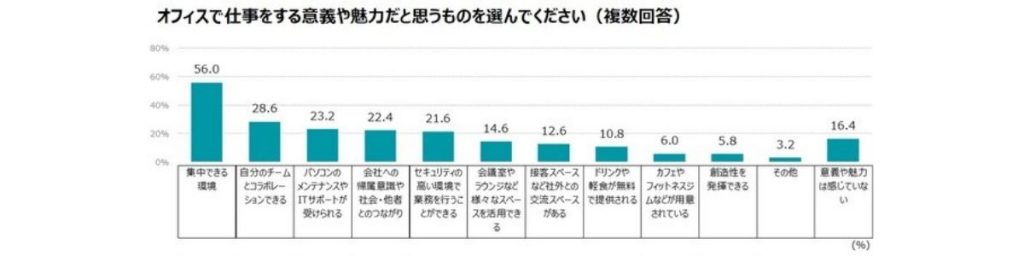
7. The top 3 reasons and attractions for working in an office are "being able to concentrate," "collaborating with team," and "having access to computer maintenance and IT support.
1 in 8.3 respondents reported an increase in "mental strain and fatigue" compared to the way they worked before the Corona disaster.
9. The top 3 current business challenges in the Corona Disaster are "mental strain and fatigue," "maintaining and securing teamwork and collaboration opportunities," and "maintaining and strengthening motivation.
The survey revealed that more than half of management and HR/administrative personnel involved in HR strategy believe that office strategy has an impact on company growth, and they tend to place particular emphasis on human capital, such as securing human resources, employees' mental and physical health, and the exercise of their abilities.
The survey of employees shows that the largest segment of the workforce believes that "mental strain and fatigue" have increased or are an issue in their work at Corona Disaster. The "work style reforms" that have been undertaken by many companies to date have focused on measures to encourage employees to work longer hours and reduce overtime. However, with/after Corona's corporate management, reforms aimed at achieving wellbeing*, a state of socially healthy and sustainable happiness that encompasses a reduction in mental strain for the sake of human capital, are considered important.
Also in the after-corona, hybrid work is expected to become the new normal, but we can see that there is still a gap between employee demand and the measures being implemented by companies. In terms of office strategies, it is expected that adjusting the headquarters to an optimal size to meet the needs of the new era and designing it with an emphasis on wellbeing and collaboration will increase employee satisfaction.
Details of Survey Results
Management, Human Resources, and General Affairs Responses
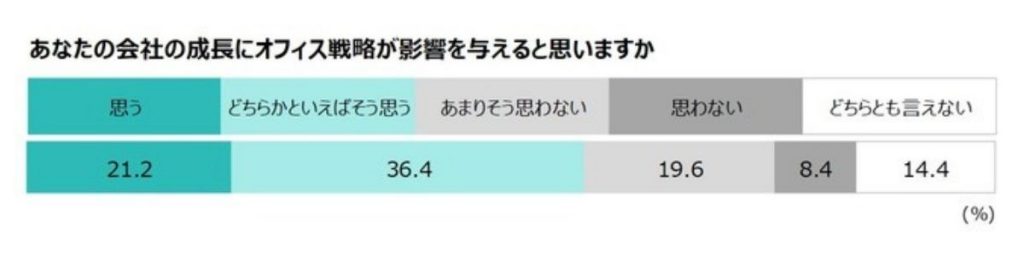
1. 57% think office strategy has an impact on company growth
When asked "Do you think office strategy influences the growth of your company?" 57.6% of respondents agreed or strongly agreed. More than half of the management and HR-related respondents believe that office strategy has an impact on their company's growth.
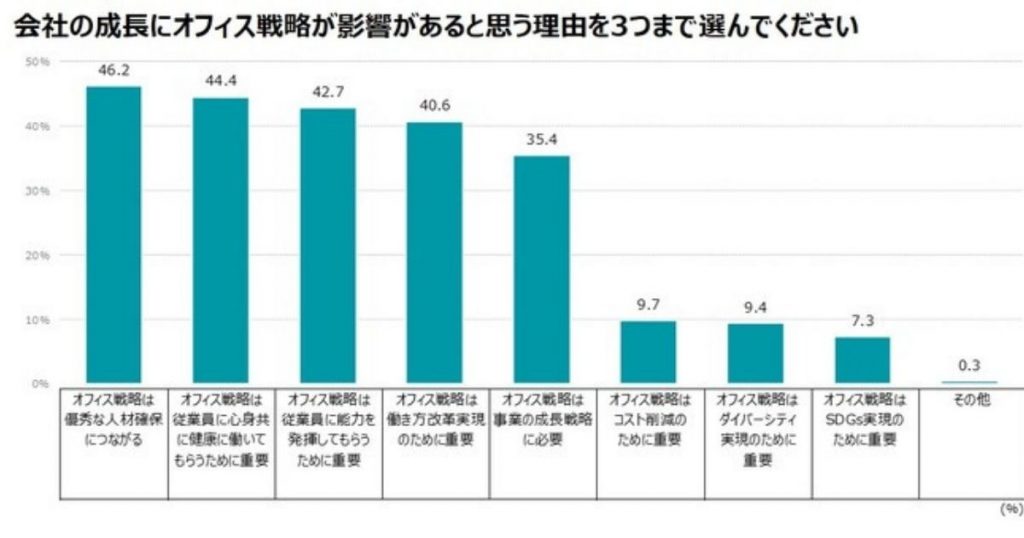
2. The top 3 expectations for office strategy are "securing excellent human resources," "healthy working conditions both physically and mentally for employees," and "employees' ability to exercise their abilities. Items related to human capital tended to be selected over cost reduction (financial capital).
When asked to choose up to three reasons why they think office strategy has an impact on their company's growth, the most common answer was "to help recruit talented people" at 46.2%, followed by "to have employees work in good mental and physical health" at 44.4% and "to have employees perform to their full potential" at 42.7%. It was found that office strategies tended to be selected for items related to human capital rather than cost reduction (financial capital).
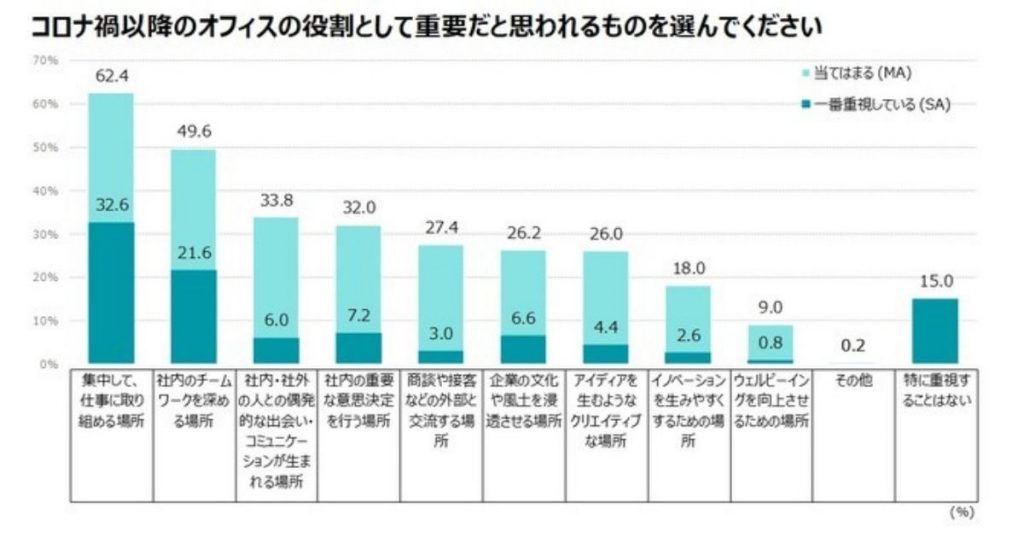
3. The top 3 most important roles of an office are "a place to concentrate on work," "a place to deepen teamwork within the company," and "a place where accidental encounters and communication with people inside and outside the company can occur.
When asked, "Please select the role of the office that you think is important after the Corona Disaster," the most common response, 62.4%, was "a place where people can concentrate on their work. A place to deepen teamwork within the company" was selected by 49.6% of respondents, followed by "a place where incidental encounters and communication with people inside and outside the company can occur" at 33.8%. The most important role of the office is "a place where people can concentrate on their work," according to the survey.
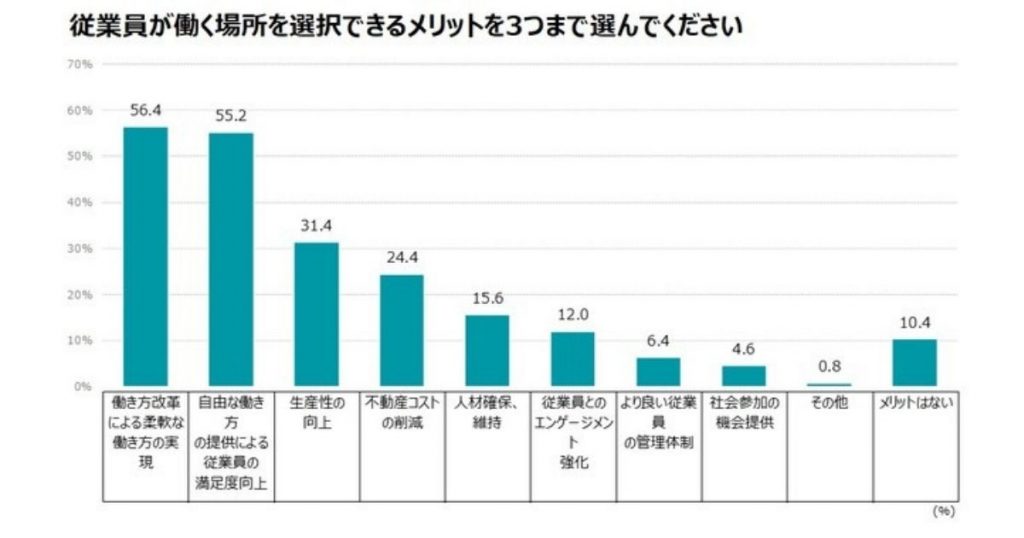
4. The top 3 benefits of allowing employees to choose where they work are "flexible work styles through reforms in work styles," "increased employee satisfaction by providing free work styles," and "increased productivity.
When asked to choose up to three advantages of allowing employees to choose where they work, the most common answer, at 56.4%, was "flexible work styles through reforms in work styles," followed by "increased employee satisfaction by providing flexible work styles" at 55.2% and "increased productivity" at 31.4%. It is clear that management expects to increase employee satisfaction and productivity by providing flexible work styles.
However, only 9% of companies are making efforts to realize wellbeing*, which is a discrepancy from the "wellbeing*" (42%) that employees selected as the most important value in their work. *(42%) as the most important value for employees in their workplaces.
The TOP 3 most important aspects of the company's personnel system and personnel policies were "employee education and skills development" at 50.0%, "maintaining and guaranteeing employment" at 48.8%, and "health care and mental health measures" at 48.6%. On the other hand, only 9.2% of the companies are working on "achieving wellbeing," a discrepancy from the 42% who chose "wellbeing" as an important value in working when asked by their employees. This suggests that efforts toward "wellbeing," which refers to a state of socially healthy and sustainable well-being, will become more important in the future.
Employee Responses
6. think a comfortable workspace environment is important to improve motivation at work83%
When asked "Do you think a comfortable workspace is important for your motivation at work?", more than 80% of the respondents chose "Yes" or "Somewhat important". The majority of respondents thought that a workspace environment that is easy to work in is important for improving motivation.
7. The top 3 reasons and attractions for working in an office are "being able to concentrate," "collaboration with team," and "access to computer maintenance and IT support.
When asked "Please select what you think is the significance or appeal of working in an office (multiple answers)," the most common answer was that the office is "an environment where I can concentrate" at 56%, followed by "I can collaborate with my team" at 28.6%. It is clear that many prefer to perform tasks that require a high level of concentration in the office rather than telecommuting.
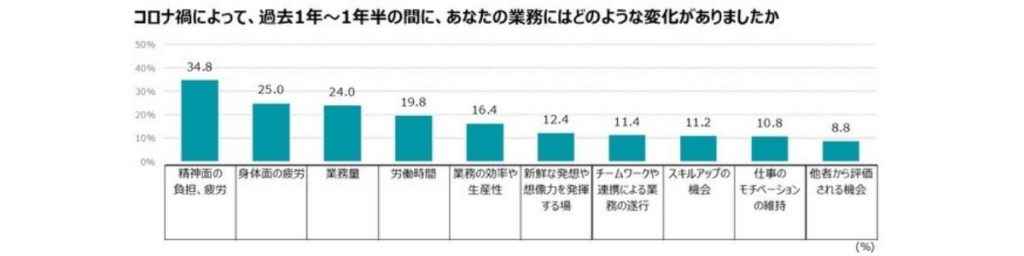
8. 1 out of 3 respondents said that the work style of the Corona Disaster has increased mental strain and fatigue compared to the past.
When asked, "How has the Corona disaster changed your workload over the past year to 18 months?" 34.8% of respondents answered that their mental burden and fatigue had increased compared to before the Corona disaster. Mental strain and fatigue were cited more often than physical strain and changes in workload.
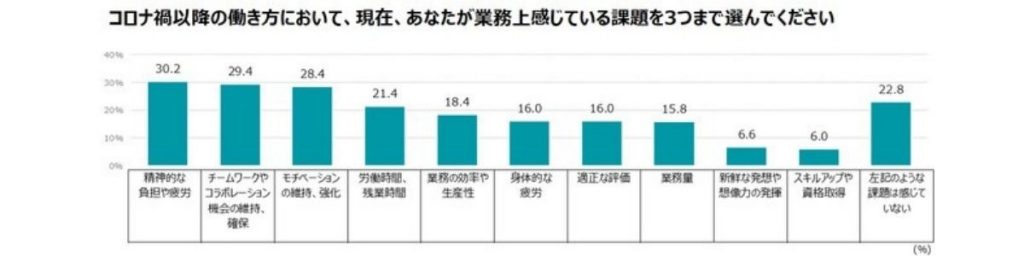
9. The top 3 current business challenges at Corona Disaster are "mental strain and fatigue," "maintaining and securing opportunities for teamwork and collaboration," and "maintaining and strengthening motivation.
When asked, "Please select up to three issues you are currently experiencing in your work since the Corona Disaster," the most common response was "mental fatigue and burden" at 30.2%, followed by "maintaining and securing teamwork and collaboration opportunities" at 29.4% and "maintaining and strengthening motivation" at 28.4%. followed by "maintaining and enhancing motivation" at 29.4% and "maintaining and enhancing motivation" at 28.4%. Mental fatigue/burden was cited 14 percentage points higher than physical fatigue, indicating that Corona Disaster needs to take care of the mental health of its employees.
Survey Summary
Survey name: Survey on Workplace and Values in the Prolonged Corona Disaster
Survey area: Tokyo metropolitan area (Tokyo and 3 prefectures), Kansai area (Kyoto, Osaka, Hyogo, Nara), Chukyo area (Aichi, Mie), Miyagi, Fukuoka
Method: Internet research
Surveyed: Men and women in their 20s to 60s
Sample collected: 1,000 people who work mainly in offices and work for companies with 20 or more employees (management and HR-related layers: 500 people; general employees: 500 people)
Survey period: July 28 (Wed.) - 30 (Fri.), 2021
About WeWork Japan, LLC
WeWork was founded in New York in 2010, and operates flexible offices in more than 700 locations in 153 cities in 38 countries around the world. WeWork Japan opened its first Japanese location in Tokyo in February 2018. Since then, WeWork Japan has been offering flexible office solutions that can be used across more than 30 locations in Japan and can be contracted on a monthly basis or from 1 person to 1,000 people. WeWork Japan has a mission to "create a community where everyone can work the way they want to work and take on challenges together," and to support diverse work styles, improve employee satisfaction, and create new office spaces that create opportunities for innovation and collaboration, WeWork Japan aims to provide new office values that create opportunities for innovation and collaboration. https://weworkjpn.com/




 JA
 EN
