


By reproducing a coral reef ecosystem with a shift in seasons, we have succeeded in having corals that normally spawn only once a year in June in Japan spawn in midwinter.
Succeeded in controlling spawning time with our unique environmental transfer technology
The success of coral spawning in a closed tank that artificially reproduces a coral reef sea is expected to enable the possibility of controlling the timing of coral spawning at will in the future. If this research continues,Coral eggs and larvae can be studied at any time of the year, whereas studies were only possible once a year.The first two are the following.
With the deepening of conservation knowledge of corals, which are the center of biodiversity in the ocean where 25% marine organisms live, but are in danger of extinction,Progress in basic research on coral as a source of innovation in drug discovery and other areasIt is expected that
Furthermore, this research has the potential to enhance the value of Japanese companies. Recently, biodiversity is gaining attention as the next step after decarbonization, thanks to the activities of international organizations such as the Taskforce on Nature-related Financial Disclosures (TNFD). This will increase the need for companies to disclose their impact assessments on biodiversity in the same way as they do on decarbonization.Basic research on coral, a representative of marine biodiversity, can be advanced from Japan, enabling Japanese companies to take the next environmental action while being internationally advanced.The first two are the following.
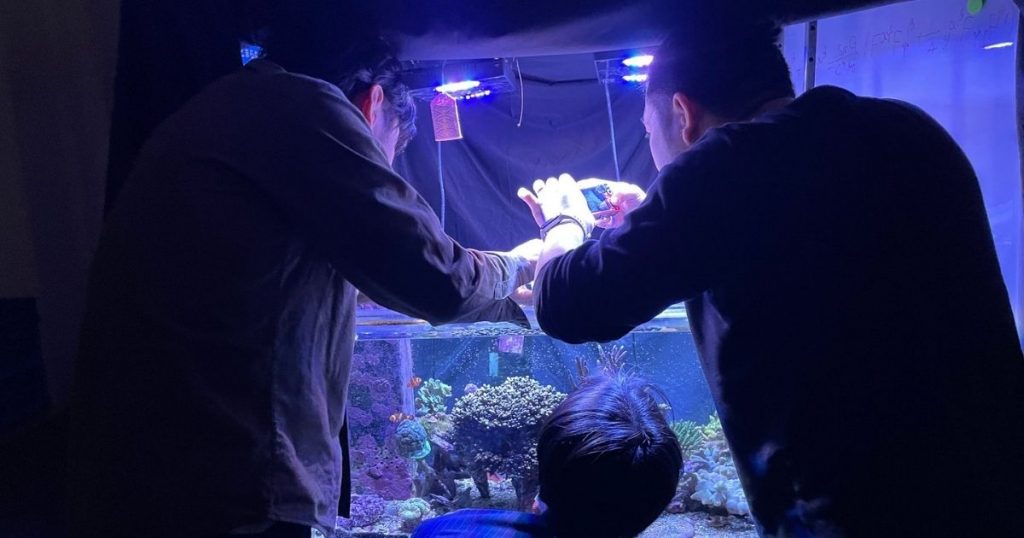
Research Outline
At INOCA Corporation, our proprietary environmental transfer technology (*) allows us toSuccessful long-term healthy rearing of corals in a completely artificial environmentThe company is doing so.
A fully artificial environment refers to a tank in which artificial seawater is used and parameters such as water temperature, light, and nutrients are controlled by a proprietary IoT system (= closed environment).
Furthermore, this experiment utilizes environmental transfer technology to reproduce the four seasons by shifting the water temperature data of Sesoko Island, Okinawa Prefecture, by four months from the natural world, which is observed in June in Japan.Coral spawning successfully shifted to FebruaryI did.
For this experiment, coral reared for more than three years in tanks managed by the company was used.
(*) Environmental transfer technology
Environmental transfer technology is a technology that reproduces an arbitrary ecosystem in an aquarium without using natural seawater, while balancing a wide range of parameters including water quality (dissolved concentration of more than 30 trace elements), water temperature, water flow, lighting environment, and relationships among various organisms including microbes, using IoT devices developed by the company. INOCA's proprietary technology.

Research Background
Corals are animals that originated about 400 million years ago and live mainly in the tropics.
It also plays an important role in terms of biodiversity, with 251 TP3T of marine life living in coral reef waters, which cover only 0.21 TP3T of the ocean's surface area.
It also plays an important role in providing the shore protection and fishing grounds necessary to support human social life, as well as materials for construction and tools for daily life,In recent years, it is expected to be utilized for pharmaceutical productsThe company has been
Corals are essential for market economy and social life from biodiversity security and environmental conservation,An estimated annual economic value of more than $375 billion (about 43 trillion Japanese yen)It is said. (*1)
However, in 20 years, 70~901 TP3T of coral reefs are likely to disappear due to rising sea temperatures associated with climate change,The conservation of coral reefs is a top priority for protecting marine biodiversity and the economic value derived from it.It is.
Previous studies have mainly used a method in which corals are brought back to the laboratory to spawn just before spawning, but the success of spawning in an artificial environment has allowed us to find a new method of spawning in the laboratory.Coral life cycle studies are possible regardless of the time of yearThe first two are the following.
If this experiment progresses, and corals can be treated as model organisms for research and investigation over many generations, like mice and Drosophila, it will greatly advance basic coral research and contribute to coral conservation.
We also believe that coral reef research is important for Japan.
Japan is a maritime power with approximately 450 of the world's 800 species of corals (*3), and its territorial waters are 12 times larger than its territory.Because Japan is a maritime power, it is necessary to promote "blue" as well as "green" in the environmental field.We believe that The study of coral reefs representing "Japan blue" will symbolize Japan's uniqueness in the world in the future.
research methods
Utilize environmental transfer technology to create an artificial ecosystem that can support long-term, healthy rearing of corals.
Water temperature control of the tank, in which seawater temperature was kept at 24 degrees Celsius, was started on 8/23/2021.
Synchronized with the December sea water temperature of Sesoko Island, Okinawa Prefecture since 021/8/23.
Continued rearing and succeeded in confirming the spawning of edaphic corals on 2022/2/16.
Upcoming events
From now on.Construct an experimental facility where corals spawn monthly.The purpose of this experiment is to increase the rate of implantation of coral larvae byBreeding research on corals tolerant to high sea temperaturesWe plan to connect to the
Comment Introduction
Graduate School of Science, Hokkaido University / NPO Kikaijima Coral Reef Science Institute, President, Tsuyoshi Watanabe, Lecturer
There is concern about what will happen to coral reef ecosystems, which are platforms for nurturing marine biodiversity, as a result of global warming. On the other hand, it has been confirmed that the larvae from coral spawning are being carried by ocean currents, causing the distribution area to move northward. Although research on coral spawning is progressing, there are still many unresolved aspects. One factor is that in natural environments and large aquariums, there are many conditions that determine the timing of spawning. Such as this time.The development of technology that enables artificial control of spawning timing in small tanks will contribute to the future development of coral spawning research and new developments in coral transplantation projects.It is expected that
Professor Masato Ueda, Faculty of Chemistry, Materials and Bioengineering, Kansai University, who is advancing research on regenerative medicine and coral
In January 2022, "egg holding" was reproduced in a completely closed system (tank). Furthermore, based on the annual water temperature data from Okinawa, they were able to reproduce "spawning" at different times of the year. This indicates that spawning can be induced year-round.It will also lead to the development of coral propagation methods based on fertilized eggsWe believe that this is a good idea. Also,Completely closed system allows acquisition of precise data on coral life historyTherefore, the establishment of this technology is extremely important from the viewpoint of science.
Associate Professor Koetsu Kon, Department of Marine Environmental Science, Tokyo University of Marine Science and Technology
Reef-building corals have hard calcareous skeletons that form complex three-dimensional structures. These structures provide habitat for a variety of organisms and support extremely diverse communities. However, global warming and ocean acidification have significantly reduced the survival of reef-building corals, and there are concerns about their disappearance. Artificial spawning technology for reef-building corals will not only contribute directly to their recovery,Enables stable sample provision and is expected to contribute to basic researchThe following is a summary of the results of the project.
Shoichiro Iwata, CEO, Force Marketing and Management, Inc.
As INOCA is working to solve problems in the coexistence of nature and humankind through research on the marine environment using the IoT, our mottoVenture to solve social issues with high aspirationsWe believe that this is a great opportunity for us to support this project. As a new way of coexistence between the environment and the economy is being explored, and frameworks such as TNFD are attracting attentionIt is significant that the world's first great achievement was born not in a laboratory but in a venture company.It has a
Above all, INOCA's love for coral has fostered the technology that produces the austere mysteries of life in Tokyo, an environmentally transferred city.
I am convinced that the direction we should aim for is for society as a whole to support ambitious ventures with a long-term perspective, so that the environment and the economy can be in balance, exploitation of nature can be transformed into symbiosis, and humanity can achieve essential and sustainable wealth.
Yukihiro Maru, Group CEO and Representative Director, Liverness, Inc.
We have watched you diligently work every day since April 2019, accumulating research at the Toranomon Lab. We believe that this coral spawning, made possible by the environmental transfer technology, is the result of their efforts. The environmental transfer technology that INOCA is developing is not a cutting-edge, out-of-the-box technology, but a "deep tech" that is a collection of technologies to solve problems.The development of this technology has the potential to change the world.I believe that the business that will change the world will come from the passion of just one person. A business that changes the world is born from the passion of just one person. Please change the world.
Mr. Yota Takakura, CEO and Representative Director, Inoka Co.
In 2019, shortly after our founding, we saw coral spawning for the first time in Okinawa, and the challenge was driven by a simple idea: "I want to show this to everyone.
The first year was a success up to the time of egg-harvesting, and the second year was a series of failures that resulted not only in egg-harvesting but also in the failure of the parent corals, but we are very happy that we were finally able to achieve success on the third occasion. Another surprise this time was that theUnexpected corals spawned.That is to say.
The coral that spawned was actually a coral that I purchased during my graduate school days when I decided to take a fresh look at corals. I was not a good breeder at the time, and I had endangered the coral many times, but after meeting Mr. Masuda, the CAO (Chief Aquarium Officer), I was able to grow it large by asking him for his guidance. I fondly remember the days when I was removing the Minobugs, the natural enemy of the common corals, from the corals day in and day out.
It was very emotional for me personally to see such a thoughtful coral spawn. It was truly the greatest reward that can be obtained from a venture that deals with living creatures. Of course, this research is only the first step toward saving coral.
However, we believe that this is a great step forward for the environmental transfer venture. We are not resting on our laurels of successful spawning.For coral, for the oceans, and ultimately for mankind. We will continue to do our best to contribute to the earth with "Japan Blue".We will
Once again, we would like to thank everyone who has been involved with and supported our company to this point. We could not have achieved this without your support. We look forward to your continued support of INOCA!
authority
1: IUCN (International Union for Conservation of Nature) Coral Reefs
https://www.iucn.org/theme/marine-and-polar/get-involved/coral-reefs?fbclid=IwAR2x9LnMAHTRNr2BGmlO364w2ePrkgA_sovBts_cziMI8L4rLdSz88Du6_8
*2: United Nations Intergovernmental Panel on Climate Change (IPCC = Intergovernmental Panel on Climate Change) Global Warming of 1.5°C (2018), p8. B.4.2
https://www.ipcc.ch/site/assets/uploads/sites/2/2019/06/SR15_Full_Report_High_Res.pdf
3: Coral reefs in Japan, Ministry of the Environment 1-1 Reef-building corals in Japan
https://www.env.go.jp/nature/biodic/coralreefs/reference/mokuji.html
【【Outline of INOCA Corporation]
This venture company was founded in 2019 by an aquarist with leading coral breeding technology in Japan and an engineer who had conducted AI research at the University of Tokyo.
Aquarists are people who keep fish, shellfish, and even corals at home, and are so-called aquarium hobbyists.
Research and development of "environmental transfer technology" to reproduce an arbitrary ecosystem in an aquarium by combining the power of people who love nature and conduct breeding research based on their curiosity with IoT and AI technologies.The company is conducting the following activities.
With the knowledge of nature lovers, this company focuses on educational projects and marine research platform projects using environmental transfer technology, aiming not only to protect nature but also to balance it with economic rationality.
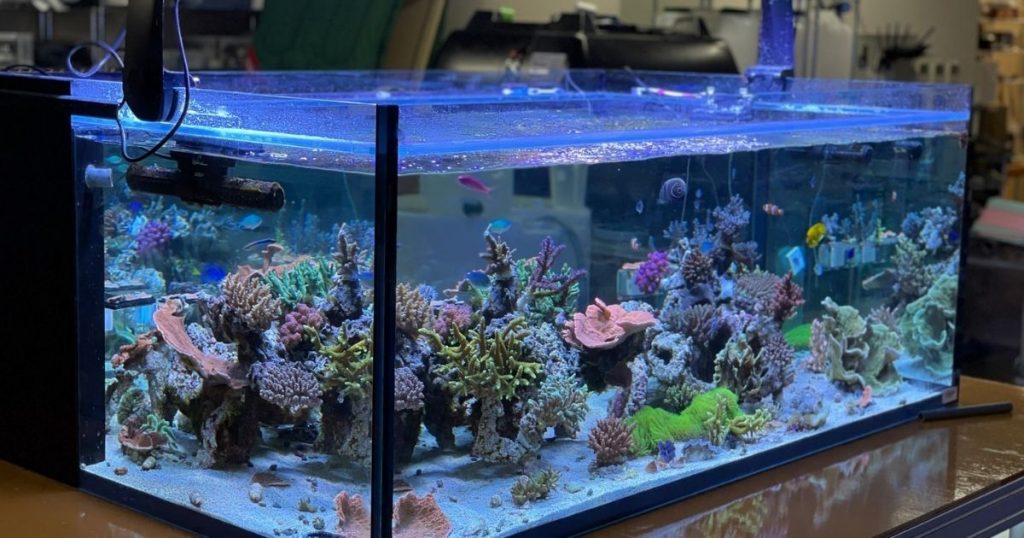
| name of company | INOCA Corporation |
| representative | Yota Takakura, Representative Director and CEO |
| Establishment | April 2019 |
| Location | 2F Landic Toranomon, 3-7-10 Toranomon, Minato-ku, Tokyo |
| Business Overview | Construction (civil engineering and building construction) and development business |
| uniform resouce locator | https://corp.innoqua.jp |
| Contact us | info@innoqua.jp |





 JA
 EN
