


This article is a reprint of an article published on the website of Hino Motors, Ltd.
New Territory
In May 2021, Hino launched "HINO ACCELERATOR 2021 - HINO DE SAFARI", a program to create new businesses through open innovation, and invited companies to participate under the themes of "For the realization of smart logistics" and "For a more prosperous mobility society We recruited companies to participate in the project. This is the first accelerator program in the commercial vehicle industry to co-create a product by combining the company's own management resources with the technologies and services of collaborating companies.note (supplementary information) symbolIt was also an initiative of the (*As of May 2021, based on Hino research)
As many as 60 companies applied, and in the first round of screening, 5 companies were selected to proceed to the demo day (final screening). The ideas were then co-created by the participating companies and Hino representatives, and each idea was brushed up by the time of the demo day on August 18.
This time, the grand prix was awarded toSompo Japan Insurance Inc.Dear Mr., you received the Award of Excellence.LocationMind, Inc.The following is an interview with a Hino representative (hereafter referred to as "co-creator"), who is teaming up with the company to commercialize the project, about the company's desire to solve social issues, commercialization ideas, and future prospects.
In Part I, we will introduce an interview with Sompo Japan Insurance Inc.
Proposed Title] "Zero Gambari Driving Project (Toward Zero Automobile Accidents)"
Summary] By combining "driver health and stress" and "data obtained from vehicles," we aim to create algorithms and mechanisms that will lead to the prevention of accidents caused by health and stress, and to commercialize them as products and services.
Presentation (PDF) (2.02MB)
.
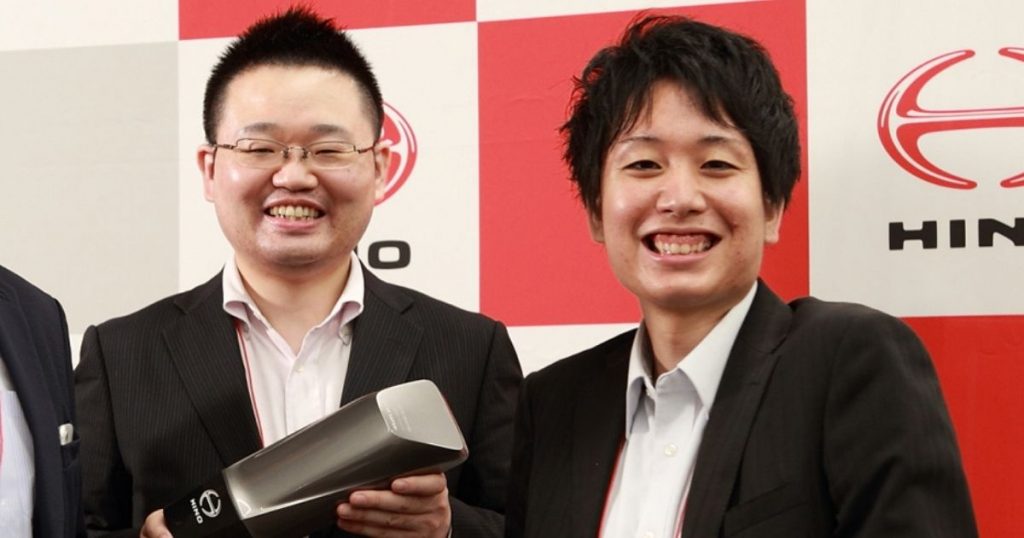
(From left to right) Mr. Yuhmasa Okamoto, Leader of Mobility Service Unit, Automobile Development Department 2, Sompo Japan Insurance Inc.
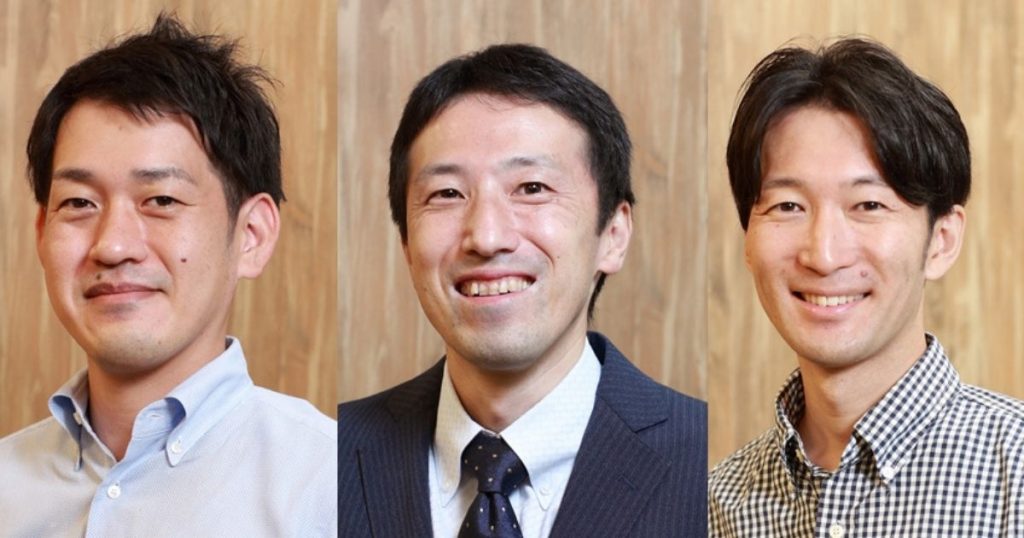
(From left to right) Keisuke Tsushima, Commercial CASE Promotion Department, Naoshi Enami, DX Promotion Department, and Shingo Hatori, Hino Motors, Ltd.
INDEX
- 1. the driving force is a strong desire to "solve social issues in the logistics industry
- Aiming for a friendly service that frees drivers from "gung-ho" driving
- 3. working together to achieve a society with "zero traffic accidents
1. the driving force is a strong desire to "solve social issues in the logistics industry
What was your motivation for participating in ---- "HINO DE SAFARI"?
Sompo Japan Insurance Inc:We aim to contribute to solving social issues and realizing a sustainable society by creating products and services of value to our customers based on the support of "safety and security" and "health," which are the original domains of non-life insurance companies.
In this respect, the direction of the HINO DE SFARI concept, which aims to solve social issues in human flow and logistics through collaboration, was perfectly aligned with the direction of the project.
In addition, as a company that provides not only insurance services but also services related to safe driving and accident prevention, we have always wondered if there was anything we could do to contribute to solving issues surrounding the logistics industry.
Against this backdrop, we thought it would be very valuable to work together with a commercial vehicle manufacturer such as Hino. In particular, we feel that the combination of Hino's use of connected data and our resources will contribute to the "realization of a more prosperous mobility society," which is the theme of this project, and lead to solutions to social issues.
In terms of team composition, we have assembled members across multiple departments, including those who are responsible for making insurance proposals to automobile manufacturers and suppliers, and those who are responsible for studying initiatives for new businesses.
----What attracts you to the Sompo Japan team?
Co-Creation Officer Tsushima:When I first read your proposal, I remember that it stuck in my mind because it was very simple, unmixed and straightforward, in a good way. As Mr. Okamoto mentioned earlier, this team has a strong desire to grasp and solve social issues in the logistics industry. I really like the phrase "zero gumball driving," in particular. I feel that this one phrase captures the challenges of the logistics industry, which is to respect drivers and eliminate stressful conditions as much as possible. Even during the co-creation leading up to the demo day, this single axis was firmly in place and did not waver at all. I believe this is what led to our winning of the Grand Prix. We are very happy to be able to work with you on the next stage.
Enonami, in charge of co-creation:When we first met him, I had the impression that he was full of ideas. They kept coming up with new ideas in response to what we were saying. I think that is why we were able to put together such a concentrated proposal in such a short period of time.
Secretariat Hatori:I supported the project in my capacity as the secretariat, and both the co-creation staff and everyone at Sompo Japan were extremely enthusiastic. Zero traffic accidents" is in line with Hino's mid-term management plan "Challenge 2025," and I personally believe that it must be realized and I would like to achieve it. Therefore, I felt passionate when I saw the discussions progressing and taking shape at my side.
Aiming for a friendly service that frees drivers from "gung-ho" driving
----How did you come up with the idea for the "Zero Gambari Driving Project" that you proposed this time?
Sompo Japan Insurance Japan Okamoto-san:Among the issues surrounding the logistics industry, we considered this to be one of the major social issues, since in recent years, accidents involving commercial vehicles, especially serious accidents caused by the health condition of drivers, have come under close scrutiny. Furthermore, we focused on the health condition of drivers in light of the social background, as surveys have shown that drivers are mentally and physically burdened while engaged in their work.
When we spoke with the operation manager, we learned that there have been cases in which drivers have died due to heart disease or have been engaged in their work under stress and distress, leading to accidents. We came up with the idea that some accidents could be prevented by noticing changes in drivers as early as possible and taking some measures.
---- I was a little surprised at the shift in thinking from "supporting accidents" to "eliminating accidents," but
Sompo Japan Insurance Japan Okamoto-san:Insurance is necessary in the event of an accident, and it is the cornerstone of the non-life insurance business to provide adequate support. However, looking ahead to the future, new technologies such as automated driving are expected to become widespread, and the form of transportation is expected to change dramatically. In such an environment, we will support our customers to prevent accidents from occurring, while at the same time responding to accidents that cannot be prevented. We hope to support our customers in both ways.
Enonami, in charge of co-creation:After all, eliminating traffic accidents is a joy for the entire society that everyone genuinely desires. We, Hino, too, are proactively working on this, but we see it as something that should be further accelerated. I remember how happy we were to receive this proposal from Sompo Japan and to be involved in it. I am also very excited to be able to move further toward commercialization from here.
----The best part of this idea is that
Sompo Japan Insurance Japan Okamoto-san:The first point is that we focused on detecting stress conditions based on changes in the driver's mind and body. As the name "Gambari Driving Zero" implies, our goal is to eliminate the stressful state of drivers while they are engaged in their work. We believe that this system is new.
In addition, the services are slightly different for STEP1, STEP2, and STEP3: STEP1 detects stress conditions based on health data before operation, STEP2 detects stress conditions during operation, and STEP3 detects stress conditions based on overall daily health data. The devices used to acquire health data for each of the three are various, including smartphones, vehicle equipment such as seats and seatbelts, and wearable devices.
Among the newest is the incorporation of technology that allows for easy and quick measurement using smartphones.
----Why did you separate the services into STEP1, STEP2, and STEP3?
Co-Creation Officer Tsushima:In fact, our initial proposal was STEP 3. The increase to three was the result of discussions and refinement of ideas during the brush-up period leading up to the demo day. One of the first considerations was the burden on drivers. Certainly, it would be ideal to measure health data 24 hours a day with a wearable device, but realistically, some people thought that it would be better to divide the steps into several other steps, so we discussed the idea into smaller steps.
Sompo Japan Insurance Japan Okamoto-san:First, we unpacked the overall flow of a driver's work and life. Their daily work begins with a roll call, most of the time during the operation they are engaged in driving duties, and again at the roll call they finish their duties and return home. We examined where we could approach this flow. We also considered the impact on the driver, as well as the cost and the burden on the carrier when introducing the system.
Co-Creation Officer Tsushima:One found that the service was geared toward operation managers who interact with drivers at the roll call at the beginning and end of the operation, and gradually the steps were neatly divided.
Sompo Japan Insurance Japan Okamoto-san:As we brushed up on the project, we also had the opportunity to interview actual transport operators and received a variety of advice based on their knowledge of the field. As we expected, their opinions from a professional perspective provided us with a variety of insights. We could not have come up with this proposal on our own. With the help of many people, I believe we were ultimately able to put together a form that would allow us to expand our services to meet the needs of our customers.
---- actually alerting and advising operations managers and drivers is a new service!
Sompo Japan Insurance Japan Okamoto-san:Details on the actual form and structure of the advice still need to be worked out. For example, if we can detect a driver's stress status during roll call, one way is to inform the operation manager to encourage the driver to see an occupational physician. We hope to provide materials that will lead to measures to eliminate gung-ho driving.
---- Although new technologies are also needed to acquire health data, the
Sompo Japan Insurance Japan Okamoto-san:For STEP 1, we plan to use existing technology to acquire health data using smartphones; for STEP 2 and STEP 3, we will be examining the most appropriate devices and technology. We would like to find a way to accurately and easily measure changes in the condition of drivers.
Enonami, in charge of co-creation:First of all, we would like to continue our discussions while giving top consideration to the fact that drivers can make measurements without feeling stress. Of course, we would like to bring ideas to each other from a broad perspective, incorporating others' technologies as well as Hino's existing technologies and new developments.
---- where is the biggest challenge?
Sompo Japan Insurance Japan Okamoto-san:Whether we can properly derive a correlation between driver health data and vehicle data, and whether we can construct an algorithm is still an unknown area. We intend to steadily put this into shape through a series of demonstration experiments. We will also continue our trial-and-error process so that the service will be accepted by carriers and drivers.
Co-Creation Officer Tsushima:Okamoto-san is right. For example, even for a single heart rate, the tendency may differ from person to person, and there may be a relationship with the route of operation. I don't think that just obtaining data is enough to make the data truly useful and reliable. I would like to brush up the "thresholds" and make them more reliable through demonstration experiments. I think that is the most important point.
3. working together to achieve a society with "zero traffic accidents
---- How do you feel now about commercialization?
Sompo Japan Insurance Japan Okamoto-san:This initiative has very high hurdles to overcome in order to be realized. It is a big challenge for our company as well. It is not something that can be achieved by our company alone, but something that can only be overcome by working together with Mr. Hino. Because we both share the same vision of the world we are aiming for, we will work together to create new value to realize a more affluent mobility society, and we will do our utmost to help solve the problems of our customers and society.
Mr. Hayashi, Sompo Japan Insurance Inc:We are responding by accelerating our efforts toward practical application within our company. We hope to collaborate and co-create with you to provide this service as soon as possible.
Co-Creation Officer Tsushima:I am sure that a variety of ideas will continue to emerge, but I would still like to keep our focus on our axis. In addition, as we work out the business potential and profitability, there will probably be lively discussions about what to do with the business model. Of course, that is also important. However, in this co-creation, I would like to give first priority to "solving social issues. I believe this service will be very valuable.
Enonami, in charge of co-creation:The social issue of "zero traffic accidents" is shared by all of us at Hino and Sompo Japan. We will continue to do our best to achieve this goal.
Reprinted from:.Hino Motors, Ltd. HP
Interview with Sompo Japan Insurance Inc.






 JA
 EN
