


Outline of the Capital and Business Alliance
The MCHC Group promotes "KAITEKI Management," which emphasizes not only economic efficiency and innovation but also sustainability, and has formulated "KAITEKI Vision 30," a medium- to long-term basic management strategy that aims to solve social issues for a sustainable future. KAITEKI Vision 30," a medium- to long-term basic management strategy that aims to solve social issues for a sustainable future.
DAIZ, on the other hand, aims to educate people about sustainable food culture and realize a sustainable society through the research, development, and market dissemination of "Miracle Meat," a next-generation plant meat with a low environmental impact.
This capital and business alliance was formed in order to collaborate by combining the management resources of the two companies, mainly from the perspective of innovation and sustainability.
Innovation
By combining the MCHC Group's and DAIZ's technologies and promoting further R&D and product development, the company aims to increase the added value of "Miracle Meat" and further promote its use in the market.
Sustainability
The project aims to solve social issues through sustainable food supply and reduction of greenhouse gases by verifying the visualization of greenhouse gas reduction effects from the spread of "Miracle Meat," a plant meat product.
MCHC CTO LARRY MEIXNER comments.
Achieving a sustainable food supply is vital to the health and well-being of people around the world, and is also extremely important from the perspective of reducing greenhouse gases that have a significant impact on the planet we live on. These are deeply connected to the core values of the MCHC Group. DAIZ is MCHC's first investment in a Japanese startup. MCHC is pleased to be working with DAIZ to contribute to society on a global scale through the further enhancement of the value of its innovative products and their market development.
Comment from Mr. Tsuyoshi Ide, President and Representative Director of DAIZ
We are very pleased that MCHC has chosen DAIZ as its partner for its first investment in a domestic startup. MCHC has world-class technologies in the field of emulsifiers and various other food ingredients, and we expect significant synergies in further improving the flavor of DAIZ's "Miracle Meat". Through this alliance, we hope to work together with MCHC to realize carbon neutrality and create a sustainable society.
Plant meat that contributes to a sustainable world
Global warming has become a major issue for us these days. Global warming is said to be caused by greenhouse gases such as carbon dioxide, methane, carbon monoxide, and chlorofluorocarbons. The largest source of greenhouse gas emissions is electricity (thermal power generation, etc.), but an equally large source is agriculture and livestock*1. Emissions of carbon dioxide and intestinal gas (methane) from the 1.5 billion head of cattle raised around the world are a major source of greenhouse gases, and we need to rethink our dietary habits.
Plant meat is attracting attention as a new meat next to beef, pork, and chicken, and is a plant-based food that is highly effective in reducing greenhouse gas emissions. To prevent global warming, what we can do now is to gradually incorporate plant-based meat into our diets in an environmentally friendly manner as much as possible. Sustainable Development Goals (SDGs) adopted by the United Nations, and contribute to the realization of a sustainable world.
*1 From IPCC "Global Greenhouse Gas Emissions Data
DAIZ's Miracle Meat, a plant meat derived from germinated soybeans
The population of the earth is expected to reach 10 billion by 2050*2. Due to global population growth and economic growth in emerging countries, a "protein crisis" is expected to occur in 2030, when the supply of protein will not be able to keep up with the demand for protein, and the supply and demand for protein will become tight, causing meat prices to rise even higher than before. This will cause the price of meat to skyrocket even higher than before. Therefore, "plant meat" is attracting attention as an alternative protein, and its market is expected to exceed 9 trillion yen worldwide*3.
The time has come for plant meats to appear on the dinner table in the same way as beef, pork, and chicken.
The main ingredient used in conventional plant meat has been the residue after soybean oil extraction (non-fat processed soybeans), which has left behind issues such as (1) a lingering discomfort in taste and texture, (2) a foul and oily smell characteristic of soybeans, and (3) functional (nutritional) value that is inferior to that of meat, which has hindered its full-fledged spread.
DAIZ's plant meat uses whole soybeans as raw materials. Furthermore, DAIZ has succeeded in developing "Miracle Meat," a plant meat that solves the problems of the past through its unique germination technology.
<Daiz's plant meat "Miracle Meat" features.

Characteristic 1: Use of whole soybeans as raw material
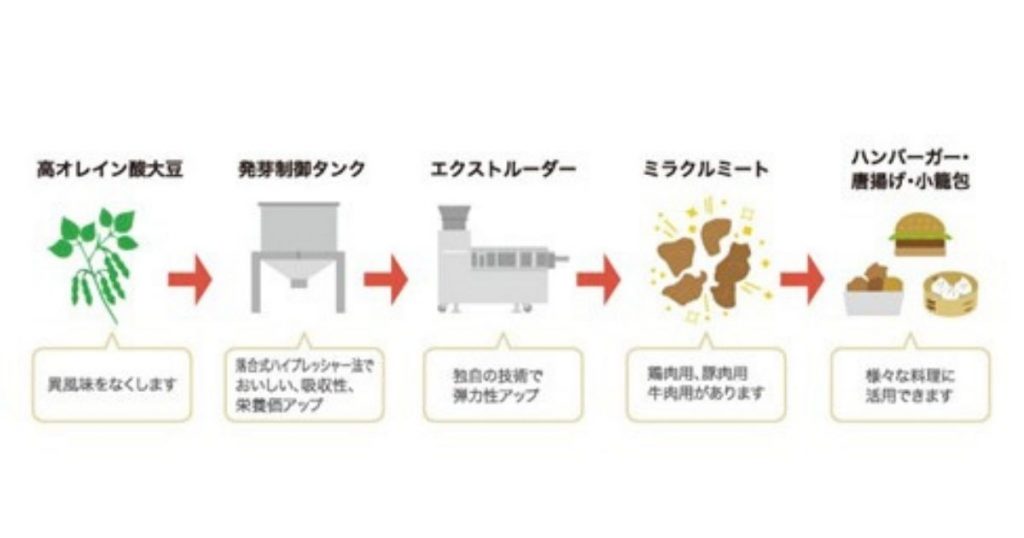
While conventional plant meat has been made primarily from defatted soybeans, the residue after soybean oil extraction, DAIZ's plant meat "Miracle Meat" uses whole soybeans as raw material. Furthermore, by using oleic acid rich soybeans, the odor characteristic of soybeans is eliminated and the off-flavor is reduced.

Unique technology to increase flavor and nutritional value and reproduce a meat-like texture
The core technology "Ochiai-style high-pressure method "*4, which freely controls taste and functionality, is used to germinate soybeans to increase their flavor and nutritional value. The sprouted soybeans are then put through an extruder (extrusion molding machine)*5 and swollen and molded*6 to reproduce the elasticity and texture of meat. These proprietary technologies are used to produce "Miracle Meat," a plant meat with a reduced off-flavor.
Feature 3. Competitiveness in price due to proprietary manufacturing process
The use of germinated soybeans with increased flavor and nutritional value makes the plant meat material complete without the addition of any other ingredients or additives. The unique production process using germination tanks enables cost reductions, making the product price competitive with beef, pork, and chicken.
*2 From United Nations estimates, World Population Estimates 2019.
*3 According to UBS.
*4 A cultivation method in which the amount of free amino acids is increased by controlling growth conditions such as oxygen, carbon dioxide, temperature and moisture during soybean germination and by activating enzymes to bring out the flavor of the ingredients. (Patent No. 5722518)
*5 Equipment used in food processing. Kneading, processing, forming, swelling, sterilization, etc. are performed by adding water to the ingredients and applying pressure under high temperature.
*6 Patent application in preparation.
About Us
| name of company | Mitsubishi Chemical Holdings Corporation |
| Establishment | October 3, 2005 |
| Location | Palace Building, 1-1-1 Marunouchi, Chiyoda-ku, Tokyo 100-8251, Japan |
| representative | Jean-Marc Gilson, President and Representative Executive Officer |
| Business Overview | Integrated chemical manufacturer with business domains of performance products, materials, and healthcare |
| uniform resouce locator | https://www.mitsubishichem-hd.co.jp/ |
| name of company | DAIZ Corporation |
| Establishment | December 1, 2015 |
| capital stock | Telwell Kumamoto Building 4F, 5-1-1 Minami-Kumamoto, Chuo-ku, Kumamoto City, Kumamoto Prefecture, 860-0812, Japan |
| representative | Tsuyoshi Ide, President and Representative Director |
| Business Overview | Development, production and sales of "Miracle Meat," a plant meat derived from germinated soybeans Development, production and sales of food products using "Miracle Meat," a plant meat derived from germinated soybeans |
| uniform resouce locator | https://www.daiz.inc/ |





 JA
 EN
