


Introduction.
Digital Transformation (DX) is said to have been proposed by Professor Erik Stolterman of Umeå University, Sweden, more than 15 years ago in 2004, as a concept that "the penetration of IT will change people's lives for the better in all aspects" (Reference 1). change people's lives for the better in all aspects" (Ref. 1).
The DX Promotion Guidelines released by the Ministry of Economy, Trade and Industry in 2018 focus on the economic activities of companies and define DX as "the transformation of products, services, and business models based on the needs of customers and society, as well as the transformation of operations themselves, organizations, processes The definition of "transforming the business itself, organization, processes, corporate culture and climate, and establishing a competitive advantage" was released by the Ministry of Economy, Trade and Industry in the same year. The so-called "2025 Cliff" report published by the Ministry of Economy, Trade, and Industry (METI) in the same year made visible the delay in DX in Japan and the risk of huge economic losses that could result.
In addition, DX is accelerating halfway due to changes in the external environment, most recently due to COVID-19: under COVID-19, the need for non-face-to-face, non-contact, and automated operations has rapidly emerged, as activities are forced from offline to online to prevent the spread of infection, and robotic replacement of manual labor is oriented toward arose rapidly.
Definition and typology of DX
Looking at the definition of DX mentioned above, it can be said that what is required for DX in companies is not simply the introduction of IT tools or the digitization of analog work, but the "creation and provision of new value" that establishes the competitive advantage of an organization (including companies and universities, cities, nations, and even international society) through digitization. On the one hand, the digitalization of work is not a simple matter of digitalization per se. On the other hand, DX can be divided into the following four types, as the way of understanding DX varies from organization to organization, and the introduction of IT tools and digitalization of work can also be considered as DX.
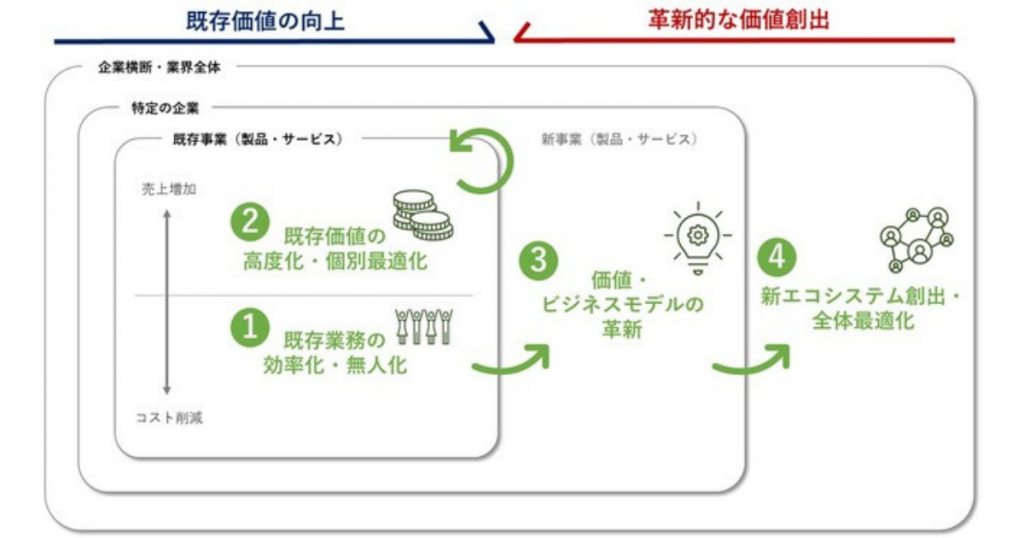
The DX direction can be broadly divided into"Increase Existing Value."or,Innovative Value Creation."The two categories are Of these, the "improvement of existing value" is,(1) "Streamlining and unmanned operation of existing operations"This will help to reduce the cost of the project,(2) "Upgrading and individual optimization of existing value"The two types can be further classified into two categories: those that contribute to increased sales through value-added improvements called "innovative value creation" and those that contribute to increased sales through value added improvements called "innovative value creation. In addition, "innovative value creation" is,(iii) Specific companies "innovate value/business modelsThe following is a summary of the results of the study,(4) "New ecosystem" across companies and industriesThe two types can be further classified into two categories: those that create
Increase existing value
(i) Streamlining and unmanned operation of existing operations
Initiatives that contribute to cost reduction by digitizing and mechanizing existing operations that have been performed by humans, thereby making the operations labor-saving and unmanned, fall under this category. For example, taking factory automation in the manufacturing industry, such initiatives include the automation of processing, manufacturing, and assembly processes by robots as various sensors and robots become more precise.
(2) Upgrading and individual optimization of existing value
This applies to initiatives to increase added value/sales in existing operations or to improve customer satisfaction through the use of digital technology. For example, taking customer service as an example, in response to the issue of inconsistent responses to inquiries from different branches and different staff members, efforts can be made to ensure uniform quality of response and improve customer satisfaction through centralization and analysis of data.
Innovative value creation
Value/business model innovation
This includes efforts to use data accumulated through digitization to provide value in other areas of the value chain, and efforts to generate revenue through the creation of new business models, such as the shift from product sales to service sales. For example, a company that has traditionally sold production equipment may begin offering diagnostic services to predict equipment failure by analyzing and utilizing data collected from sensors installed in the equipment. This will also change maintenance operations from the conventional Time Based Maintenance (TBM) model to a Condition Based Maintenance (CBM) model.
New Ecosystem, Total Optimization
This applies not only to specific companies or entities, but also to efforts to optimize specific industries or entire ecosystems through the use of digital technology. For example, in the field of e-commerce and logistics management, purchase history and inventory data are not only used by specific companies, but are also shared throughout the supply chain, leading to more sophisticated inventory forecasting and more efficient logistics.
Worldwide DX-related Patent Application Trends
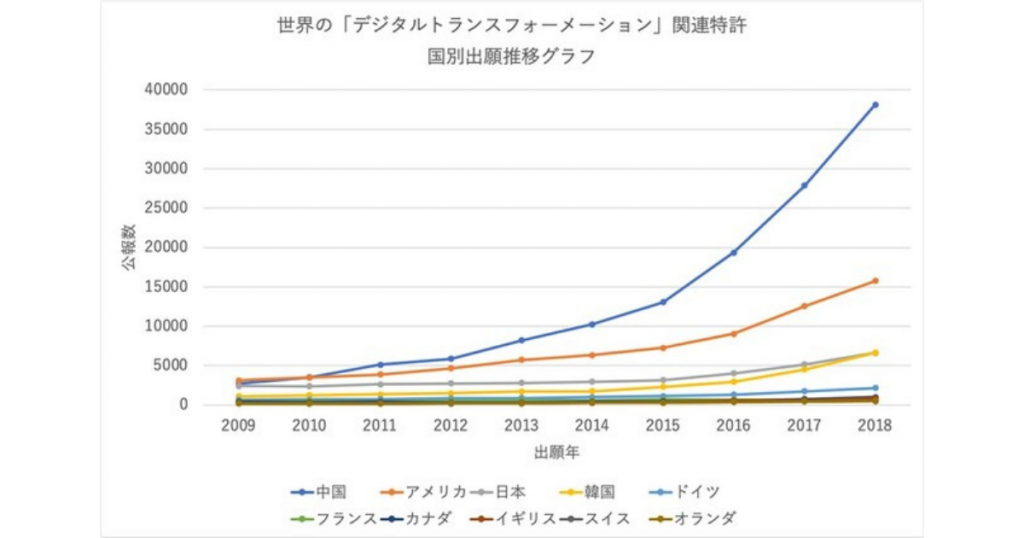
The following graph shows the results of annual trends of approximately 460,000 DX-related patents filed worldwide since 2009, broken down by applicant country of attribution. Although the number of countries to which the applicant is attributed covers 124 countries, the graph shows only the top 10 countries in terms of the number of applications filed. Applications from China account for about 200,000, or more than 40% of the total, and have the largest presence, with a sharp increase in the number of applications filed in a single year since the mid-2010s. The next largest number of applications is from the U.S., where the number of single-year applications is also increasing year by year. In terms of cumulative applications, Japan and South Korea follow, but applications from South Korea have been growing rapidly in recent years, with the growth rate overtaking that of Japan.
The rapid increase in the number of DX-related patent applications from China is believed to be due to the Chinese government's strong policies aimed at making China a digital superpower: "China Manufacturing 2025," announced in 2015, promotes the integration of next-generation information technologies such as artificial intelligence IoT with the manufacturing industry and the transformation from a manufacturing superpower to a manufacturing powerhouse. In addition, the 2015 Mutual Network Network (MNNO) agreement was signed. In addition, coupled with the 2015 Mutual-United-Net+ (Internet Plus) and the 2017 Next Generation AI Development Plan, Chinese society has been digitizing a wide range of areas, including online financial settlement, cashless services, car sharing, and online medical systems, ahead of the rest of the world.
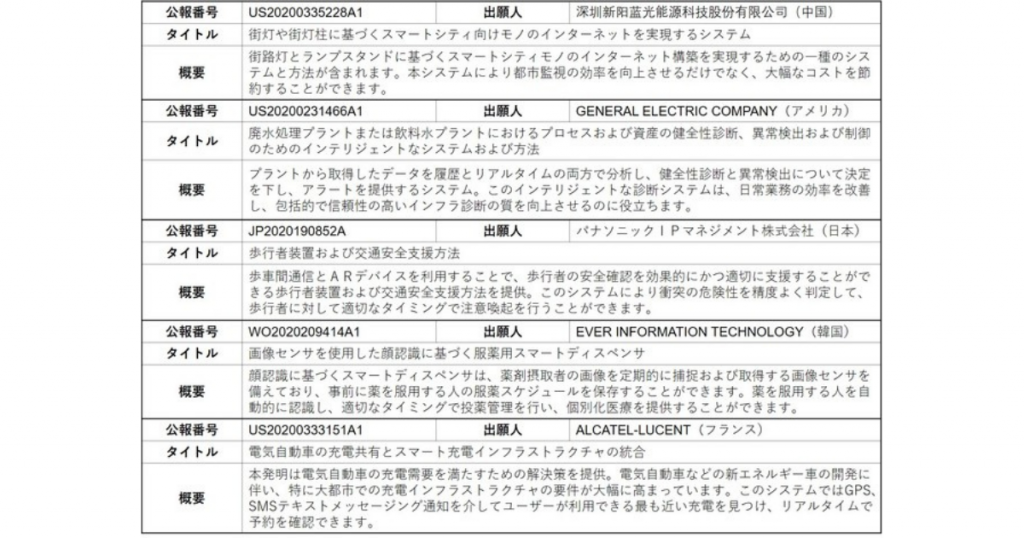
Examples of the latest DX-related patents from various countries
Examples of DX by Domain
DX in the medical and healthcare fields
(i) Streamlining and unmanned operation of existing operations
Examples in this category include electronic medical records and other systems for medical institutions. Medical institutions in Japan have traditionally managed patient information using paper medical records, and the penetration of electronic medical record systems, etc. in general hospitals was only 46.71 TP3T in 2017. The reasons for this are thought to be the existence of sunk costs for capital investment and low IT literacy, especially among small- and medium-sized hospitals. Despite these hurdles, the introduction of electronic medical records is expected to improve efficiency by reducing the complexity of medical record management and improving searchability. For example, M3's electronic medical record system, M3 Digical, is equipped with an automatic learning function that uses AI to learn prescription patterns for specific patients and reduce the amount of labor required for input.
(2) Upgrading and individual optimization of existing value
An example in this category is remote/home medical care. By combining online medical care via video chat and other means in addition to existing in-home medical care, patients will have more opportunities to be seen, and more effective treatment will be available when they need it. In China, since the expansion of COVID-19, the need for non-contact diagnosis has accelerated, and coupled with the deregulation of medical insurance coverage (*1), the use of online medical treatment platforms has increased rapidly.
(iii) Value/business model innovation
Examples of this type of business include the development of preventive medicine businesses that utilize accumulated data from wearable devices, etc. There are three levels of preventive medicine: primary prevention, secondary prevention, and tertiary prevention (*2). Secondary prevention, which aims at early detection and early treatment, is the mainstream of preventive medicine, but if it becomes possible to analyze what kind of lifestyle and activities make people more prone to illness by accumulating data, primary prevention will become more sophisticated.
*1) Telemedicine is not covered by insurance companies in many countries including the U.S. However, in China, insurance coverage has been approved in Jiangsu, Hubei, Shanghai, etc. due to the expansion of COVID-19.
(*2) Primary prevention is to prevent the disease, secondary prevention is to prevent the disease from becoming severe, and tertiary prevention is to prevent the disease from recurring.
New Ecosystem, Total Optimization
An example of this type of development would be the creation of a new ecosystem by providing anonymized data on patients' daily lives, prescriptions, etc. to stakeholders outside the medical industry. For example, by providing the accumulated data to insurance companies, they will be able to set more appropriate insurance premiums, and this will create a cycle in which individuals are encouraged to maintain their health through incentives to lower premiums if they lead a healthy lifestyle.
DX in the Urban and Transportation Domain
(i) Streamlining and unmanned operation of existing operations
An example of this type of application is a cab dispatch application. According to a survey conducted by the Ministry of Land, Infrastructure, Transport, and Tourism, most cabs are used for pre-arranged calls, and the percentage of calls made using applications such as smartphones is minimal. While the use of cab dispatch applications can be viewed as an improvement in consumer convenience, there may also be an aspect of increased operational efficiency due to the reduction of telephone-based cab dispatch responses in the cab industry.
(2) Upgrading and individual optimization of existing value
An example of this type of service is the provision of real-time traffic information, using AI and machine learning to forecast passenger demand and route congestion, allowing passengers using various modes of transportation to reach their destinations more comfortably and more quickly.
Value/business model innovation
An example of this type of service is Mobility as a Service (MaaS), a concept in which all forms of transportation (mobility) other than personal cars are considered as a single service and seamlessly connected. If MaaS is developed to the stage where information acquisition, reservation, and payment, which have been done separately for each means of transportation, are integrated and freely available on a subscription model, it will be a clear departure from the business models of the past.
New Ecosystem, Total Optimization
An example in this category is the urban digital twin. Digital twin refers to the real-time collection of products and operations that exist in the real world and the reproduction of the same conditions as in the real world in digital form. It can be used in a wide variety of ways, such as for disaster simulations and city planning simulations, and is likely to be used to solve problems in the city as a whole.
COVID-19 and DX
As mentioned in the introduction, changes in the external environment due to COVID-19 have accelerated DX halfway, but the promotion of digitization alone is not necessarily a good thing; the value of the real world has also been reevaluated. While the overall direction is shifting from analog to digital, there are areas where the digital and the real are merging, and areas where a return to the real is required.
(omitted)
⇒For more information on COVID-19 and DX, and to download the full report, click here.
https://www.astamuse.co.jp/information/2020/1216/?utm_source=prtimes&utm_medium=referral&utm_campaign=201216_dx
DX from each point of view
Then, we will use the DX.Individuals, consumers, business companies, investorsWe will examine the aspects of each of these perspectives.
Individual and Consumer Perspectives
From the perspective of individuals and consumers, the types (1) to (3) of DX are the main value-enjoying objects at the foot of the market. However, individuals and consumers are not so much aware of which of the conditions achieved by DX conform to (1) through (3); rather, individuals and consumers are more likely to accept DX if they recognize that it is convenient as a service and easy to use. For individuals and consumers, switching costs and resistance are more problematic, so the key factor is the degree of penetration of existing infrastructure and systems. For example, face-to-face meetings used to be the norm, but after COVID-19, it was recognized that online meetings are more efficient in terms of time and location when the agenda for the meeting has been decided in advance, and the use of online meeting tools has increased.
Operating Company Perspectives
From the perspective of business companies, DX is broadly viewed in the categories (1) through (4). For example, although switching costs will be an issue in the case of DX on the ground, such as (1), it is expected that introduction and service development will proceed quietly in the context of cost reduction. For (2) to (4), strategies are being formulated and demonstration experiments are being conducted in the context of future concepts and investments.
On the other hand, it is assumed that there are many companies that are considering the above two issues without having separated (1) and (2) to (4). As a result, tools and systems tend to be optimized for each division and become siloed, and even if data and information are accumulated, they tend to be unusable. In fact, according to IDC Japan's DX Trend Survey, "DX projects are implemented individually" and "there is no coordination among DX systems" are cited as DX issues.
On the other hand, for (2) to (4), it is possible that business strategy formulation and demonstration experiments are being conducted mainly by the Corporate Planning Department, etc., which is far removed from such on-site activities. Therefore, there is a possibility that DX will be divided into the long-term business strategy perspective and the short-term DX for the purpose of digitalization, as in (1).
This is where data assets can be the glue. Even companies that have been considering the use of data as "data business" in the past, as they proceed with their consideration within the broad framework of DX, there have been many cases where the content to be implemented in (1) and the content to be considered in (2) to (4) have become separated. Therefore, it is important to take a new look at how to maintain and utilize the data assets accumulated in various places in the company on a company-wide basis. In addition, it is important to redefine real assets as the "eyes" of data asset construction. In light of business strategy, it is necessary to define in advance what kind of information in the real world, how often it should be acquired, and in what format it should be stored, before acquiring the necessary data.
Investor Perspective
From an investor's perspective, the DX areas of focus will naturally differ depending on the investment concept. For example, the stage of the company to be invested in, the way the portfolio is organized, and the investor's capability as an investor.
⇒For more information on investor perspectives on DX, and to download the full report, click here.
https://www.astamuse.co.jp/information/2020/1216/
Summary and Outlook
The definition and overarching typology of DX have been discussed so far, but the key to promoting DX is to focus on creating and providing "experience value" that establishes the competitive advantage of the organization (including the satisfaction and happiness of the city or nation), rather than simply digitization as the objective. This is the case.
Labor savings and unmanned operations through digitization of existing operations have already been accelerated by COVID-19 and will continue to advance solemnly in the context of cost reduction. In addition, it will be necessary to create new value in the future by combining real and digital operations to enhance the value of existing offerings. For more information on these trends, the Tokyo Metropolitan Government released in October 2020 the recommendations and opinions of the Expert Council on Post-Corona Structural Reforms through DX Promotion (Reference 2).
Kawaguchi, the author of this report, also participated in this collection of expert recommendations and opinions.
On the other hand, when looking at DX from various perspectives, the main Factor for individuals is the switching cost and low resistance due to DX, and for business companies, the bridge between DX on the feet, such as cost reduction, and DX as a long-term business strategy, based on data, can be a major Factor. For investors, it is possible to approach DX from both sides of demand and supply, layer by layer, and this is an important part of DX acceleration.
From the next issue onward, we plan to introduce specific DX initiatives and their significance in individual areas such as medical/healthcare and urban/transportation.
(Nobuaki Kawaguchi and Daiichi Ito, General Managers, Technology Intelligence Department, Astamuse Corporation)
References
Erik Stolterman & Anna Croon Fors: "Information Technology and the Good Life,"
January 2004, DOI: 10.1007/1-4020-8095-6_45
2. Tokyo Metropolitan Government "Structural Reform of Tokyo in the Post-Corona Era: Digital Transformation as a Driving Force" Expert Council
(Proposal) https://www.seisakukikaku.metro.tokyo.lg.jp/basic-plan/20201030teigen.pdf
(Opinion Collection) https://www.seisakukikaku.metro.tokyo.lg.jp/basic-plan/20201030ikenshu.pdf (Official NOTE) https://note.com/kouzoukaikaku/n/n22b 477843838
| Click here to download the full report and PDF. (free of charge) https://www.astamuse.co.jp/information/2020/1216/ |
| name of company | Astamuse Corporation |
| Establishment | September 2, 2005 |
| Location | Tokyo Head Office: BIZCORE Jimbocho 4F, 3-9-2 Kanda Ogawa-cho, Chiyoda-ku, Tokyo |
| representative | Ayumu Nagai, President and Representative Director |
| uniform resouce locator | https://www.astamuse.co.jp/ |







 JA
 EN
