


Consortium type with collaboration among multiple companies, universities, government agencies, etc.
When we think of open innovation in Japan, many people think of collaboration between a large company and a startup, or so-called problem solving between two companies. However, at Creww, we believe that the form and concept of open innovation will change in three stages.

The first to become apparent is the need for consortium-type initiatives with a large social impact (Social Impact). This is a method in which multiple companies, universities, governments, organizations, etc. come together to solve major issues in the industry that cannot be solved by a single company. Consortium-type projects have already begun at some large IT companies, and we expect these projects to spread to the medical, construction, and civil engineering fields in the future.
The consortium type is unfamiliar to Japanese companies and is often thought of as an evolution of open innovation, but it is actually a concept that has existed for some time.
There are three types of open innovation: "corporate type" between two companies, "regional type" by state, etc., and "consortium type" where multiple companies gather for each theme such as mobility or sports, and they have been used in the United States according to the purpose and issue.
The reason why the consortium type is still not very familiar in Japan is that it is more difficult than the corporate type. For example, if the theme of the project is mobility, it is necessary for automakers and others to get together, reveal their respective strengths, and further coordinate their interests. Recently, with the emergence of accelerator programs and other companies with abundant experience in co-creation, an increasing number of companies are taking on the challenge of this highly difficult method. In general, unless the areas of collaboration are first established, it is difficult to achieve the desired results due to conflicting interests. The consortium type is still in the process of development and is expected to play an even greater role in the future.
Once the process is structured, open innovation becomes commonplace
As the number of consortium-type projects increases in this way, know-how for collaboration with multiple companies, universities, and governments will accumulate, and examples of successes and failures will emerge. Then the process is visualized and structured, and open innovation begins to spread (Spread) to the general public.
This is the same principle as when a product that was initially handmade and expensive, and therefore available only to the wealthy, quickly becomes low-priced and spreads to the general public once it can be mass-produced by machine. Collaboration with other companies, which only large companies with ample funds could challenge, becomes so low-priced that even small and medium-sized companies can easily take on the challenge as the process is structured.
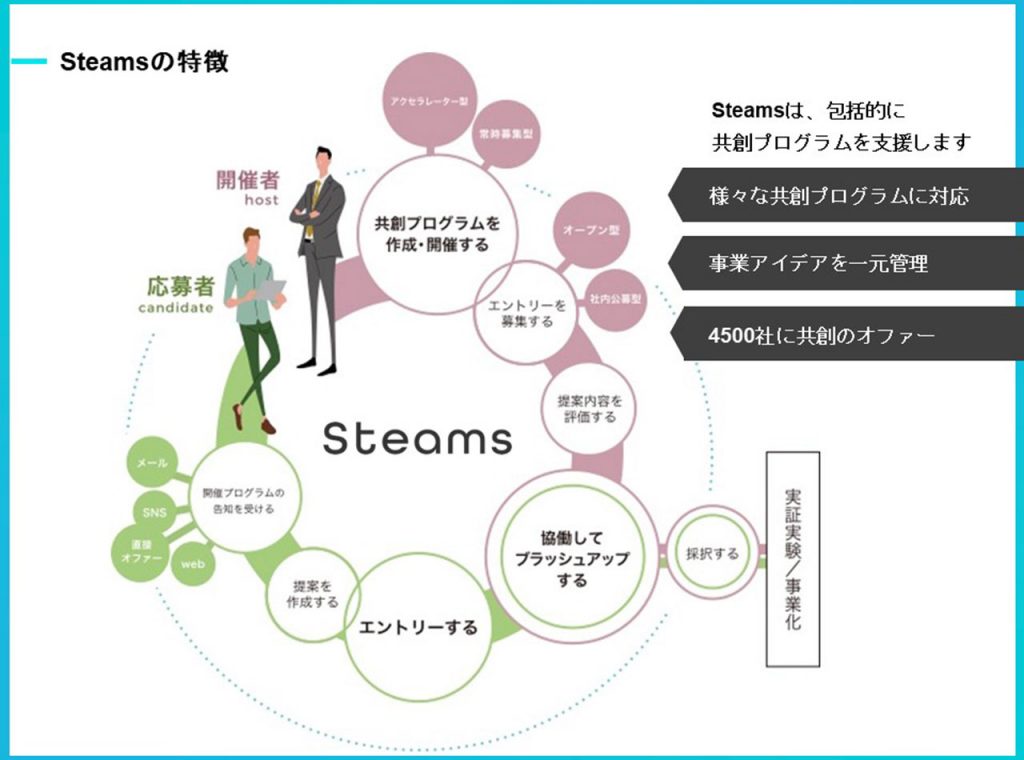
In fact, Creww has also structured the know-how of its accelerator program to date and released a cloud service called Steams at the end of 2019, which makes it easy to start collaborative projects at a tenth of the conventional price. The low price makes it easy to start small and simple in departments, subsidiaries, and project units.
As project units become more prevalent, the last step is to go to individual units.
Thus, as open innovation spreads to small and midsize companies, the final result will be an increase in the number of activities (INFORMAL) in which individuals come together to create services rather than on a corporate basis.
In fact, in Hollywood in the U.S., Tom Cruise and Brad Pitt plan movies as producers and produce movies with actors and staff gathered each time and sell them to distributors. This way of working with a group of individuals is called the "studio type," after Hollywood.
I call it, and it is common practice to work with this method in the U.S., not only in the film production field.
In Japan, it is expected that companies will eventually shift from the idea of hiring people as full-time employees and trying to create new businesses in-house to the idea of individuals coming together to create services as a matter of course. Creww has also launched a service called "STARTUP STUDIO," which aims to create new businesses from scratch by individuals and transfer them to business companies.

The reason why "STARTUP STUDIO" has set the goal of business transfer rather than incorporation is because in some cases, no matter how good a service is created, the company will collapse due to organizational problems, and in other cases, even if a person is very talented at creating things, he or she may not be interested in management. That is why we separated service creation from company management.
A society in which everyone can and should take on challenges
In 2020, many people will suddenly be forced to work remotely due to the new coronavirus. Including those in business categories where remote work is not possible, I believe that the meaning of belonging to a company, the nature of work, and the way we think about work are changing.
With these changes in values, it should no longer be companies that create new services, but rather a group of sympathetic individuals who come together to take on the challenge. If this happens, it may become difficult for companies to survive unless they choose to free up their resources and collaborate with multiple companies and individuals, rather than trying to manage on their own as they have done in the past.
Our ideal future for Japan is a world where anyone can take on challenges; in fact, taking on challenges is the norm. In order for Creww to continue to be an indispensable community for those who take on challenges when this future prediction becomes a reality, we would like to continue to develop services that are one step ahead of the competition and brush up our services by investing ahead of time.
 SORATO IJICHI Representative Director, Creww K.K.
He spent high school and college in the United States. While attending California State University, he started his own business and has established a total of four companies in Japan and abroad. He is currently focusing on his fourth company, Creww, as a serial entrepreneur!
Member Organizations/Projects
Executive Director, New Economics Association of Japan
Director, Design Association for Information Society
J-Startup recommendation committee member (METI x JETRO x NEDO)




 JA
 EN
