


Background of Service Provision
Importance of Early Detection of Dementia
Dementia is one of the most serious social issues in an aging society, and the number of patients has been increasing in recent years. It is known that cognitive functions deteriorate as the brain is affected (damaged) by aging and various stresses. It is also said that the brain begins to atrophy more than 10 years prior to such changes in brain health.
Increased awareness of the risk of dementia and cognitive decline risk such as brain atrophy. Increasing number of people receiving brain-doctoring services related to cognitive function.
Brain docks are traditionally performed to detect vascular brain diseases such as stroke and brain tumors, and are mainly recognized as a test used for early detection of stroke. However, in recent years, with the growing awareness of the risk of dementia and cognitive decline, such as brain atrophy, the number of people requesting tests related to cognitive function However, in recent years, the number of people who wish to undergo testing for cognitive function has been on the rise due to increased awareness of the risk of dementia and cognitive decline, including brain atrophy. For the examinees, there are advantages to having their brain's cognitive function measured at a relatively young age, such as being able to refrain from risk behaviors that may lead to dementia in the future, and being more aware of the importance of a brain-healthy lifestyle.
Seeds Clinic Shinjuku Sanchome, which will introduce Brain Life Imaging®, is a diagnostic imaging clinic specializing in MRI and CT examinations, and is equipped with a 3.0T MRI that can detect even the slightest abnormalities with high-resolution images. The clinic offers a variety of checkup courses that can be taken without a doctor's referral. In addition to imaging recommended by the Brain Doc Guidelines, the Brain Doc Platinum course, which utilizes Brain Life Imaging®, will be available from March 2022. The Brain Doc Platinum course not only examines brain infarctions and hemorrhages, but also measures and visualizes the volume of the hippocampus area, which is closely related to memory and learning, to bring awareness to the examinee.
In addition to Seeds Clinic Shinjuku Sanchome, Brain Life Imaging®-based brain doc courses are also available at Shinjuku Oiwake Clinic/Shinjuku Oiwake Clinic Ladies, Shinjuku Tomihisa Cross Clinic, Shinjuku Tsurukame Clinic, and Mirraza Shinjuku Tsurukame Clinic, all in the same Shinjuku area. Brain Life Imaging® is also available at Mirraza Shinjuku Tsurukame Clinic.
Facilities with Brain Life Imaging® in the Shinjuku area of Tokyo
Seeds Clinic Shinjuku Sanchome
3F Q Plaza Shinjuku 3-chome, 3-5-6 Shinjuku, Shinjuku-ku, Tokyo
https://www.seeds-clinic.jp/
Shinjuku Oiwake Clinic / Shinjuku Oiwake Clinic Ladies
Keio Shinjuku Oiwake Building, 3-1-13 Shinjuku, Shinjuku-ku, Tokyo
(Shinjuku Oiwake Clinic on the 7th floor, Shinjuku Oiwake Clinic Ladies on the 8th floor)
http://www.s-oiwakeclinic.com/
Shinjuku Tomihisa Cross Clinic
Tomihisa Cross 1F, 17-2 Tomihisa-cho, Shinjuku-ku, Tokyo
https://www.tomihisa-clinic.jp/
Shinjuku Tsurukame Clinic
Shinjuku Tokio Marine Nichido Bldg. 3 and 4F, 2-11-15 Yoyogi, Shibuya-ku, Tokyo
https://tsurukamekai.jp/index.html
Mirraza Shinjuku Tsurukame Clinic
Mirraza Shinjuku 7F, 3-36-10 Shinjuku, Shinjuku-ku, Tokyo
https://mirrazatsurukamekai.jp/index.html
Concerned about forgetfulness" and "Concerned about lack of attention" Launch of a 5-minute self-testing tool for memory and attention.
Seeds Clinic Shinjuku Sanchome and Splink have jointly developed the "Memory and Focus Self-Check" and started a demonstration experiment. The system can be easily operated in the waiting room of a clinic using one's own smartphone to perform a simple memory and attention check.
Lifestyle habits and cognitive function are said to be related. It is important to adjust daily habits and lead a lifestyle that is good for the brain (brain health care).
*Can be checked from a smartphone

https://web-cq-seeds-poc.web.app/
*This check does not diagnose any disease or medical condition such as dementia.
Comment from Dr. Jiro Ishida, Chairman of Eijinkai Medical Corporation / Director of Seeds Clinic Shinjuku Sanchome

In the past, most people had brain docks to examine the risk of cerebrovascular diseases, but in recent years, an increasing number of people have come to see us because they are concerned about memory loss. In our "Brain Doc Platinum" service, in addition to lesions such as cerebral infarction, cerebral aneurysm, and brain tumor, hippocampal atrophy can be depicted with high precision and evaluated in a database of healthy subjects, enabling us to acutely detect "change trends" in conditions that precede cognitive decline. Observation of the results over time can also provide indicators for maintaining a healthy brain. Since many brain diseases have few subjective symptoms, it is important that regular checkups lead to early detection, even if the patient is asymptomatic."
About Brain Life Imaging®, a program for brain docks
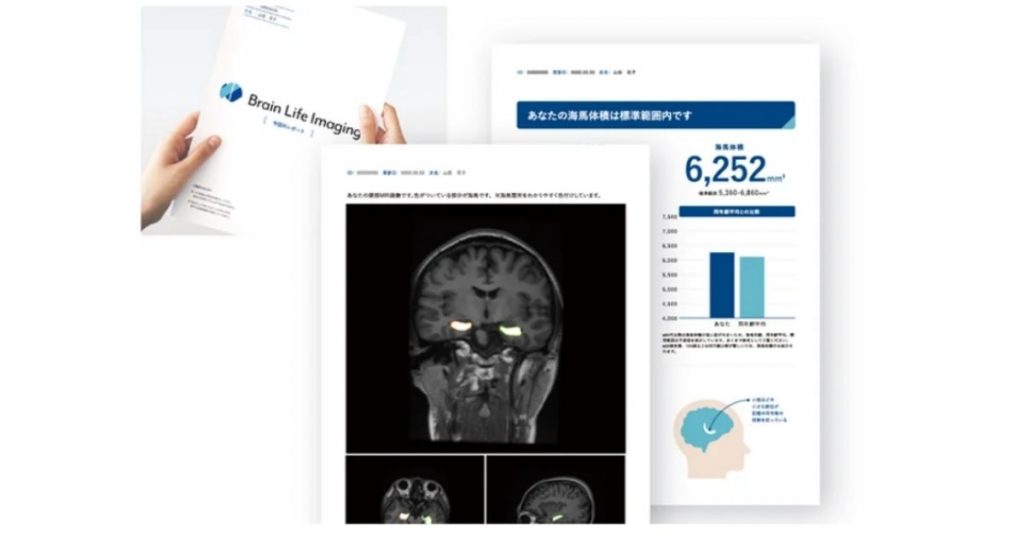
Visualizes brain health by measuring the "hippocampus," which controls the center of memory. AI program for brain docks to promote dementia prevention
This program is an AI program for brain docks that uses AI to analyze head MRI images, measure and visualize the volume of the hippocampus region of the brain, which is closely related to memory and learning, and deliver an easy-to-understand report from the examinee's perspective to promote awareness. The program also provides deeper insights to each individual by visualizing changes over time through the storage and accumulation of analysis data. Through the provision of this service, Splink aims to raise awareness of dementia prevention among the younger generation and reduce the burden of medical care in the future.
General orientation page:
https://www.sitelp.brain-life-imaging.com/index.html
Splink Conducts "Survey on Brain Docs and Brain Health Awareness and Factors".
Awareness of dementia prevention is growing among younger people. 60% of respondents want to have their brain checked for "dementia risk" during a brain scan.
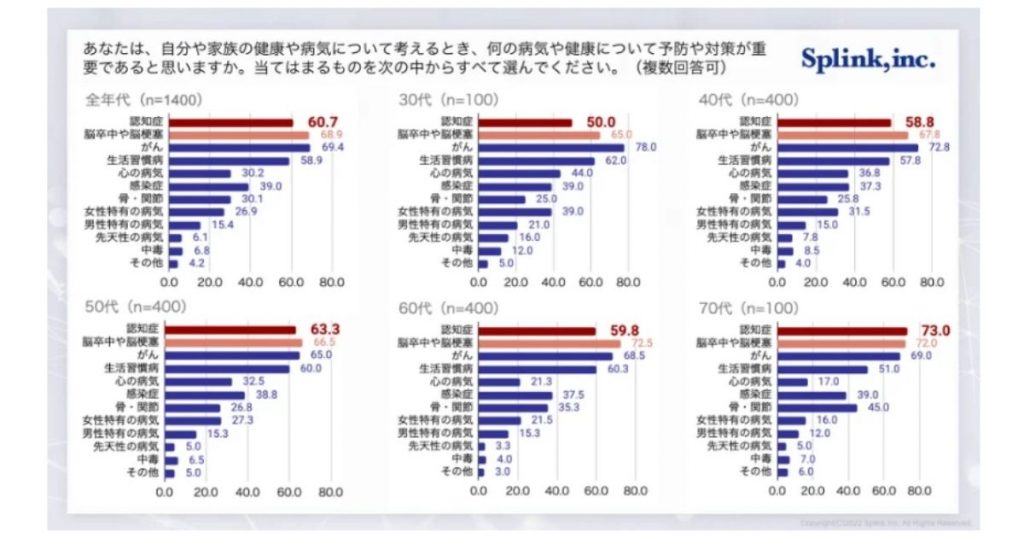
In January 2022, Splink's "Brain Docs and Brain Health Awareness and Fact-Finding Survey" revealed a growing awareness among younger generations of the importance of preventing and addressing dementia as well as cancer, stroke/stroke, and lifestyle-related diseases.Visualization of increased awareness of disease risk related to cognitive function of the brainThe "I" in "I" is the "I" in "I".
The top three most important health and illnesses for themselves and their family members to prevent or control were cancer (69.4%), vascular brain diseases such as stroke and cerebral infarction (68.9%), and dementia (60.7%). By age group, 50.0% of respondents in their 30s, 58.8% in their 40s, 63.3% in their 50s, 59.8% in their 60s, and 73.0% in their 70s reported "dementia.
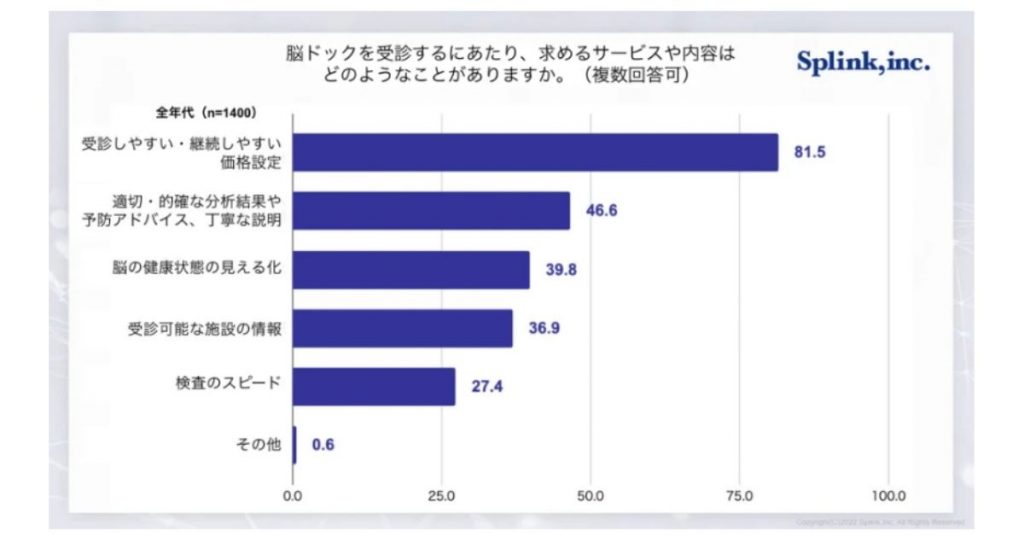
In addition, "high price" has been cited as a hurdle to increasing the consultation rate for brain docks, but this survey revealed that in addition to price setting, the following other factors are required for brain dock consultations: "appropriate and accurate advice, detailed explanations," and "visualization of brain health status" from the perspective of the patient. The results of the survey showed that the need for brain checkups from the viewpoint of examinees is evident. It is clear that easy-to-read and easy-to-understand reports on brain health information are needed so that examinees can say "I didn't know" or "I am glad I took the exam.
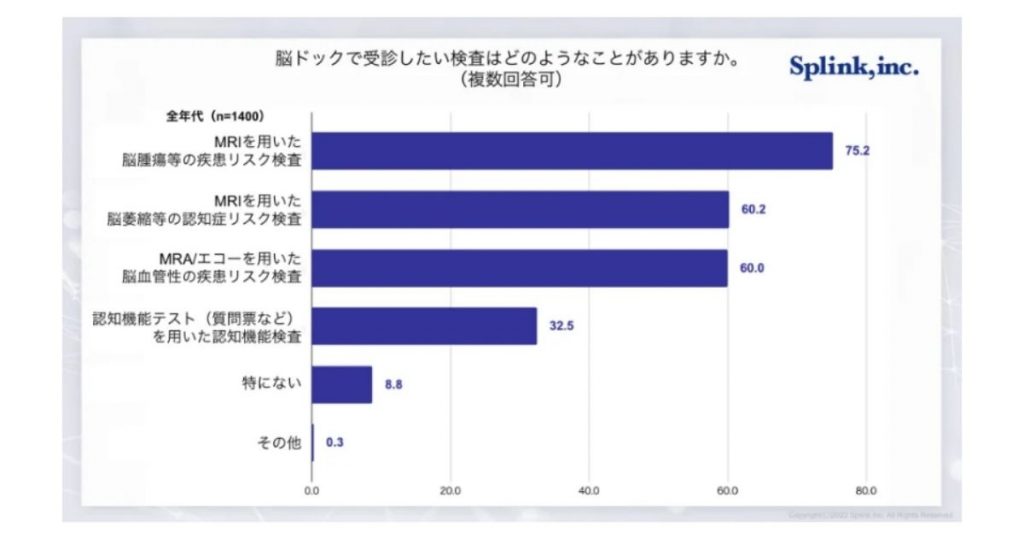
The most popular examination items that respondents would like to undergo during their brain docks are: "Disease risk test for brain tumors and other diseases using MRI" (75.2%), "Dementia risk test for brain atrophy and other diseases using MRI" (60.2%), and "Cerebrovascular disease risk test using MRA/echo" (60.0%). About 60% of the respondents would like to be tested for "risk of dementia such as brain atrophy".
<Survey Summary
Implementation period: January 28 - February 1, 2022
Survey method: Internet questionnaire survey (survey company: Rakuten Insight)
Number of people surveyed: 1,400 men and women in their 30s to 70s from all over Japan
(100 in their 30s, 400 in their 40s, 400 in their 50s, 400 in their 60s, 100 in their 70s, equal numbers of men and women per age group)
Figures are rounded to two decimal places. The order of response items was changed in preparing the graph.
By offering its Brain Life Imaging® AI program for brain docks to a wider range of medical institutions than ever before, Splink aims to promote early detection of dementia and appropriate preventive intervention, and contribute to an appropriate diagnostic flow of dementia treatment.
About Splink
| name of company | Splink Corporation |
| Establishment | January 2017 |
| Location | 18F Shin Kasumigaseki Building, 3-3-2 Kasumigaseki, Chiyoda-ku, Tokyo |
| representative | Yuki Aoyama |
| Business Overview | Brain Healthcare Business, Health Data Infrastructure Business |
| uniform resouce locator | https://www.splinkns.com/ |





 JA
 EN
