


*1...This is an incubation program held for a limited period of time to support startups and commercialization. The program aims to commercialize new businesses by recruiting members, developing products, and verifying the market in a period of approximately six months.
Clothes lying at home are revived by the hands of a colorful dyeing studio.
Earth-friendly CtoK platform service by somete
First of all, please tell us about the services provided by SOMETE.
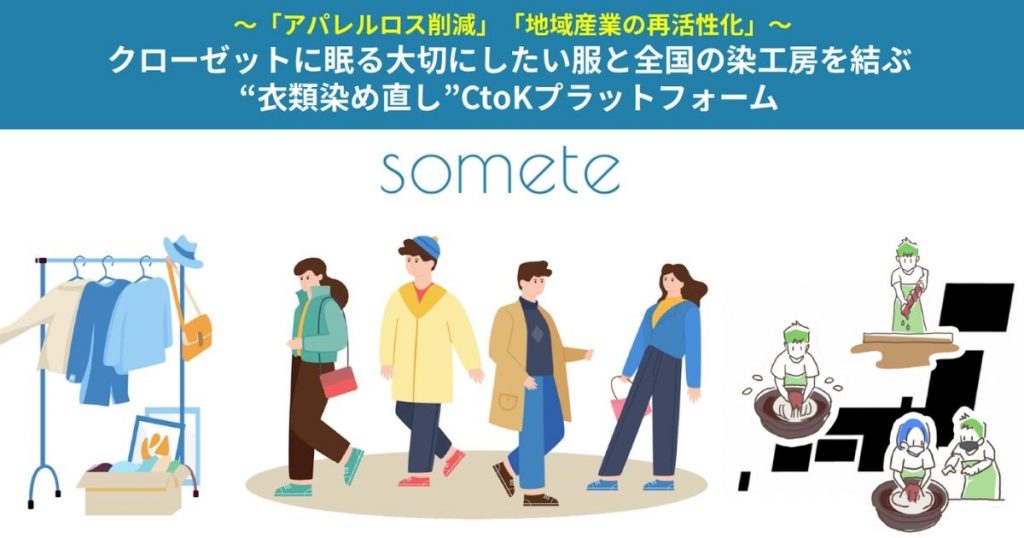
Aono:We are creating a "C to K" platform, in which we commission dyeing studios across the country to re-dye your favorite clothes that are still in your closet at home.

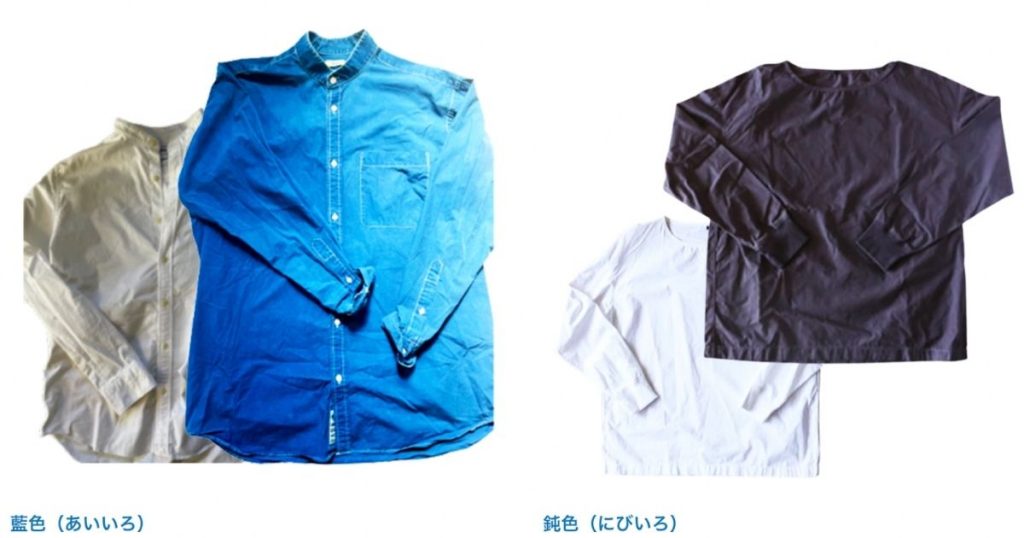
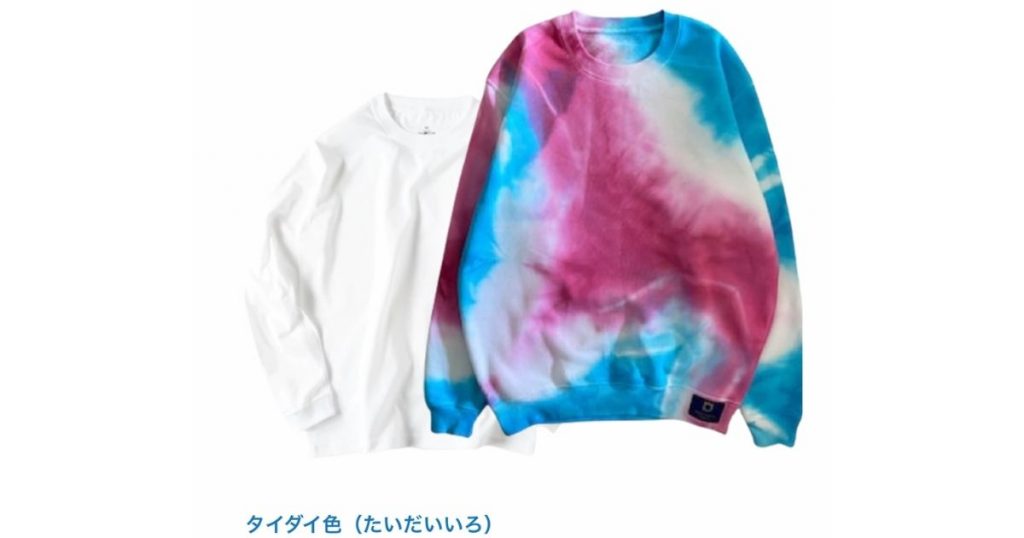
Currently, as a test, customers can request dyeing in their desired color from a limited selection of five colors: indigo, jet black, coffee, nibi, and tie-dye.

What was your motivation for starting SOMETE?
Aono:I had originally started and managed a local media company that interviewed local players in my hometown as part of my double business. One of the people I met at that time was an indigo dyeing workshop, and he told me that the indigo dyeing culture was facing a crisis of survival.
One day, you saw that the collar of a white shirt you had worn a lot had turned yellow, and although it was a bit shabby to wear outside, you couldn't bear to throw it away because you had received it for your birthday and treasured it.
So I decided to have a white shirt dyed by an indigo dyer I had heard about. Two weeks later, the shirt came back very well finished and refreshed. It looks great!" I thought. That was the original experience that led to this business.

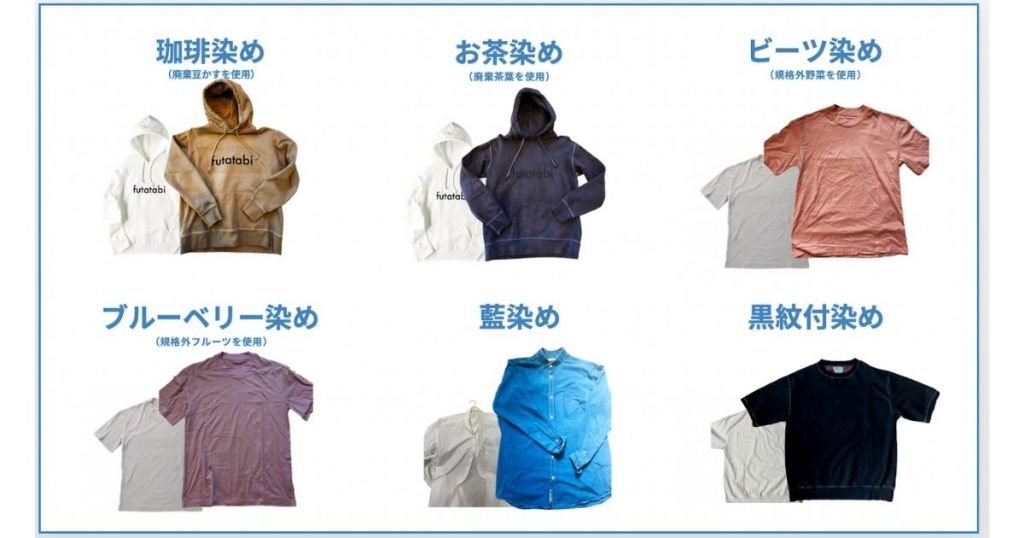
We were initially thinking of developing products and services focusing on indigo dyeing, but as we began our research, we found that there are many other dyeing methods in Japan, including traditional crafts such as black crest dyeing, coffee dyeing using waste bean grounds, and "strawberry dyeing" using out-of-spec strawberries that cannot be marketed...and so on. We learned that there are workshops that dye in a variety of ways.
We decided to create a platform to differentiate ourselves from other services. I thought it would be a novel service and help solve the problems of apparel loss and food loss, so I applied for Creww's incubation program when it started accepting applications.
The timing of the Creww program application coincided perfectly.
Aono:That's right. I applied because I wanted Creww to see how good or bad my proposed business concept was, and I wanted to know how they would react to the service.
Initiatives at STARTUP STUDIO by Creww
What did you actually start working on the program?
Aono:The first step is to interview users. Then, we develop dyeing studios. And then we had to come up with a business model. I purposely put off the formation of the team until later. I thought it would be easier to share the worldview of Somete when gathering members after I had fully verified the image in my mind and output it by myself.
When the business model was somewhat settled, we brought in a designer to create a site for Somete and changed the eye-catching images. Originally, we used free materials to express Somete, but by expressing Somete's worldview in the design, we were able to attract people who shared our vision, and I felt that the business moved forward from there.
Were there any difficulties in participating in the program?
green fieldI guess it was the fact that we interviewed 50 users. It was difficult to find the physical time, including finding interviewees. It may have cost us a lot of communication costs to explain what kind of service it was in the first place.
I also had to visit the studio to experience the dyeing process, so it was very difficult to find the time while continuing to work my day job.
Did you discover anything new in your conversations with users?
Aono:Before I started interviewing, I had a half-product-out mentality, saying that "what I thought was good was good," but as I interviewed people, I made new discoveries and became convinced that my hypothesis was correct. Looking back on it now, I realize how necessary it was.
I see what you mean when users say that the amount of money is too high. The interviews are carefully reflected in the data. We also realized that the large number of people who said, "I have clothes lying around in my closet," was also in line with the data. In the future, we would like to challenge to collect clothes from those who say, "I would rather support this good initiative than throw clothes away," and then somete will collect the clothes, re-dye them, make them into products, and sell them as a D-to-C brand. This was also inspired by the user interviews and led to our next action.
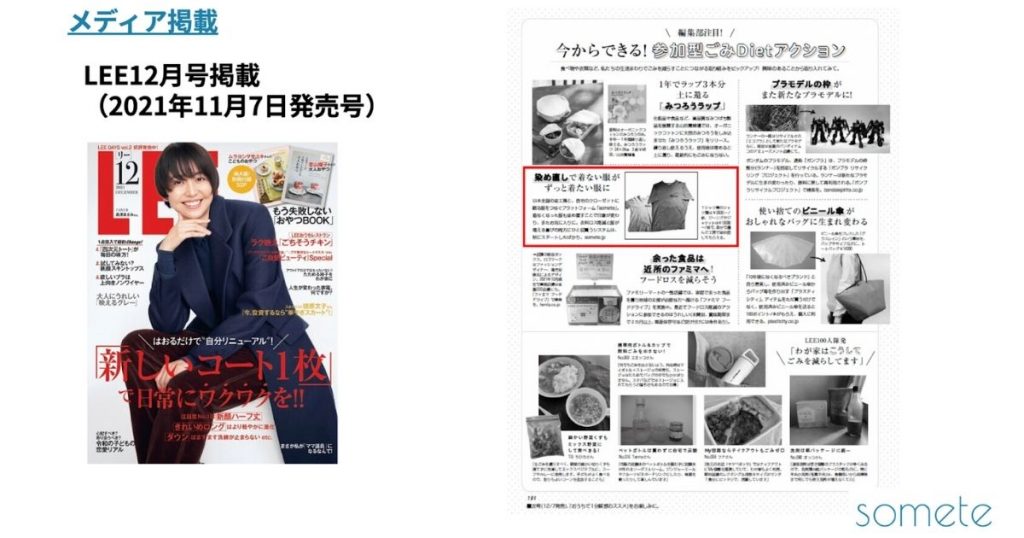
In some cases, the interviewee was a magazine editor who learned about our activities through the interview, leading to the publication of the article in a magazine.
Aono-san, you had to develop not only the buyers' side but also the dyeing studio side.
Wasn't it difficult to get them to understand SOMETE's services?
Aono:We made a list of all the workshops in Japan and sent e-mails from one end to the other. We also made direct phone calls to those who seemed to respond to our "feel" and explained our services, and had close communication with those who had websites and were operating social networking services, and those who were working on new initiatives. We are currently in the process of making requests to four to five companies for re-dyeing.
Throughout the entire program, was there anything like a secret to keeping the business going?
Aono:When we were selected for STARTUP STUDIO by Creww, we had monthly pitches where we received feedback from Creww every month, and this was quite motivating for us. The opportunity to pitch externally was also very significant. It was valuable because it is not often you get the opportunity to get exposure.
We also made use of Creww's open innovation platform for other purposes,Acceleration program for OPA, an urban commercial facilityWe applied to the After discussions and presentations on the co-creation plan, we managed to get it adopted. I can't thank Creww enough for all their help from the startup to the growth of our business. I can't thank Creww enough.
The Future of SOMETE
Who would you like to see use SOMETE's services in the future?
Aono:We want Millennials and Generation Z to use this service. The reason is that we have the impression that they have a high level of interest in environmental issues. We believe that they already have a mindset of supporting environmentally conscious brands by purchasing them.
Finally, what is your outlook for the future?
Aono:In the U.S., data shows that the Corona disaster has increased thrifty thinking, which has led to an increase in the number of people buying used clothing. We hope to create a brand that says, "If you buy one piece of used clothing, why not one piece of re-dyed clothing too?" We would like to solve the problem of "clothing loss" through the service of Somete, and we feel that clothing loss, especially from households, is an area that has not yet been fully explored. If the number of users of "somete" increases, the amount of clothing loss will decrease, and the workshop will become more prosperous. We would be happy if we could realize such a sustainable world.
I hope that the service of "dyeing" SOMETE will become popular as an option other than selling or discarding.
Aono:Yes, I believe that somete is not only a problem-solving service, but also a value-creating service. We hope to solve social issues by communicating carefully and speedily with customers, the market, and society, while also focusing on educational activities about our initiatives!
| name of company | Play Blue Inc. |
| Establishment | March 18, 2022 |
| representative | Yuji Aono |
| uniform resouce locator | https://somete.jp/ |
 Mr. Yuji Aono Representative Director and CEO, Play Blue Inc.
After graduating from college, he worked for a fashion advertising company and a major advertising firm before becoming a freelance PR planner/editor. While editing owned media at a startup, he became interested in circular regional economies and launched a local story media company in 2018. He also produces "cup curry," which allows people to taste the story of local vegetables in a single cup of curry, and hosts talk events to think about the future of local communities. He launched "somete," a service that aims to "pass on dyeing culture" and "reduce clothing loss" as his second business, using the experience he gained from his local media activities as a catalyst. His projects have been selected by Startup Studio by Creww, Shibuya QWS, and OPA Accelerator Program 2021, and he received the Gaiax Startup Studio Entrepreneurship Award.
◆interviewer◆
Talent Team Biz Dev. / STARTUP STUDIO Management, Creww Co.
Ms. Reimi Terada
https://twitter.com/remiterada





 JA
 EN
