


A startup created by a major social issue that one day I suddenly found out about when I became a person with a disability.
Considering QOL improvement based on individual characteristics, including disabilities
Collaboratively developed a package for employment of persons with disabilities.
Diversity and Inclusion through Employment of People with Disabilities
Aiming for a society where even people with disabilities can create publicly traded companies
Solving the challenges of the future society through open innovation
-What is the background behind Fujikura's introduction of open innovation in 2017?
flatboat For more than 130 years since its establishment, Fujikura has grown as a company that "connects" the world through its businesses in telecommunications, electronics, and automotive electronics. Just,Society is changing at a dizzying pace these days, and there was a sense of crisis that Fujikura needed to change in order to create a sustainable future.I guess so.
Until now, we have contributed indirectly to solving social issues by responding to the needs of our customers, but in order to solve increasingly diverse and complex social issues, we need to reach out directly.
Therefore, in 2017, the Fujikura Group has been working to "connect" by providing solutions that "connect",Solving the problems of a comfortable and sustainable "future" society and continuously increasing corporate valueUnder the slogan of "2030 Vision," we have set forth our "2030 Vision" to solve social issues through open innovation.
The specific markets we have envisioned are Advanced Communication (contribution to an advanced information society), Energy & Industry (utilization and efficient management of various types of energy), Life-Assistance (improvement of quality of life), and Vehicles (contribution to the next-generation mobility society).

-So you aimed from the beginning to solve social issues through open innovation?
flatboat Yes, it is. To solve the challenges of the future society, we need a completely new approach, not just the existing way of doing things. That is why ourWe want to solve social issues by combining management resources with startup ideas and technological capabilities.and we also held an accelerator program.
At that time in 2017, we did not know what was going on right and left, but as a result of our continued efforts while facing startups, we are now collaborating with dozens of companies, including POCs.
A startup created by a major social issue that one day I suddenly found out I had a disability.

-ActivateLab is a company that specializes in social networking services for people with physical disabilities, as well as employment consulting for people with disabilities.
revised edition of a book I had a sudden cerebral hemorrhage at work 12 years ago. I was unconscious for two weeks and when I woke up, I was unable to speak or get up. For the next four years, I continued rehabilitation, and although I was left with paralysis in the right side of my body, I recovered to the point where I was able to speak and walk by myself.
However, after trying to find a place to work and going to dozens of job interviews, I couldn't get anywhere. Somehow I managed to find a company that hired me as a part-time worker, but it was far from what I had imagined. I also felt a sense of hopelessness that from the moment I became disabled, my path to full-time employment was closed.
In addition to this employment issue, when I became disabled, I learned that people without access to computers and the Internet were inhibited by society, creating disparities in wealth, opportunity, and social status that made it more difficult for them.
This is what I call the "digital divide," and as someone who was originally involved in the IT business at USEN Corporation (now USEN-NEXT Holdings), it was a big problem for me.
The situation was 180 degrees different from the world we had been living in, and it was not good if we did not change it somehow. With a keen awareness of this, he founded Activate Lab six years after suffering a stroke.Created "OpenGate," a social networking service specialized for people with physical disabilities, to build a place where people with disabilities, their families, medical professionals, and businesses can connect.I did.
-You mentioned that the part-time job was far from what you had imagined, what challenges did you encounter?
revised edition of a book I was very happy to have been hired, even if it was only part-time, so I went to work in a new suit, but after a week I still hadn't gotten the job.
I had sales experience at Recruit and USEN, so when I told them that I was paralyzed on the right side of my body but could track numbers, they said, "Masumoto-kun, you just sit there. Because I was a personnel to achieve the employment rate for people with disabilities.
When I learned this, I was really sad and did not understand the meaning of my existence. Even if you have a physical disability, you should be able to be active if you can commute to work, and even if you have a mental disability, you should be able to be active if they consider the time you come to work.
Various issues surrounding people with disabilities should be resolved, and the accumulation of these issues will lead to the resolution of major social issues.So, we developed a business plan.
Thinking about improving quality of life based on individual characteristics, including disabilities

-It was quite a spectacular experience for you. Why did you apply to Fujikura's accelerator program in 2017, two years after founding Activate Labs?
revised edition of a book Actually, I had known about Fujikura since I was in the fifth grade, when my father, who worked for NTT, gave me an industry-oriented comic book depicting "future communications" that showed people using smartphones to communicate and submarine cables to connect information around the world.
And written on the back of the comic was the words "Cooperation: Fujikura. About 40 years ago, when there were no smartphones or the Internet, Fujikura made a strong impression on me.
When I learned that Fujikura was working to solve social issues, I knew I wanted to apply and work together with them. I was very excited.
-Why did Fujikura adopt Activate Labs?
flatboat Fujikura is promoting health management, such as extending healthy life expectancy and improving quality of life, but what we had in mind was improving QoL based on life stages. But when Mr. Masumoto said to me, "There is another axis," I had an epiphany.
It is important to consider improving quality of life based on individual characteristics, including disabilitiesAnd we must not lose sight of that. In order to ultimately achieve diversity and inclusion, I wanted to start by working with Mr. Masumoto to change our company's employment of people with disabilities.
Collaborative development of employment packages for people with disabilities
-What initiatives have you been promoting for the past four years, from 2017 to now?
flatboat First, we worked to improve our company's employment of people with disabilities. Specifically, we started by having Mr. Masumoto attend our hiring interviews.
Until now, HR personnel did not know how much to ask about disabilities, but Mr. Masumoto told me, "It is OK to ask about disabilities. But Mr. Masumoto taught me the viewpoint that "it is OK to ask about disabilities, but the person wants to talk about it, but only because he or she is not asked.
In addition to what should be taken care of during the hiring interview, we worked together to create a "package for hiring people with disabilities," with Mr. Masumoto accompanying us to take care of them after they join the company and their colleagues working in the same workplace.
However, Fujikura alone cannot cover "what companies are having trouble with," so Mr. Masumoto is now approaching various companies to update the content of the program together with his consulting services for employment of people with disabilities.
-Masumoto-san, what perspective do you think companies are lacking?
revised edition of a book There are four categories of disabilities: physical disabilities, mental disabilities, intellectual disabilities, and developmental disabilities. However, companies do not understand disabilities to the extent that there are joint recruiting fairs for people with disabilities that have all the categories jumbled together.
During my four years of rehabilitation, I met and researched all around me four categories of people, and one particular difference was the way they viewed mental disability.
When people hear about mental disabilities, they tend to have concerns that they will be late, absent, or leave early, but that can be dispelled. For example, if you are diagnosed with depression, you will be prescribed medication, which includes a sleep aid, so you will need 12 hours of sleep.
In other words, he needs 12 hours of sleep to get into full swing, so even if he says, "I will come to work at 9:00 a.m.," it is impossible for the company to ask him to do so. Even if he has no disability, if he takes a sleep aid, he cannot work unless he sleeps for 12 hours. So, just make him work in the afternoon. Just that much will make both parties happy.
Then, when we hear about cerebral palsy or stroke, we tend to think that there is something wrong with the brain and that you cannot work, but only a part of your body is paralyzed and your brain is normal. You may be slow at typing on a computer, but you can think of a plan.
By talking about this, HR will realize that it is possible to hire people with disabilities, and by carefully explaining this to the departments that accept them, I believe that the barriers to hiring people with disabilities can be gradually dissolved.
-I feel that the major challenge is that society knows too little.
revised edition of a book You are right, companies do not understand people with disabilities. I myself did not know until I had a disability, and there was no environment prepared for me to speak up after I had a disability.
flatboat Before I met Mr. Masumoto, I had no idea what the disabled were having trouble with.
Diversity and Inclusion with Employment of People with Disabilities as a Starting Point
-What changes have you seen within Fujikura as a result of the collaboration?
flatboat Although the employment of persons with disabilities has yet to spread throughout the company, the awareness of personnel has changed significantly. Although it is only a small portion, the understanding of the departments that actually accept them is also progressing.
-I think the change in major companies will lead to a major social change.
flatboat Exactly, hiring people with disabilities is not only an issue for our company. Besides, it is not only people with disabilities who are subject to restrictions on working hours and wages, but also those who are raising children, caring for sick or injured family members, or those who need to go to the hospital for illness or injury.
If we can create an environment that makes it easier for people with disabilities, who have many restrictions, to work, it will make it easier for people raising children and caring for family members to work, and it will lead to a society where everyone can work easily.
That is why we are also focusing on sales activities so that our package of employment for people with disabilities will spread throughout the world. Since the Corona Disaster has changed the way people work, why don't we think about diversity and inclusion starting from the employment of people with disabilities? We are working with various people to brush up on areas that cannot be covered by just one Fujikura company.
-What kind of people do you brush up with?
flatboat Some are Fujikura customers, others have participated in webinars that are open to the general public, and many others.
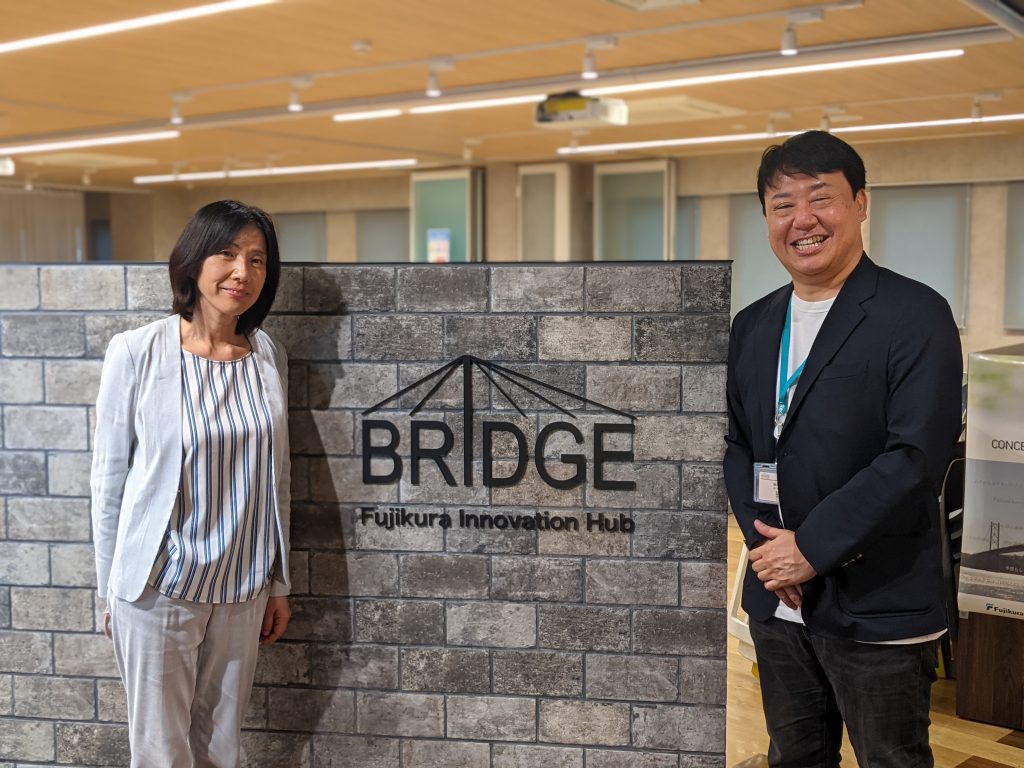
For Fujikura,A base called BRIDGE, an innovation hub where diverse people from companies, organizations, research institutions, and government gather to co-create value.and you collaborate with the people who gather there.
revised edition of a book To the think tanks and major firms that flock to the "BRIDGE."Diversity and Inclusion Can Be Achieved Starting with Employment of People with DisabilitiesIt is a big step forward to be able to propose that "we are the best in the world.
Aiming for a society where even people with disabilities can create publicly traded companies
-Please tell us what kind of development you are aiming for in the future.
revised edition of a book Our goal is not to support people with disabilities as "at-home volunteers," but to build a successful business that starts with people with disabilities and go public.It is. I strongly believe that we do not want to make money by going public, but to create a society where even people with disabilities can create publicly traded companies.
Also, people with physical disabilities have problems with various activities such as food, clothing, housing, education, and work, depending on the part of their body that is disabled. However, even if they want to know how they can make their lives easier, it is difficult to obtain information anyway.
That is why I want to create a society where people in the same situation, medical professionals, and companies can share information through "OpenGate" and provide and enjoy optimal services and products. We would like to make this a common practice in Japan first, and then deliver it to the entire world.
flatboat In order for society as a whole to move toward improving quality of life, we would like to first promote the employment of people with disabilities as a means of establishing a firm footing for such employment and spreading the Activate Lab system throughout the world.
If the ecosystem expands while increasing the number of partners, new value and services will eventually be created. As Fujikura,Creating a society where no one is left behindI would like to contribute to the
 Ms. Sayaka Hirafune General Manager, Tsunagu Mirai Innovation Promotion Office, New Business Promotion Center, Fujikura Ltd.
After joining Fujikura, he was engaged in the development of optical fibers and electronic devices, as well as the start-up of mass production. 2013, he moved to the New Business Promotion Center, where he was mainly in charge of product certification and incubation of new businesses, In April 2017, he assumed the position of General Manager of Tsunagu Mirai Innovation Promotion Office, New Business Promotion Center, and is working to create new value through open innovation.
 Mr. Yuji Masumoto Representative Director, ActivateLab Inc.
After graduating from university, worked in sales and business planning at a major/developer, advertising agency, and telecommunications company. 2009, while at work, suffered a cerebral hemorrhage and fell unconscious, woke up 2 weeks later and was class 2 disabled with right hemiplegia. 4 years of rehabilitation, worked as "part-time employment for the disabled" at a consulting company. After four years of rehabilitation, he was hired by a consulting firm as a "part-time worker with disabilities. In July 2015, she established Activate Lab Inc. with the aim of realizing a society where people can work actively regardless of their disabilities.





 JA
 EN
