


With a generation gap, digitization is inevitable for passing on skills
-Please tell us about UI Seiki's business and what kind of challenges you faced when you participated in the Business Matching Program.
UI Seiki is a prototype manufacturer mainly engaged in manufacturing stamped prototypes for the automotive industry. We also focus on research and development, and have been solving our customers' wants and challenges for many years.
There were two challenges that we sensed. The first was that business practices have gradually changed over the past decade or so due to digitalization and other factors, forcing us to change our business model.
In the past, our customers, the major manufacturers, had a strong sense of nurturing subcontractors like us, and if we waited, they would give us many assignments. But now, instead of waiting for assignments, it has become necessary to add value to ourselves and build new connections by proposing and communicating our ideas to our customers.
The second issue is the problem of passing on skills during generational change. Since employees are largely divided into older and younger generations, it has become necessary to change the method of passing on skills.
Procedures can be taught in a manual, but hunches and tricks cannot be taught. Besides, to teach experience, you need to have them go through the same experience, but it is not realistic to expect them to spend the same 10 years cultivating the same know-how that took them 10 years to develop.
We wanted to find a way to pass on skills smoothly to younger generations by collaborating with startups' cutting-edge technologies and ideas, as digitization is necessary for the future transfer of skills.
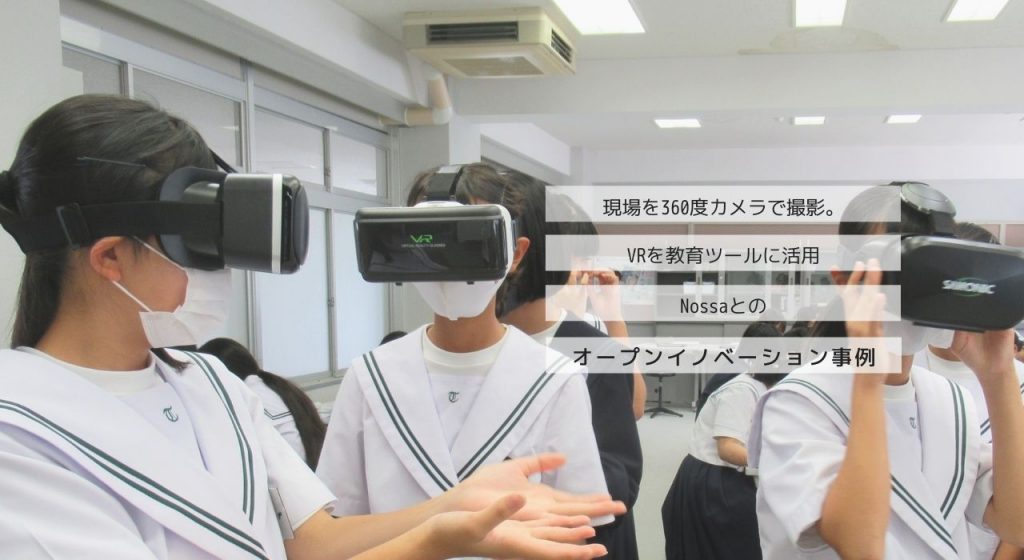
360-degree camera at work site, using VR as an educational tool
-Did you envision working with startups from the beginning?
No, I could not imagine what kind of people were at the startup and what they were doing. But when I applied for the event, I heard from the person in charge of the event, and I thought I might be able to meet a startup that could solve the problem of passing on skills. It was an unknown world until I heard the explanation in person.
-To talk about the initiatives of the two companies that have already started working on this project, could you start with the case of Nossa Corporation, which uses VR?
Nossa is a company that develops VR tools that use 360-degree video and voice calls to enable users to converse with others at a distance while sharing real-life situations.
I had never experienced VR, but as I was shown and talked with them, I realized that this is exactly what I could use for on-site training. For example, there are only a limited number of people who can go directly to the customer's site for business meetings, and it is difficult to convey the information received there in a written report.
But if you use a 360-degree camera to film the site, you can pick and choose where you want the viewer to look, not just where the person filming wants to show you. Different levels of proficiency will have different things they want to know, so I thought it would be great to be able to customize the program individually, rather than learning from the same textbook uniformly.
-It could be used not only for passing on skills, but also for social visits at school sites that are no longer accessible due to the Corona disaster.
Exactly, we experimented with virtual factory tours at schools. I found that different people looked at different parts of the factory, and most importantly, the children accepted the experience smoothly and found it very interesting.
Since there is value in being able to experience something, even if it is a simulated experience, we believe we can expand our business into areas where digitization has not progressed, such as educational content for social tours and tools for company introductions.
Smart Glasses to Help Pass on Skills
-Please tell us about the case study of Enhanlabo Inc. using smart glasses.
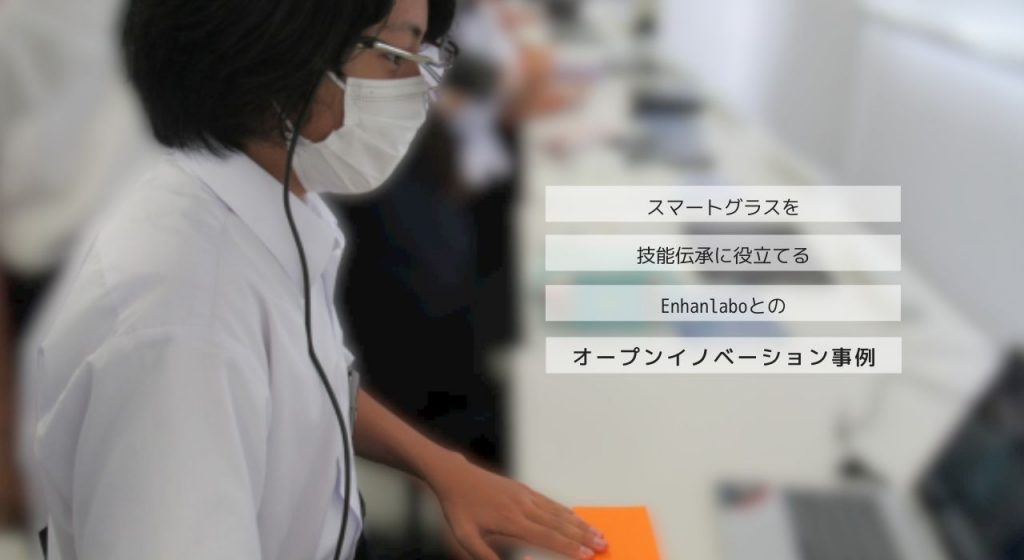
Enhanlab is a company that develops products that augment vision by attaching displays to glasses with eyeglass-shaped wearable devices, primarily to improve productivity.
Actually, about three years ago, I had an idea that if a model image of a senior craftsman was projected on smart glasses, even younger workers could work using both hands while looking at the image, but for various reasons I was unable to realize this idea.
So when Enhanlab showed us their product, we realized that we could do exactly what we wanted to do, and we are now moving forward with our plans.
The difficulty, however, is that it is necessary to prepare a large number of images, including images tailored to the viewpoint from which the work can be easily performed and different images for each level of proficiency, which requires ingenuity and know-how in the way the images are taken. In addition, the images projected on the smart glasses are small, so it is important to capture them in a way that is easy to understand.
If we can solve these image-related issues and accumulate know-how on photography for smart glasses, we believe we can not only solve internal problems but also expand our business outside the company.
We want to expand the circle of open innovation by providing a place for demonstration experiments and creating case studies.
-What insights have you gained from working with startups?
It is important to proceed without deciding what you want to do from the beginning, and to keep the idea from becoming fixed. If you don't start with a clean slate, you may end up ruining your idea, or even saying, "If it can't be used in this way, we won't use it. That is why I was careful to keep my mind flat.
Another thing I learned from collaborating with the startups was how smart they were in the way they worked; even for web meetings, I thought I was prepared, but the startups were more advanced and used to it.
I was taught how to use IT tools I didn't know about, and I believe that the combination of online and offline communication will be useful in the With Corona society.
Above all, I was happy to work with young, enthusiastic start-up people in a completely different industry, who talked together with me and gave me a rapidly expanding image of problem-solving, which was exciting and fun to work with.
-If this initiative spreads to surrounding companies, it will invigorate both manufacturing companies and start-ups in Japan.
That is precisely the significance of collaborating with startups. It is meaningless if the results of our efforts with them do not increase the number of startup customers.
My role is to provide a place for startups to demonstrate their work, and I would like them to expand their circle of collaboration with other companies with these examples.
Increasing the number of collaborators to solve internal and external issues.
-What are your plans for the future?
In fact, when I joined the Business Matching Program in February, I was only thinking of developing new initiatives to solve internal problems.
However, the impact of Corona has necessitated major changes in the world as a whole, such as digitalization and changes in business models. Moreover, if this situation was still going to continue, we began to think that we needed to properly commercialize the business and solve problems outside of our own company.
In particular, technology transfer is not an issue unique to our company; it is a life-and-death problem for manufacturing companies if it is not resolved due to the aging of employees and the shrinking workforce.
There is only so much we can do on our own, so we would like to continue to meet with people in various industries, try out new initiatives, commercialize them, and expand them not only to manufacturing companies in Japan but also to countries around the world that are looking for Japanese technology.
First, we would like to commercialize our efforts with Nossa and create an educational tool that can be used in school education and corporate training.
-What advice would you give to companies considering collaboration with startups to make it a success?
I think there are a certain number of companies that have the idea, "We want to solve our company's problems, so we need to find someone who can solve them." But if you want to collaborate with a startup, I think that idea will fail.
What you need to have is a mindset of working together on an equal footing. Otherwise, it is easy to fall into the trap of judging whether or not to use the startup's technology and tools. If you let the startup create a product that can only be used by that company in an order-and-supply style, it will not lead to the expansion of sales channels for the startup.
Rather, I believe that if we approach the issue with the attitude of "let's work together to solve the problem," I am sure it will lead to successful results.
| name of company | UI Seiki Co. |
| Establishment | 1969 (Showa 44) |
| Location | 2-13-12 Shonaka-cho, Owarisahi, Aichi, Japan |
| representative | Kazumichi Mizuno |
| Business Overview | Automobile press prototype production / Small-lot press mass production Progressive press dies and single dies for automobiles Design and fabrication Mold parts manufacturing Research and development of "material processing technology for product weight reduction" for next-generation industries |
| uniform resouce locator | http://www.yuai-seiki.co.jp/ |






 JA
 EN
