


Four manufacturing companies from Shinagawa Ward participated in this program. In response, 49 startups applied for the program, and three were selected. The following is a report on the results of the presentation held in March 2024.

CASE 1, Yamashita Electric Co.
Digitalization of analog progress management and accumulation of technical information
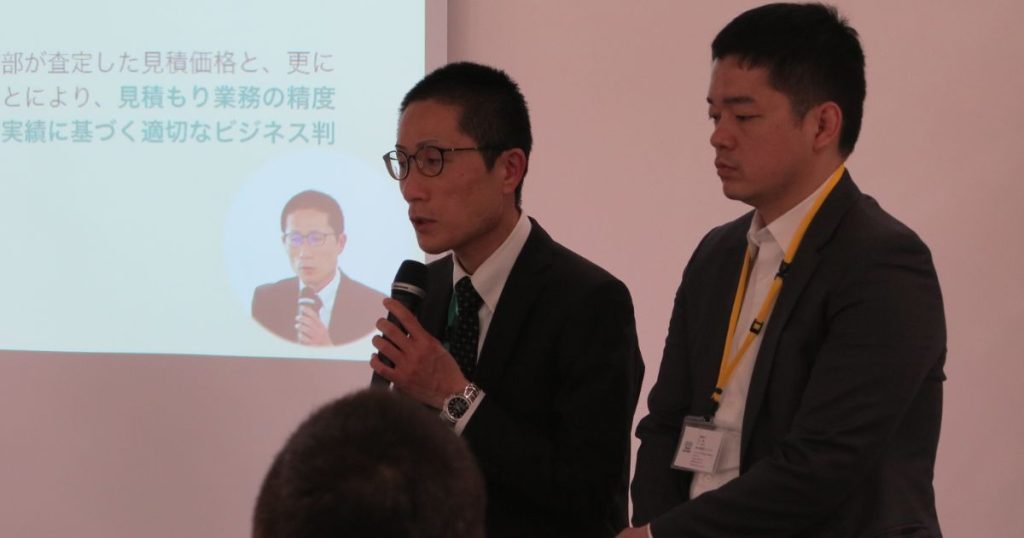
Kei Niikura, Deputy Manager, General Affairs Section, General Affairs Department
Risa Idakura, Chief, Design Section, Resin Product Design Dept.
new stock Our company designs and manufactures plastic precision molded products and precision molds for automotive parts, PC communication equipment, measuring instruments, etc. We mainly manufacture plastic parts related to automobile navigation panels and interior appearance products.
The background of my participation in this program was that I wanted to find a way to efficiently use the data accumulated within the company and the know-how of skilled engineers. In particular, there was an urgent need to digitize work that was being done with the experience and know-how of veteran employees and engineers, and to improve operations by utilizing the data accumulated in the company.
In the sales department, for example, more than 80% of quotation documents are deleted without being reused. Despite the enormous amount of time and effort spent on creating quotations, valuable information assets are not being utilized.
We would like to link the quotation data received from customers, quoted prices assessed by our sales department, contract information, and areas related to die manufacturing to improve the accuracy of quotation operations, increase operational efficiency, reduce costs, and eventually develop the ability to make appropriate business decisions based on past results.
Therefore, for this program, we recruited startups under two themes: "promoting the digitization and data utilization of internal operations" and "encouraging startups to utilize our technology, products, and equipment in their businesses.
As a result, we received applications from 12 startups, and selected Tokyo Factory, Inc., which has developed "Proceed Cloud," a site DX service that uses photo data to visualize sites and achieve more sophisticated and efficient site management. We wanted to accumulate our company's technology, which has been accumulated on a text and text basis, in the form of photos and videos.
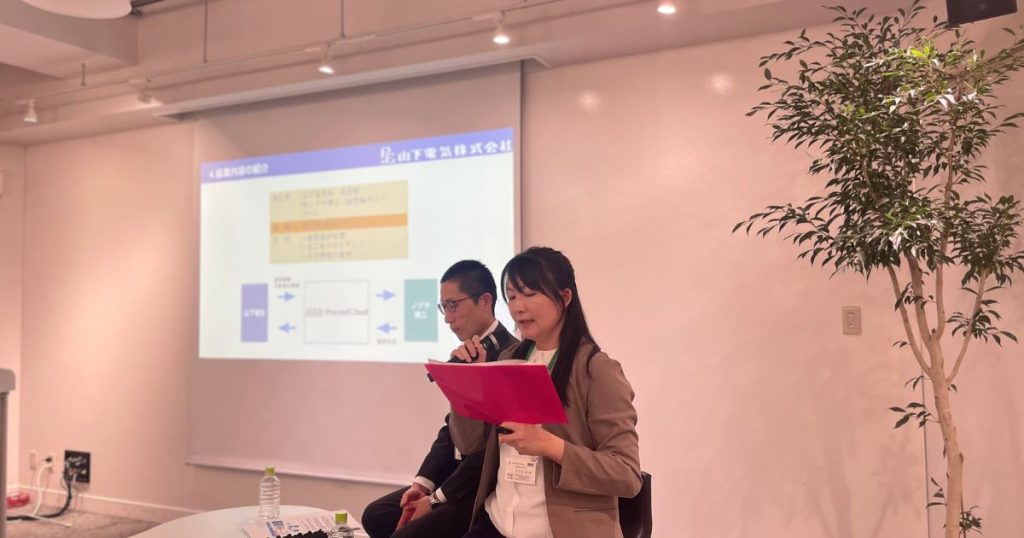
part of a Japanese-style house (e.g. restaurant) where the actors prepare the food Specifically, our engineering department and Noguchi Seiko, a mold manufacturer, worked together for a month to verify whether the Proceed Cloud could be used to efficiently "manage the progress of the new mold manufacturing process," "use each process as evidence," and "accumulate technical information.
For the fabrication of a new mold, we would receive an order from the customer, make adjustments, ask the mold maker to fabricate the mold, and deliver the finished product after multiple adjustments and revisions, but the progress was based on conversational communication.
By utilizing Proceed Cloud for this process, it is now possible to share photos of mold machining status, molding status, and molded products on the cloud, enabling on-time, speedy, and accurate confirmation of progress.
I feel that the Proceed cloud can be used not only to share progress with mold makers, but also to manage individual schedules within the company and for managers to check the progress and workload of their members. I am very glad that my participation in this program has broadened my thinking and perspective by exposing me to the startup way of thinking.
Cooperative startups
Company name: Tokyo Factory Co.
Representative: Minoru Ike
Establishment: April 2020
Business activities: Development, sales, and operational business improvement consulting of SaaS for the manufacturing industry
URL:https://tokyofactory.co.jp/
CASE 2, Yamashita Systems, Inc.
AI appearance inspection system is built, moving away from human visual inspection.
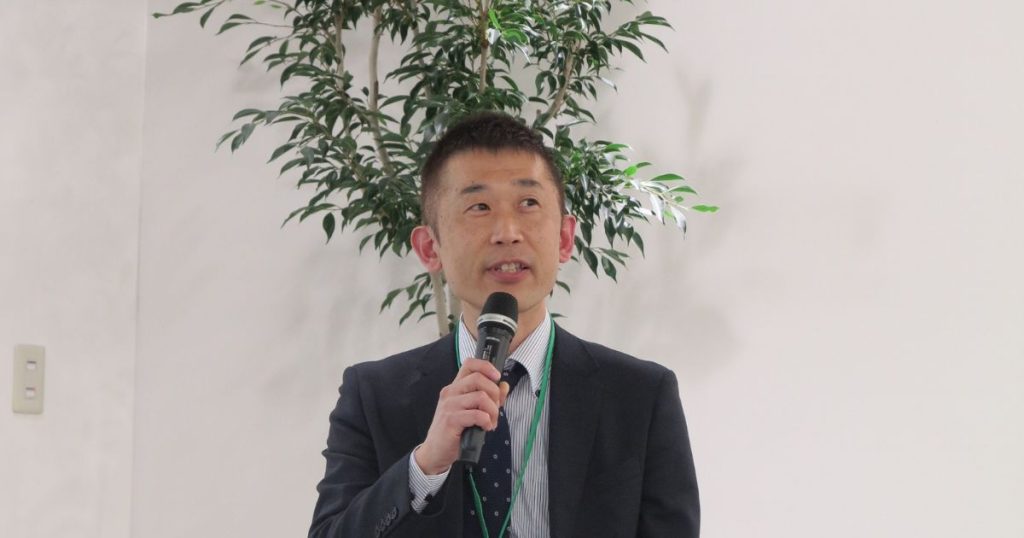
Takuya Koizumi, General Manager, Sales Dept.
Yamashita Systems was the first company in Japan to popularize board computer systems, and is engaged in integrated in-house production for the development, manufacture, and sale of industrial CPU boards. Industrial CPU boards are used in machine tools in factories, order terminals in restaurants, checkout machines in hospitals and supermarkets, fueling machines in gas stations, tonometers in ophthalmology, and other products that we touch in our daily lives.
I participated in the program this time because I wanted to solve problems in manufacturing and production sites with IoT, increase solutions for the manufacturing industry, and take on the challenge of developing new products by utilizing and applying our own technology. In other words, the main objective was to break away from being a hardware specialist manufacturer.
Therefore, we adopted AItoAir Corporation, developer of the no-code edge AI development platform "Tinyboom," to conduct the demonstration experiment.
What we verified this time was the construction of an AI appearance inspection system. The goal was to build an automatic AI inspection system using a camera and image processing AI, to gain knowledge about learning and inference models, and to establish a basic technology for new business.
Specifically, we verified whether the process that had been inspected one by one by human eyes could be converted to automatic inspection by AI. The inspection targets were plastic molded products that had been painted.
In developing the AI, we started by capturing a large amount of photographic data of OK and NG products that had been discriminated based on conventional inspection standards. Then, we had to go through the process of annotation to tag the captured data, machine learning, model evaluation, and implementation.
As a result, there was not a single case where NG products were judged as OK products, but there was a 20% rate where OK products were judged as NG products, so a new program is currently being added and tested.
Although the data collection and annotation was a simple and difficult task, and the camera and lighting settings were very serious and demanding, I feel very happy to have participated in this project and to have improved the AI literacy of the members involved in the project, as well as to have clarified future issues to be addressed. I feel it was very good that the members involved in the project improved their AI literacy and clarified future issues. Above all, we are very grateful to AirtoAir for their flexibility in responding to our requests.
Cooperative startups
Company name: AitoAir Inc.
Representative: Jeong Doowon
Establishment: November 2021
Business Description:
Research, development and sales of Tinyboom, an edge AI development platform
Support and consulting for implementation of AI-related solutions
URL:https://aitoair.com/
CASE 3, Techno Accel Networks, Inc.
Interactive robot x sensor to monitor family health even remotely
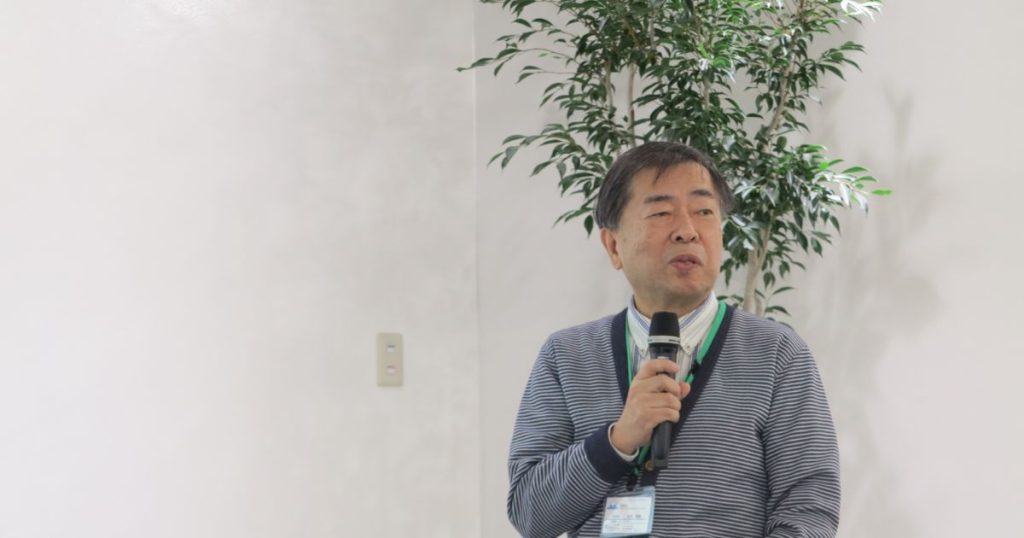
Naoki Yamauchi, Representative Director
Techno Accel Networks was founded in 2011 as a manufacturer with strengths in sensor and AI technologies, mainly for use in automobiles. It is a start-up by seniors, but we have been challenging new things together with young engineers from major automakers.
As I continued to take on new challenges, I began to wonder if I could apply the sensors and AI-related technologies that I had developed mainly for in-vehicle use to other applications, as they had been accumulated within the company. I had originally developed a driver monitoring system that uses millimeter wave radar, a sensor that uses radio waves to casually monitor the physical condition of drivers, and I wanted to apply this to nursing homes and other facilities, which is why I joined the program.
The three themes solicited were: "Joint construction of applications and services using non-contact sensors based on millimeter wave radar and other technologies that can measure the heart rate and respiratory rate of humans and animals," "Reduction of stress and burden on drivers and nursing staff," and "Construction of sensor systems that can detect the road surface environment (down stairs, cliff, shoulder, etc.) several meters ahead of the road". The three are.
Ten companies applied for this theme, and we ultimately selected Uni-Robot Corporation, which is developing Unibo, an interactive communication robot with integrated vital sensing technology, to take on the challenge of developing a new service.
What was great about working with Unibo was that they were already providing services in nursing care and other settings. In addition, the demonstration of Unibo's interactive function at the exhibition allowed us to conduct many demonstrations and receive feedback efficiently.
Specifically, we asked exhibition visitors to sit in front of Unibo and measured their heart rate and breathing rate using millimeter wave radar. The measurements were then sent to Unibo via Bluetooth for display and also transmitted to their smartphones.
Many participants in the demonstration experiment agreed that if Unibo were installed in nursing homes and long-term care facilities, it would be possible to monitor the health of family members remotely by talking with them via their smartphones.
In the future, we will evaluate and identify issues while expanding use cases. We intend to brush up the system through repeated demonstration tests at actual nursing care facilities, etc., and continue our collaboration toward practical application.
Cooperative startups
Company name: Uni-Robot Co.
Representative: SAKAI Taku
Established: August 2014
Business Description:
Research, development and sales of communication technologies in general (voice I/F, natural language processing, emotion analysis, personal AI, chat, etc.)
Development and sales of an automatic answering AI solution (Voicebot) for telephone answering service.
Planning, development and sales of cloud services utilizing the above (unirobot cloud)
Development, manufacturing and sales of communication robots (unibo)
Contracted development of software and hardware
URL:https://www.unirobot.com/
CASE 4, Fine Corporation
Created an AI automatic inspection system to eliminate defective products and transform the production process into an efficient one.
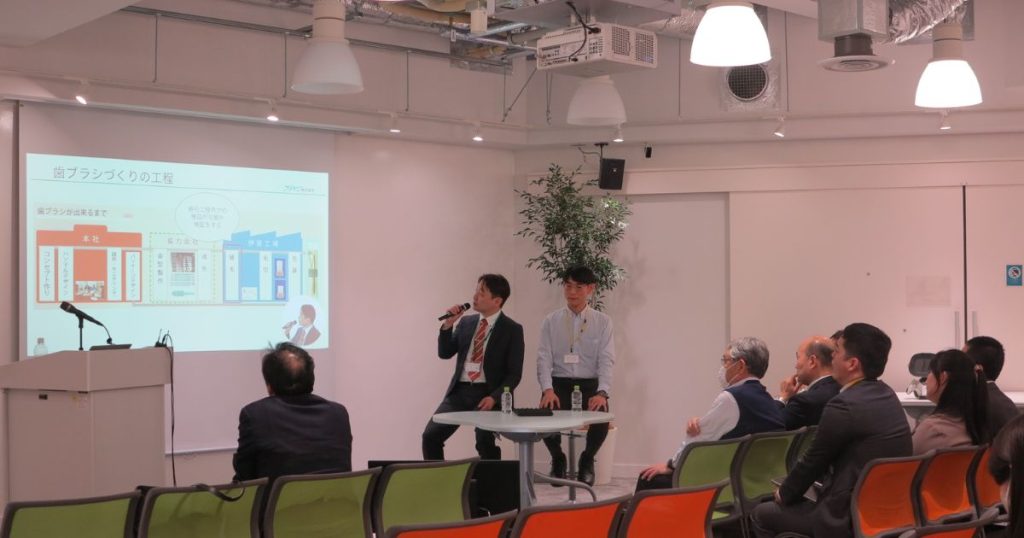
Director Kenichi Magarao
Fine is a company that develops and manufactures a wide variety of toothbrushes, from baby products to environmentally friendly products. Some of its main products include the POSY series of ring-shaped toothbrushes that do not poke babies in the throat even if they fall down, nursing cups for drinking without choking, and toothbrushes made of bamboo.
Bamboo toothbrushes are characterized by the use of a resin that returns to the soil. Applying this technology, the company also focuses on manufacturing locally produced and locally consumed products, such as golf pins made from black pine trees in Miyazaki Prefecture, toothbrushes made from cypress trees in Hinohara Village, Tokyo, and toothbrushes made from cacao in Myanmar.
The reason for our participation in this program was that soaring raw material prices were creating a variety of challenges. Since the market price of toothbrushes remains the same despite soaring raw material prices, there is an urgent need to streamline manufacturing costs and increase production while reducing the burden on factory staff.
Possible solutions include saving space on the production line to accommodate the manufacture of more varieties and increasing the inspection process to reduce defective products and make the production process more efficient.
Therefore, we solicited four themes: "We want to promote automation and operational efficiency in toothbrush factories," "We want to create and promote new oral care products," "We want to increase the probability of closing business negotiations by automating request estimates through data linkage," and "We want to convert factory inventory management into data and make real-time inventory control. We solicited proposals for the following four themes.
The selected startup from among those that applied was AItoAir Corporation, which is developing a no-code edge AI development platform. In the inspection process of toothbrush manufacturing, human eyes are used to inspect all products, which inevitably results in omissions. Therefore, we built an automated inspection system using AI to verify the accuracy of the inspection process.
This time, the AI system was built for 98 toothbrushes with more defective products, using a total of 240 images (66 good product data and 174 defective product data). As a result of image analysis, the system was found to be able to correctly inspect defective products with blurred printing and scratches, and was proven to be effective for Fine products.
On the other hand, several issues became clear. The most difficult part this time was to tell the AI the boundary between "this level is OK" and "this is a defective product. Once the actual operation starts, we will have to set appropriate parameters for each product type by ourselves, so we realize that training is necessary.
We also found that in order to improve the accuracy of image analysis, it is necessary to unify the conditions under which images are acquired (camera position, lighting, etc.), and that it is necessary to pre-set the target area for defect detection because some varieties may be good even if they are detected as defective.
We will continue to verify the inspection of the hair-planting process, and in the future we hope to increase productivity and strengthen our competitiveness by introducing an AI inspection system for all processes.
Cooperative startups
Company name: AitoAir Inc.
Representative: Jeong Doowon
Establishment: November 2021
Business Description:
Research, development and sales of Tinyboom, an edge AI development platform
Support and consulting for implementation of AI-related solutions
URL:https://aitoair.com/
editorial postscript
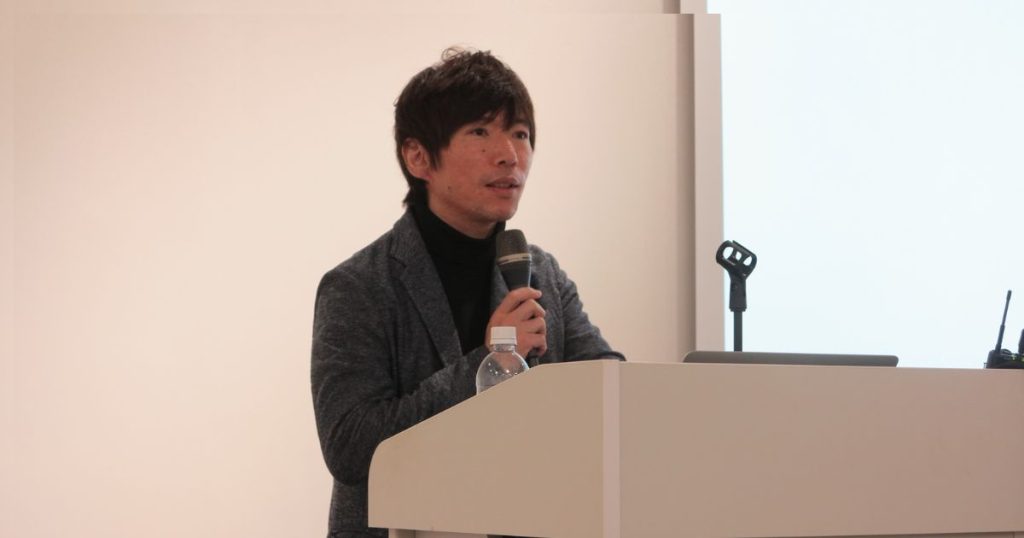
Creww Inc.
Representative Director and CEO Ten Ijichi
In this initiative, digital was used to increase productivity or reduce costs. As a result, not only did the operating companies accumulate knowledge about specific technologies, but they also accumulated knowledge about how to collaborate with companies using unknown digital technologies.
I would like them to use this knowledge to take on new challenges with people who have new technologies such as blockchain and AR/VR as well as AI, and I would like them to take on the challenge of "aggressive" collaboration to create new businesses and expand sales. I would also like them to take on the challenge of "aggressive" collaboration, such as creating new businesses and expanding sales.
Also, recently, many overseas startups from Korea, Taiwan, Singapore, and other countries have come to Japan to collaborate with Japanese companies, and we actually receive many inquiries, and the number of Japanese companies collaborating with overseas companies is also increasing. Japanese companies have wonderful technologies and traditions, and I am certain that new possibilities can be found by collaborating with startups not only in Japan but around the world.
Collaboration with overseas companies may seem like a hurdle, but it is not. For example, if we collaborate with various startups in Japan, and then create a CVC when investment becomes necessary, startups from all over the world will be eligible for investment from that point on. We hope that you will take on this challenge without letting the knowledge you have accumulated this time wither, and if there is anything we can do, we will do our best to support you.






 JA
 EN
