


At the "REGIONAL GROWTH ACCELERATOR CHALLENGE 2020" results presentation held on March 12, 2021, keynote speeches were given by Mr. Yoshinari Matsuda, head attorney at Urima Law Office, and Mr. Naoki Yokomuro, attorney at law. The keynote speeches were entitled "The Significance of Open Innovation for Regional Companies" and "Intellectual Property and Legal Matters in Open Innovation between Regional Companies and Startups.
Significance of regional companies' open innovation efforts
The environment surrounding local businesses continues to deteriorate. Consumers are decreasing due to the aging and shrinking population, and managerial and excellent human resources are flowing out to urban centers. Consumption styles have changed from mass consumption to ethical consumption, and recently, the new coronavirus has greatly changed the way people behave.
With such dramatic changes in the world, many managers may know that the current situation and common sense will not last, but they may not be able to find a way to break through.
Behind this is the fact that systems that were created because of the "success" of the period of rapid economic growth still persist. For example, personnel systems and management based on restrictions on layoffs and lifetime employment, and a joint guarantee system that gives priority to banks, are factors that make people hesitate to take on new challenges.
Under these circumstances,Metropolitan area firms, regional firms, and venture firms are polarizing in eachThe company's branding and marketing activities are not only to be promoted by the company but also by the industry. For example, metropolitan area firms establish a strong foundation by enhancing their brand within the industry,To be a "winner," you need to find the technology and needs that will disrupt the industry.The following is a list of the most common problems with the
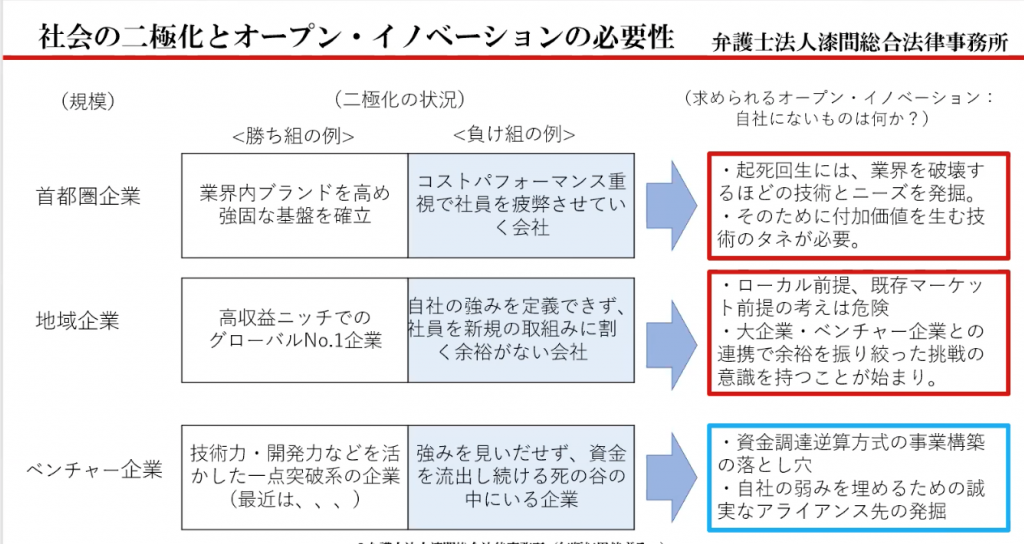
A regional company needs to become a highly profitable global niche company by collaborating with large companies and venture companies, rather than assuming existing markets, while venture companies are looking for funding and partners. In other words, each is looking for open innovation.
In implementing open innovation, it is important to know the strengths, weaknesses, and characteristics of each.

Large companies and venture companies have different decision-making speeds, organizations, personnel systems, management policies, development capabilities, governance, and so on. It is extremely important to understand each other's differences without taking the organization we belong to as the norm.

Local companies, on the other hand, believe that the proximity of management and those in charge fosters a relationship of trust, and that a sense of crisis that "we will not be able to stand still" sparks the promotion of open innovation, rather than collaboration between large companies and venture firms.
Sufficient resources for a single point of contact, due to local strengths and local influence, and easy to convince the company about personnel exceptions.I believe that regional companies are well-positioned for open innovation. Therefore, we believe that regional companies are well-positioned for open innovation.
Intellectual property and legal affairs in open innovation between local companies and start-ups
Open Innovation Challenges for Large Companies and Startups
On November 27, 2020, the Japan Fair Trade Commission reported on its "Survey on Business Practices of Startups. Summarized in the report are issues in contracts required for each phase of open innovation, such as non-disclosure agreements, PoC agreements, joint research and development, and licensing agreements.
For example, when signing a nondisclosure agreement, the issue arises as to the length of the contract and to what extent the company is obligated to maintain confidentiality after the contract ends. In the case of a short term contract, the startup sees it as a "short contract period that they are forced to sign," but there is a different logic for large companies.
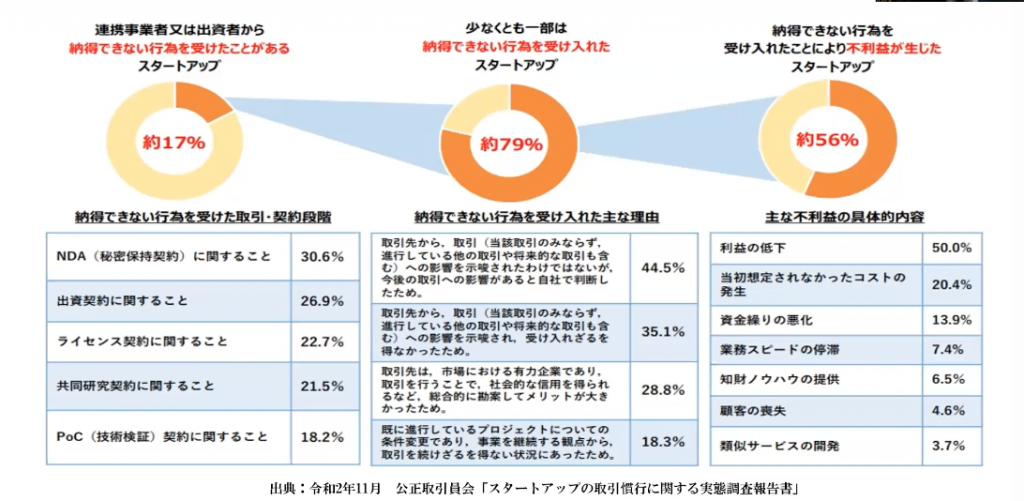
From the perspective of a large company, even if the startup's technology is initially attractive, it may overtake the startup's technology within a year or two. At such a time, if a long-term nondisclosure agreement is concluded, the startup's technology will be said to have been used, causing a glitch. These issues arise in each phase when companies with different capital strength team up.
What are the key points to keep in mind when collaborating with local companies and startups?
good point
The number of companies that have not accumulated know-how in the alliance and have little bargaining power.
Difficult to be in a development prime contractor/subcontractor relationship due to power relations
Antitrust issues are unlikely to arise.
Points to keep in mind
Both local companies and start-ups are groping each other, and it is difficult to conclude contracts at the necessary stage.
They do not always have a legal department, so it is difficult to access specialists, and they often proceed without laying down the necessary rules for each other.
It is important to sort out intellectual property and legal matters early on in order to take advantage of the good points and build a win-win relationship for both parties. In order to make the necessary agreements at the necessary stage, clarify "what you want to achieve in this transaction," and determine the rules after understanding the risks involved in the collaboration. That way, even if a discrepancy arises, it can be dealt with immediately.
In some cases, by partnering with a different industry, you may have to deal with laws that you have not had to deal with before, so the key is to involve the legal department from the beginning. IP should not be held simply for protection, but rather to ensure that IP belongs to and is used in a way that contributes to the business models of both parties.
Ownership and Use of Intellectual Property Rights
How much IP ownership should be insisted upon and to what extent is necessary requires detailed consideration. For example, if a business company monopolizes a startup's technological capabilities more than necessary, the world's economy will stagnate, and sharing all intellectual property rights can be legally troublesome.
For example, when a manufacturing start-up needs a license to manufacture or mass produce its product for a third party, it may need to obtain a license from a business company with which it shares intellectual property. The problem here is that it takes time for the operating company to settle internally. So, instead of sharing everything, it would be ideal to decide on a field and make it the sole ownership.
(1) Intellectual property rights are vested in the entity where the inventor who made the invention is enrolled.
The terms are intuitively fair, in line with the default rules of intellectual property law.
(2) All shared.
Although this may be a reasonable drop in the bucket, there is a disadvantage of co-ownership, which requires the consent of the co-owners to exercise their respective rights, and this point needs to be handled appropriately.
→In particular, when a manufacturing start-up needs to license its products to a third party in order to commission the third party to manufacture and mass produce its products, it will need to obtain a license from the operating company.
(iii) Method of determining the fields and attributing each of them solely.
Based on the disadvantages of sharing, for example, the following arrangement is made.
General-purpose inventions of new materials that can be applied to many applications belong to startups.
Inventions specific to this product belong solely to the operating company.
Examples of Collaborative Research and Development
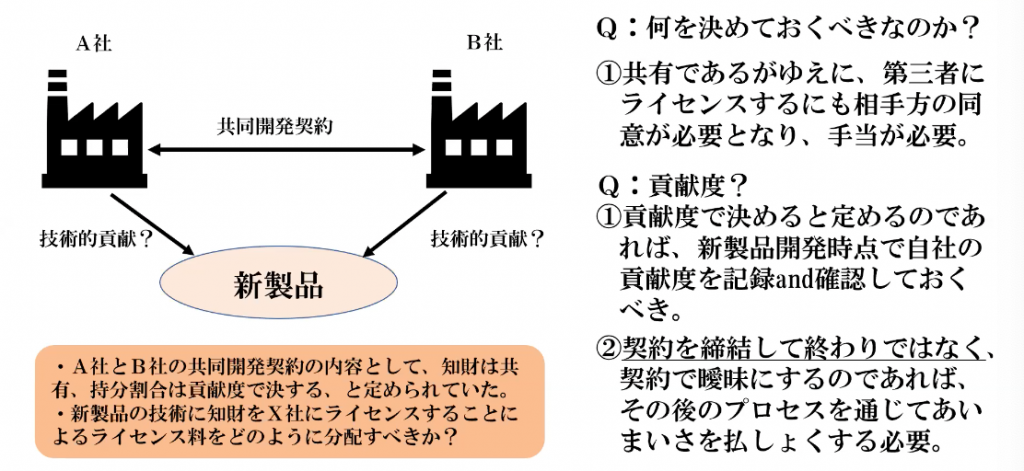
When joint development through open innovation is conducted, it is common for the contract to stipulate that "intellectual property rights are to be shared, and the ratio of ownership is to be determined by the degree of contribution. However, there is another pitfall here, and the actual degree of contribution becomes a problem later on.
Rather than signing the initial contract and leaving it at that, ambiguities need to be dispelled in the subsequent collaboration process.
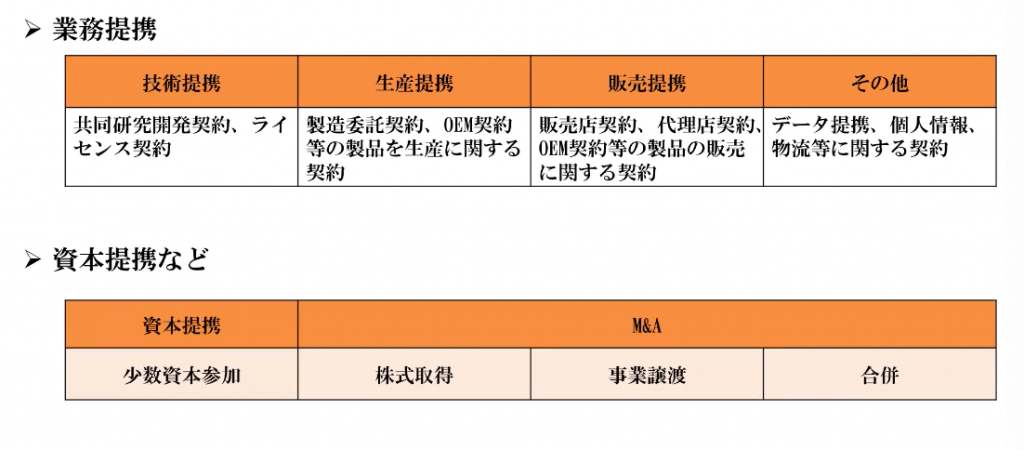
Also, as joint development proceeds, the product may change and a third party may be brought in. It is advisable to consider intellectual property at each stage of the various phases from R&D to commercialization. Then, open innovation is not limited to joint development agreements, but also includes various forms of partnerships such as production, sales, and data partnerships, so it is extremely important to tailor the agreement to the actual situation.
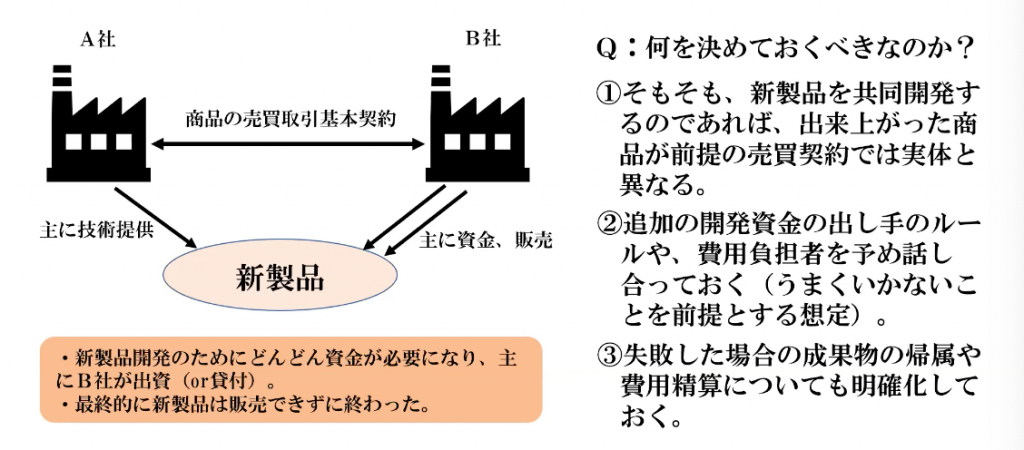
Turning to contracts, even in cases of collaboration where a startup provides the technology and a large company provides the funding, it is often the case that the contract is concluded using the usual model of a sales contract for a product. This is different from the actual situation because it is based on the assumption that a completed product is bought and sold. If you form an alliance to carry out business together, it would be better to clarify in the contract the attribution of deliverables and cost reimbursement, including the attribution of deliverables and cost reimbursement, in the event that the new product is ultimately not sold.
Points to note when concluding a contract
- budget negotiations
Depending on the content of the discussions, it is important to clarify the budget breakdown and other details, incorporate installment payments, etc., and foster a sense of mutual understanding. - Costs and intellectual property rights are separate.
- Keep track of progress
- It is important to set up a forum for reporting along the way. Prevent both parties from going in different directions from their intentions.
- Keep brief notes. It is important to be diligent after signing the contract.
Finally,When you try to build a new business model through open innovation, you will naturally face new challenges, such as whether the content of the collaboration itself complies with the law.Accordingly,Conflict with current permits, ,Protection regulations for personal information and data, ,Investigation of infringement of third-party intellectual property rights, ,Legal Issues Related to Going Onlineand others will arise. Although many legal and other issues related to blockchain and AI have already been discussed, there are still many unresolved issues and challenges that will be faced in the future.
Particularly,Combining new technology with an existing business is likely to violate the law, so it is important to understand the risks from the beginning and create rules accordinglyIt is. We urge you to avoid problems and risks in your collaboration by keeping the legal perspective in mind from the beginning.







 JA
 EN
