


The second part of this article summarizes the benefits of working in a start-up studio, the challenges, the status of the project, and future plans.
~Free valuable surplus food with advertising~ "Freeat".
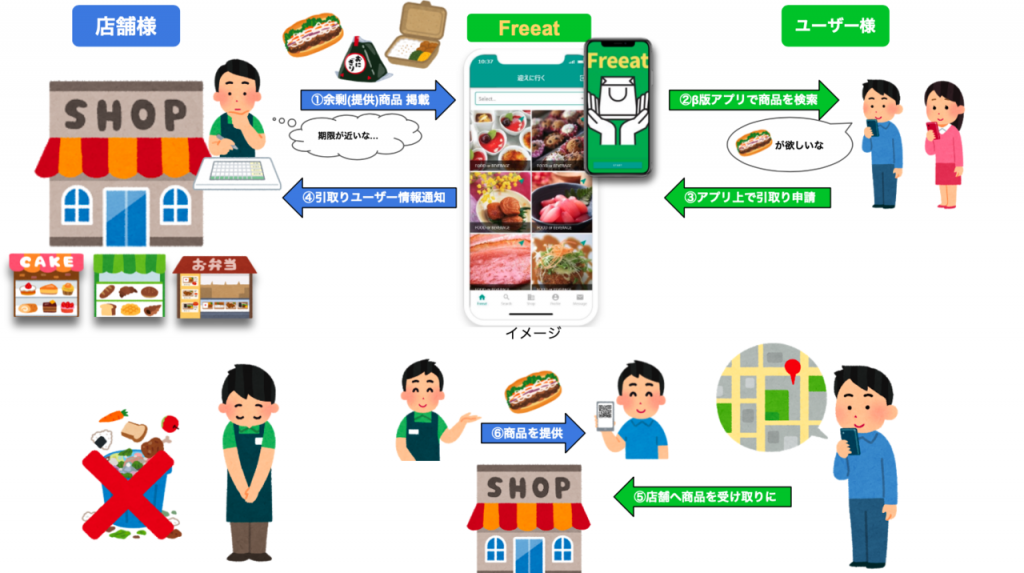
The service allows companies to post advertisements on the service, and consumers who view the advertisements can obtain free products that are about to expire from retail stores, etc., thereby contributing to the reduction of food loss.
This project will conduct a demonstration test for the creation of a 3-sided platform that also solves the issue of sales decrease and loss on the store side.
Founders talk about the benefits of start-up studios
What are some of the best things about joining Startup Studios?
Mr. KojimaI was very pleased that the program was designed for people who know nothing about new business development, such as what they need to do now and what will be the solution if they complete the program.
The program is divided into phases such as needs validation, MVP development, and demonstration testing, and each phase has well-defined KPIs, so I was able to commit myself to achieving the goals and learn a great deal.
In addition, the secretariat introduced us to people in each phase of the program, provided regular mentoring and pitching opportunities, and provided attentive facilitation, which was very reassuring.
What are start-up studio negative points?
Were there any negatives?
Mr. KojimaI think that each team member has a different busy season. Especially now that we do not meet in person at Corona and are working completely online, we are not able to share the busyness of the project, which makes it difficult for me to manage my personal tasks and scheduling progress.
Also, unlike in a company, there is no one like a boss that you can talk to directly when you hit a wall, so the ups and downs there were very intense (although of course the secretariat provides mentoring) (laughs).
Also, there are still quite a few time constraints. I work on it after my day job is done, and it is like weekend business development, so my schedule is very tight. It's like x2 busyness, and since I challenge myself to do things I don't understand, it's 2.5 times...3 times busier than my day job. I think that's where you have to be prepared to work on it.
Of course, we haven't reached our goal yet, but we started the project in April, and the past six months have flown by so fast that I don't think there is a moment when I can rest (laughs).
I was always on my toes, always on top of things, but on the other hand, being able to experience zero new business development in six months was an unparalleled experience, and what I learned there was unbelievably significant.
Can the start-up studio experience be applied to your core business?
Did your experience at the start-up studio help you in your day job or elsewhere?
Mr. KojimaIn my case: my main business is an IT company that is close to entertainment, but I was not in charge of new business, so I had never done anything like issue validation.
However, when promoting a new service, I feel that my experience at the startup studio is reflected in the way I think through the process from target selection to needs analysis, such as what kind of things the assumed target audience is thinking about, what kind of things they want now, and what kind of things would appeal to them. I feel that my experience at Startup Studio has been reflected in my work.
In my main job, I often have to think about how to materialize projects created or conceived by my superiors, so the experience of starting a project from scratch with my own ideas is completely different from the structure and approach to work.
I am curious about Freeat's track record, current status, and future plans?
Please tell us briefly about Freeat's achievements to date, its current status, and your plans for the future.The following is a list of the most common problems with the
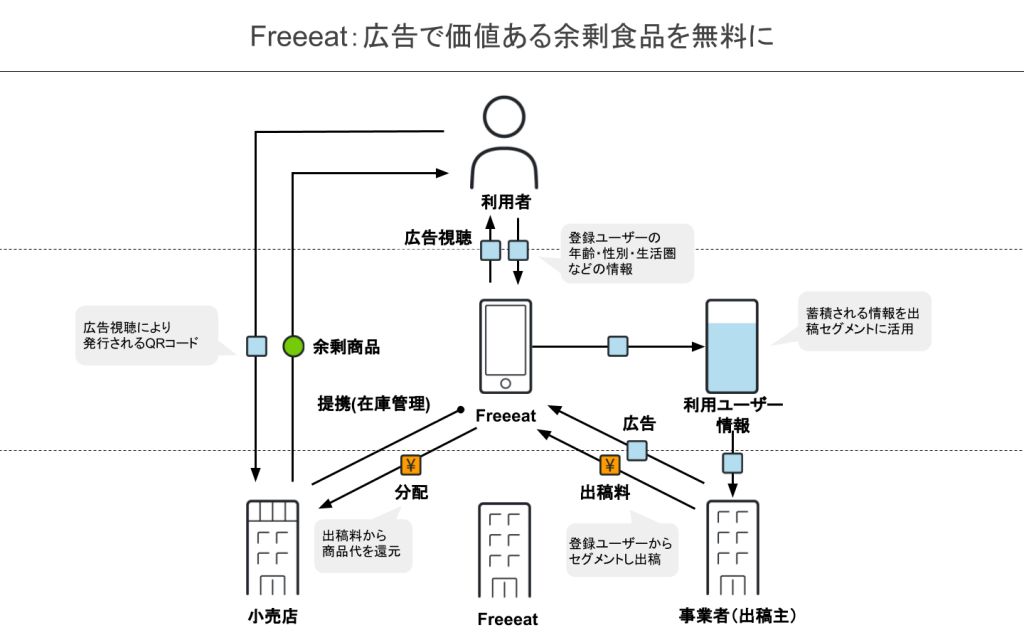
Mr. KojimaIn the case of Freeat, there are three stakeholders: first, the students (university students) who are the target and end users, second, the retailers and restaurants that generate surplus food, and finally, the advertising companies that pay for the ads. Finally, there are the companies that pay for the advertising.
Students were very conscious of the challenges they faced with money, such as the fact that their part-time jobs were reduced due to Corona and they were in a tight financial situation, but on the other hand, their expenses were very high.
Many restaurants are aware of the problems they face but do not know how to deal with them. We have heard that many shops are not sure how to respond to the challenges they are facing.
We designed the service while taking the voices of the three parties into shape, incorporated them into the product, and began development in the summer. As for the development engineers, we had a pitch at a NoCodeCamp event and had an engineer who used a NoCode service called "bubble" join us from the middle of the project.
The current situation is that we have been able to gather a certain amount of students and advertising companies, but we are having a very difficult time finding restaurants. Currently, we are really developing one or two restaurants at a time, little by little (but steadily).
In addition, the local governments of the 23 wards of Tokyo are working on food loss "Eat-all-you-can cooperation stores" (allowing customers to take home food, offering small portions, etc.), so we approach restaurants from various aspects, such as talking to them via the local governments. We are approaching restaurants from a variety of angles.
As soon as that is ready, we are in the phase of running a full-scale demonstration starting with one store. In any case, we are now increasing the number of actual transactions and running toward the sale.
As you are in the last spurt of your activities at Studio, what are your plans for the future?
Mr. KojimaI would be very happy to work with any company that would like to join us in this program. However, I personally want to be involved in any way I can in solving the social issue of food loss, so I would like to make this my main business eventually, not just sell the company here.
If you could start over again from scratch, what would you value most?
You are still in the middle of the project, but if you could start over again from scratch, what would you value most?
Mr. KojimaThe most important thing is the user's voice, right? To be honest, in the beginning, since the KPIs were program KPIs, it was like we were listening to user interviews without knowing the essential meaning of what we were doing them for.
However, as we incorporated the user interviews into the product, the underlying reasons and "Why did we do this? I feel that the conversations we had with users in the initial phases are now slowly having an effect on us like a body blow, as if we were saying, "Oh, I remember what that person said.... Therefore, I felt once again that we should be more careful in conducting user interviews.
As is often the case with user interview theory articles, I think it boils down to this: "Listen to what the user wants. When I first came up with the idea, I was overconfident that it would work! However, we are now incorporating feedback from users and team members and brushing it up as we go along, and many parts of it have changed from what we initially thought it would be. I realize now that if we don't listen to our users, we will end up with a service that no one will use, which is exactly what I mean when I say, "If you don't listen to your users, you will end up with a service that is self-interested and no one will use.

~Retailers and restaurants
We are currently accepting applications from retailers and restaurants who are willing to cooperate with us in the demonstration experiment! If you are a restaurant or retailer that is having trouble with food loss and would like to recover some of the sales, please contact us! If you are a restaurant or retailer that has a problem with food loss and would like to recover as much sales as possible, please contact us.





 JA
 EN
