


Outline of the Project
This project aims to develop technologies to produce various chemical products and feedstock from CO2 and H2. bioprocessing, which produces materials directly from CO2, is a new manufacturing technology with no commercial examples in the world, and is expected to be one of the options to realize a carbon neutral society. It is expected to be one of the options to realize a carbon-neutral society.
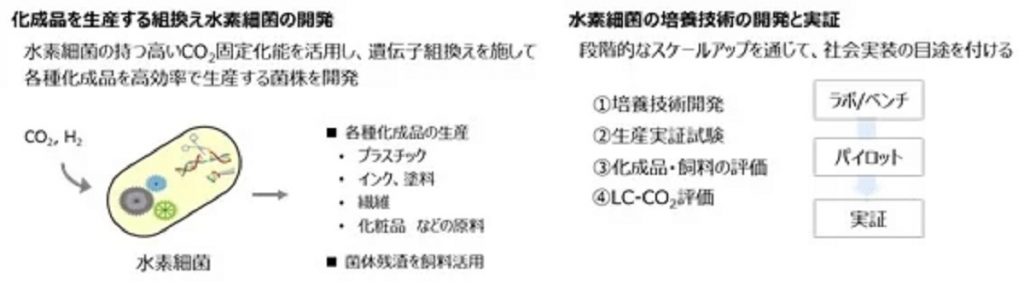
The hydrogen bacteria*1 to be developed are considered to be one of the fastest CO2 fixation microorganisms. By utilizing its high CO2 fixation ability and genetically modifying it, we will create a strain that can produce useful chemical products at high efficiency. The chemical products produced will be used as raw materials for plastics, inks, paints, fibers, cosmetics, and many other applications in our daily lives. Furthermore, the by-product residue from the chemical production process can be used as an alternative protein source for feed, which has been in increasing demand in recent years, thereby further increasing the decarbonization value of the business and contributing to solving the food problem.
In parallel with the development of the bacteria, we will conduct demonstration tests with stepwise scale-up to establish a safe and efficient gas cultivation method, as well as to properly measure the CO2 reduction effect and add environmental value to the product.
By bringing together the knowledge, technologies, and functions developed by the six businesses to date, we will realize the social implementation of next-generation bio-manufacturing technologies and promote structural transformation of the chemical and materials industries to meet the growing needs for decarbonization.
Project period
Contract period : FY2023 - FY2025
Total project period (planned): FY2023 - FY2030
total project cost
Approx. 6.8 billion yen
Role of each organization and implementation details
<Sojitz
As a general trading company with operations in various countries and regions around the world, Sojitz is strengthening its materials business in line with a low-carbon and recycling-oriented society by leveraging its broad business expertise.
In this project, in addition to overseeing the business as the managing company, the company will be responsible for marketing and demonstration testing of various products. In addition, the project will develop the infrastructure for hydrogen as a raw material, which is indispensable for social implementation, and build a supply chain and realize commercialization through the development of derivative products and high value-added products.
<Central Research Institute of Electric Power Industry
The Central Research Institute of Electric Power Industry (CRIEPI) has set the realization of a "sustainable and socially acceptable energy system" as its goal for 2050. One of the themes necessary to realize this goal is "establishment of resource recycling and carbon recycling" and is working to establish the technologies necessary to convert CO2 into resources.
This project aims to develop a culture technology that will serve as a foundation for the utilization of hydrogen bacteria, and to demonstrate a culture process up to a pilot scale that will enable safe and efficient gas utilization, with the aim of realizing an unprecedented CO2 resource conversion. We will also conduct a Life Cycle-CO2 evaluation of the material production in the process and estimate the CO2 reduction effect if the existing petrochemical production process is replaced.
<GEI>
GEI aims to be a platform company for biomanufacturing as a specialized biorefinery company to realize its mission of "Fostering Green Technology and Walking with the Earth".
In this project, we will be responsible for the development of bacteria that produce biochemicals that can be used as raw materials for bioplastics using hydrogen bacteria, the scale-up of the hydrogen bacteria culture facility to demonstration scale, and the operation of the demonstration test.
<DIC>
As a global chemical manufacturer, DIC positions sustainability as an important management strategy and aims to "build a business portfolio that contributes to the sustainable prosperity of society" and "contribute to the realization of sustainability in the global environment and society. DIC aims to "build a business portfolio that contributes to the sustainable prosperity of society" and "contribute to the realization of environmental and social sustainability.
In this project, we will be responsible for developing production processes and conducting demonstration tests for bio-chemicals using the bacteria developed by GEI, utilizing our strengths in diverse fundamental technologies and bio-material design technologies. Through the commercialization of sustainable bio-chemicals derived from hydrogen bacteria, we will contribute to the realization of a carbon neutral society.
<Toray
Toray considers sustainability to be the most important common issue for the world in the 21st century. Under our corporate philosophy of "contributing to society through the creation of new value," we will do our utmost to pursue the Paris Agreement, the SDGs, and other global goals.
In this project, Toray will utilize its biotechnology to develop hydrogen bacteria capable of producing monomers directly from CO2, as well as conduct a production process demonstration, with the aim of establishing a supply chain from CO2 to our products.
.
Since its founding, Daicel has been creating value that contributes to the world through manufacturing. We aim to contribute to the realization of a sustainable society by developing and advancing technologies to produce valuable products that provide happiness to people in a human- and earth-friendly manner.
In this project, we will develop technologies to produce cosmetic raw materials from CO2 and conduct production demonstrations. By replacing the conventional petroleum-derived chemical process with a CO2-derived bioprocess, we will contribute to a carbon-neutral society by providing products with a higher degree of purification.
1 Hydrogen bacteria: A type of autotrophic bacteria. 1 Hydrogenotrophic bacteria: A type of autotrophic bacteria. Compared to algae (cyanobacteria), autotrophic bacteria have 50-70 times higher carbon fixation capacity, making them a promising source of CO2 absorption. Hydrogen bacteria, which are among the most promising autotrophic bacteria, do not depend on light energy and can fix CO2 with the chemical energy of hydrogen, enabling high-speed, high-density cultivation and high potential for industrialization. Compared to the production of materials derived from fossil resources, it has been suggested that emissions could be significantly reduced not only by reducing CO2 emissions in the production process, but also by the double effect of absorbing CO2. (Excerpt from the Ministry of Economy, Trade and Industry document "Direction of R&D and Social Implementation of the Project "Promotion of Carbon Recycling Using CO2 as Direct Raw Material through Biomanufacturing Technology")
For more information on the Green Innovation Fund projects and the results of the selection process, please refer to the following
Promoting Carbon Recycling Using CO2 as a Direct Feedstock through Biomanufacturing Technology | NEDO Green Innovation Fund
https://green-innovation.nedo.go.jp/project/bio-manufacturing-technology/
Outline of each company
| name of company | Sojitz Corporation |
| Location | 1-1, Uchisaiwai-cho 2-chome, Chiyoda-ku, Tokyo |
| representative | Masayoshi Fujimoto |
| name of company | Central Research Institute of Electric Power Industry |
| Location | 6-1, Otemachi 1-chome, Chiyoda-ku, Tokyo |
| representative | Yoshiro Hiraiwa |
| name of company | Play Blue Inc. |
| Location | 5-6, Shinjuku 3-chome, Shinjuku-ku, Tokyo |
| representative | Tomohito Ihara |
| name of company | DIC Corporation |
| Location | 7-20, Nihonbashi 3-chome, Chuo-ku, Tokyo |
| representative | Kaoru Ino |
| name of company | Toray Industries, Inc. |
| Location | 1-1, Nihonbashi-Muromachi 2-chome, Chuo-ku, Tokyo |
| representative | Mitsuo Oya |
| name of company | Daicel Corporation |
| Establishment | Sep. 1919 |
| Location | 3-1 Ohfuka-cho, Kita-ku, Osaka-shi, Osaka |
| representative | Yoshimi Ogawa |
| uniform resouce locator | https://www.daicel.com/ |






 JA
 EN
