




Provides new criteria for assessing the aging status of individual Japanese
(President: Atsushi Shimizu), which was born out of Iwate Medical University and is pioneering the forefront of anti-aging and personalized healthcare, reported that a patent (Patent No. 7442221) was granted on March 4, 2024 for a method of calculating biological age and a method of evaluating the state of aging by Shimizu and other members of the Bioinformation Analysis Division of the Iwate Medical University Institute of Biomedical and Dental Sciences. (President: Atsushi Shimizu) reported that a patent (Patent No. 7442221) was granted on March 4, 2024.
This patent will revolutionize the calculation of biological age based on DNA methylation (epigenome), optimized for the Japanese, and is medically and academically certain, having been published in the international medical journal, The Lancet Healthy Longevity *1. This patent will lead to the development of social implementation of the measurement of epigenomic age.
The technology by Shimizu et al. for which the patent has been granted provides a method for accurately estimating an individual's biological age through detailed analysis of individual DNA methylation patterns. The patent includes technology that selects between 215 and 235 CpG sites and analyzes the methylation status of these sites to assess an individual's health status and aging progress. This technology has the potential to revolutionize future medicine and health care by improving our understanding of the biological age and aging process of the Japanese population.
Epichronos was established by Professor Atsushi Shimizu, a member of the Department of Bioinformatics at the Institute of Biomedical Research and Innovation, Iwate Medical University, with the aim of implementing the groundbreaking research results of the Tohoku Medical Megabank (TMM) Project in society as a venture company originating from Iwate Medical University. This patent is an important step in the fulfillment of that mission and provides a new method for calculating biological age based on DNA methylation patterns unique to Japanese people.
The DNA methylation age estimation method estimates the biological age of an individual by measuring the methylation status of DNA due to lifestyle and environmental exposure. Unlike estimation methods that have been developed mainly in Europe and the United States, we have developed an epigenomic age estimation method specifically for the Japanese, providing a new standard for assessing the aging status of individuals.
*1 Link:. https://www.thelancet.com/journals/lanhl/article/PIIS2666-7568(23)00002-8/fulltext
Epichronos Strengths
Among various methods of measuring epigenomic age, a method of calculating biological age optimized for the Japanese population was patented for the first time in the world.
The inventor of this patent is a core member of EpiCronos, and Shimizu, a leading bioinformatician with more than 10 years of experience in epigenomics research, will serve as its representative.
As a venture originating from a medical university, the company has established relationships with medical institutions and academia, allowing for a variety of collaborations. We are currently discussing with various companies and research institutions to collaborate for social implementation.
Summary of this patent
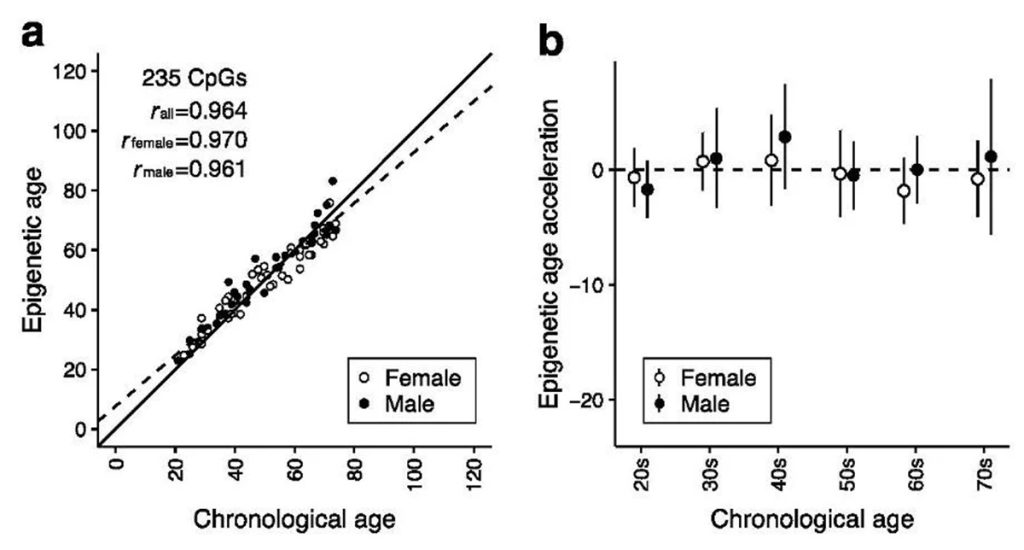
Developed a model for calculating biological age using DNA methylation information (Figure a)
While the biological age calculation models reported so far have been trained primarily on Western data, the Epichronos model can be said to be a model for the Japanese, trained on Japanese data.
While the existing model uses early Illumina microarray data, this model uses the Common DNA Methylation Variation (CDMV) method, which uses DNA sequence information and selects CpG sites with large inter-individual variation in Japanese, resulting in a completely As a result, we were able to develop a completely new and highly accurate model.
In addition, a formula was developed to evaluate the acceleration of epigenomic age (Figure b)
Japanese people are often seen as younger than their Western counterparts of the same age. Genetic background and lifestyle are assumed to be factors in this, as well as a longer life span, which may lead to a different (slower) progression of epigenomic age.
Therefore, epigenomic age based on existing methods may overestimate the youth of all Japanese, and it is necessary to take into account the aging rate of the population/ethnic group to which the individual belongs in order to evaluate individual aging.
Therefore, we examined the progression of epigenomic age with aging in a Japanese population, and based on this, we developed a formula to evaluate how much the epigenomic age of each individual is accelerating.
This patented technology also contributes to extending healthy life expectancy. Accurate measurement of biological age will enable individuals to identify the risks of aging they face at an early stage and to improve their lifestyle and take appropriate preventive measures. In this way, we aim to contribute to people's health and well-being by providing a new perspective on personal health management and disease prevention.
In close collaboration with Iwate Medical University, we plan to develop various products and services based on this patented technology and provide them widely to society. Specifically, we will contribute to the extension of healthy life expectancy and early detection and prevention of diseases by providing the technology to medical institutions and health checkup centers, as well as developing health management tools for individuals.
EpiCronos, Inc. will continue to research and develop new ways to contribute to people's health and well-being through the power of science and technology. We strongly hope that this patent will be an opportunity to accelerate innovation in the field of health and medicine in the spirit of co-creation with even more researchers and companies.
About Epichronos

Epichronos Corporation is a university-launched venture company established based on the advanced bioinformatics technology of Iwate Medical University. At the forefront of aging research and health science, we are developing innovative methods for calculating biological age and technologies for early detection of diseases using DNA methylation. Aiming to contribute to the extension of people's healthy life expectancy and the early detection and prevention of diseases, we provide products and services based on scientific evidence.
| name of company | Epichronos Corporation |
| Establishment | Aug. 2023 |
| Location | 15F Toranomon Hills Business Tower, 1-17-1 Toranomon, Minato-ku, Tokyo |
| representative | Atsushi Shimizu |
| uniform resouce locator | https://epixnos.com/ |
What is DNA methylation?
It refers to the addition of a methyl group (-CH3) to the C of the base A (adenine), C (cytosine), G (guanine), and T (thymine) that make up DNA, mainly at the site where C and G are aligned (CpG). It is involved in the determination of cell types during development and the regulation of gene expression, and is acquired through lifestyle and exposure to environmental chemicals.
What is DNA methylation age estimation method?
DNA methylation status continues to change throughout life due to lifestyle and environmental exposures. In addition, since changes in DNA methylation status may accumulate over time, DNA methylation status reflects changes in time after birth, i.e., age. Focusing on this feature, methods have been developed to estimate an individual's age (DNA methylation age or epigenomic age) from DNA methylation status.
Conventional DNA methylation age estimation methods have been developed based on data from Westerners, but Iwate Medical University has developed a DNA methylation age estimation method specifically for Japanese people based on DNA methylation information collected in the TMM Project Community Cohort Survey.
DNA methylation age correlates with calendar age, but may be higher or lower than calendar age for each individual. Deviation of DNA methylation age from calendar age has been shown to reflect aging and health status, and is beginning to be used as a health indicator.






 JA
 EN
