


Deregulation and drug price issues have brought the pharmaceutical industry into a period of change.
--What kind of transition did Taisho Pharmaceutical go through before introducing the Accelerator Program?

Founded in 1912, Taisho Pharmaceutical has developed and marketed ethical pharmaceuticals in the "Ethical Pharmaceuticals Business" and "Self-Medication Business" in Japan and overseas, developing and marketing medicines and health foods that can be purchased at pharmacies. Among these, Taisho boasts the largest market share in Japan for OTC drugs, which can be purchased at pharmacies and drugstores without a prescription.
The steadily growing industry began to change in the mid-1990s and early 2000s, when price competition began in the OTC drug market.
Until then, OTC drug prices had been set by manufacturers based on the resale system, or fixed prices, but around 1995, the resale system for energy drinks was abolished. Since then, the resale system has been abolished for other OTC drugs as well, allowing drugstores and other retailers to set prices freely, and price competition has begun.

Around the same time, nutritional drinks went from being pharmaceutical products purchased only at pharmacies to a new category of quasi-drugs that could also be purchased at convenience stores. This expanded the market quickly, but the inability to set retail prices caused unit prices to fall and sales to stagnate over the long term.
Against this backdrop, Taisho Pharmaceutical started its overseas business in earnest in the late 2000s in order to find its next avenue for growth overseas. Although Taisho had been selling its own products overseas, it created a new pillar of business by acquiring companies handling OTC drugs in Indonesia, Malaysia, Mexico, Vietnam, France, and other countries.
--Have there been any changes in the area of prescription drugs?
The structure surrounding "drug prices" for ethical drugs is undergoing a review in order to curb the increase in social security costs associated with the increase in longevity. In addition, the government is strongly promoting the use of "generics," which are less expensive than brand-name drugs, in order to reduce medical costs, creating a difficult environment for manufacturers developing new drugs as a whole.

Until now, drug prices did not fall rapidly, so stable profits were allocated to the development of new drugs. But now, when a generic drug is released, the amount of prescriptions drops all at once, and drug prices drop more rapidly than before, so the time margin given to develop the next new drug has become extremely short.
So it became necessary to review the business model not only for Taisho Pharmaceutical but for the industry as a whole.
What was missing was the behavioral habit and culture of trying new things.
--What has been done to change the business model?
There are several brands that are the main competitors, but no matter how hard you try, it is difficult to increase sales in the same sales channel. One day, there will not be an increase in the number of people buying Lipovitan D in large quantities at a certain local drugstore.
So we thought we had two choices: find a new sales channel for our existing brand, or create a new brand and leverage our existing sales channel. Of course, there are new businesses that develop new products with new sales channels, but first we decided to create new demand and sales by utilizing our own business assets.

We have therefore begun entering categories we had not previously entered and developing renewal products that make the most of our existing brands. Examples include the energy drink RAIZIN, the diet drink Kobala Support, and mail-order health foods and skincare products.
However, what came to light in the process of launching these new businesses was the issue that new businesses cannot be created without a top-down approach. We cannot continue in the same top-down manner for the foreseeable future, but voices were not raised from the bottom-up.
That is no wonder, since the employees who are currently active in the company have only experienced "promoting" existing businesses that are already well known.
Employees who have worked diligently, having been taught that work is about "improving operational efficiency" rather than creating some new value, do not have the behavioral habits and culture in place to take on new challenges.
So, of course, we are not in the habit of diving into new sales channels or networking with people outside the company to create new business.
Since it is difficult to change these employees' work styles and attitudes toward work overnight, we felt that we needed to create an environment where they are continuously exposed to new information and stimulated.
Transforming the culture of legacy companies with the enthusiasm and challenging spirit of a startup
--So that sense of challenge led you to this accelerator program?
That is correct. Even if we are not able to commercialize the project as a result, it will be very valuable to the company if our employees can learn about a world they did not know, foster a desire to challenge themselves, and encounter interesting things they want to do by networking with people from startups.

The raison d'être of a manufacturer is to make people feel the value of the products they produce, buy them, and like them. However, as the size of the company grows, it becomes commonplace for things to sell, and people lose interest in them.
But if we put ourselves in an environment where we can constantly receive feedback from society, we will understand the views of people outside the company on issues and the cutting-edge services available in the world, and we will start to think about how our business is valued by the public and how we can make it better. This will then give us the opportunity to shape what we should do and the future we should aim for.
So we are not necessarily looking for short-term returns in this accelerator program. Of course, we would be happy if we could commercialize the project, but we are hoping that employees will learn about social issues, ways of working, and speed that they would not know if they were closed inside, which will lead to a change in culture, from which they will be able to identify social issues that need to be solved.
Hiring people at the same cost as the accelerator program will not change anything.
--Since open innovation is co-creation with the outside world, there are collaborations with large companies and government agencies. Among these, why did you choose startups, which is Creww's specialty?
I believe that the advantages of working with a large company or established organization are quite different from the advantages of a startup. With large companies, we co-create with minimal risk while leveraging each other's assets, but if things don't work out, we will often stop there.

On the other hand, startups and growth-oriented companies change hands to achieve their goals and continue to take on challenges in order to succeed. Even if it is risky, they will take action first, and if they fail, they will make the most of it and keep on running.
This spirit of challenge is something Taisho Pharmaceutical lacks, which is why I wanted employees to be exposed to the enthusiasm and seriousness of the startup.
--What was the reaction of other board members when you started the accelerator program?
I told them my thoughts and ideas, and they shared them. He said that even if no business comes out of it, we can have a relationship with startups, and if we can understand services and advanced technologies that we don't know about, let's give it a try.
There was also the issue of cost, but even if we used the cost of the accelerator program to cover personnel costs and hired three or four people, we would never get the same value as working with a startup.
What kind of chemical reactions will emerge from a network of people who are our opposites? It could be the seed of an idea, a new business, or a culture change. In any case, nothing will come of it as it is now, so I can't help but look forward to this initiative. And one more thing. As a byproduct of working on the accelerator program, I would be happy if people get the message that Taisho is a company that is open and listens to what people outside the company have to say from the ground up, and if we can create a future where more people and companies think, "Let's give it a try and sell it.
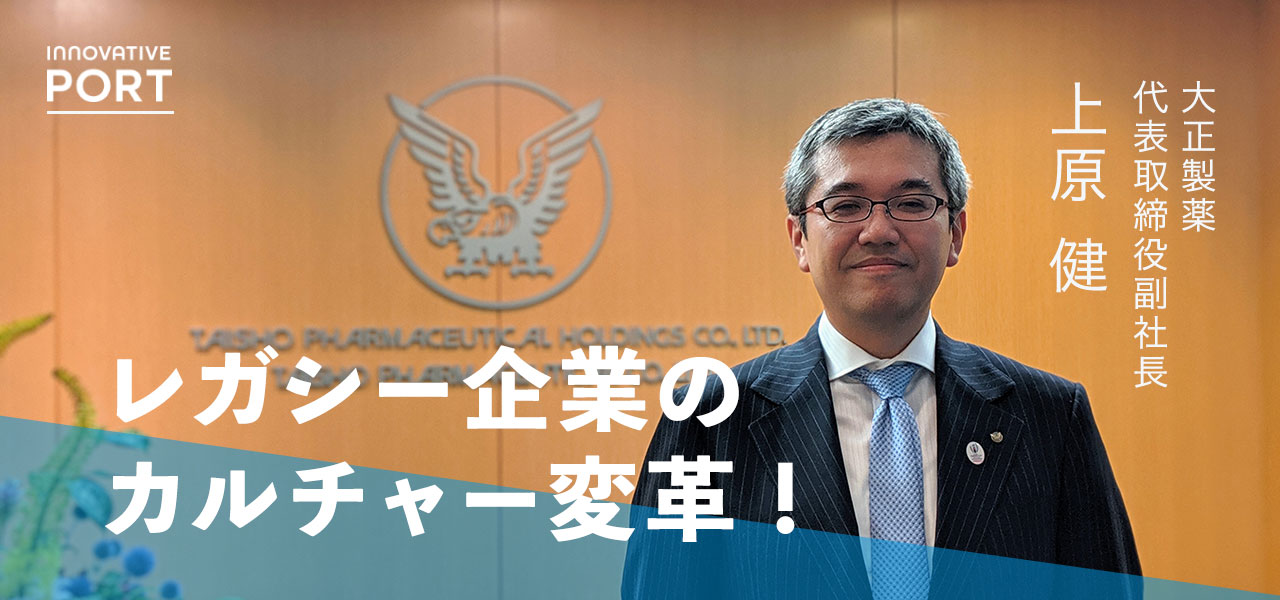
 Ken Uehara Executive Vice President and Representative Director, Taisho Pharmaceutical Co.
Born in Tokyo, 1977
B.A. in Economics, Keio University, 2000
B.A. (MBA), Tuck School of Business, 2006
2004 Joined Taisho Pharmaceutical Co.
2011 Managing Director, Taisho Pharmaceutical Holdings Co.
2012 Senior Managing Director, Taisho Pharmaceutical Co.
2013 Director, Taisho Pharmaceutical Holdings Co.
2014 Vice President and Representative Director, Taisho Pharmaceutical Co.
2017 Chairman of the Board, Biofermin Pharmaceuticals, Inc.





 JA
 EN
