



Why Toyo Ink changed its name to "artience," a fusion of art and science
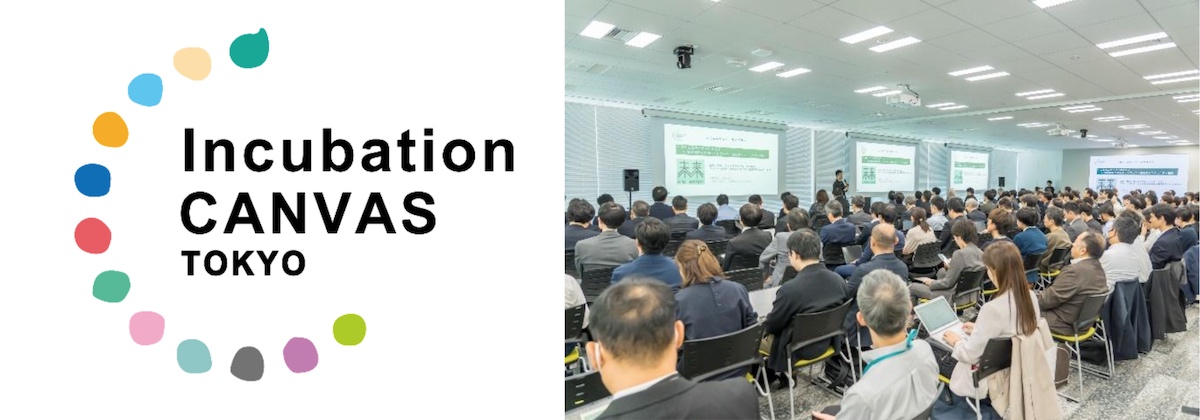
arience (formerly Toyo Ink SC Holdings Co., Ltd.), which operates Incubation CANVAS TOKYO, is a well-established company founded in 1896.
Despite the brand power and name value of "TOYO INK" built up over more than 100 years, the company changed its name because of a "sense of crisis. In a rapidly changing social environment, we wondered whether we could continue to provide products that are truly needed by the world and whether we could continue to exist in the future. To demonstrate both inside and outside the company that the entire group was prepared to undergo a corporate transformation based on this sense of crisis, the company changed its name to "artience," a fusion of art and science, in 2024.
Science is a concept that the company, a chemical manufacturer that develops and proposes fine chemical materials, has valued since its founding. While this concept will continue to be important in the future, another concept that will become important in this turbulent world is art. The company intends to solve social issues by providing "values that resonate with the senses," which are created by refining the value (art) that affects people's minds, such as surprise, excitement, and comfort, and the trust (science) based on functions and high quality backed by solid technologies.
This sense of crisis over the company's survival led the company to start a "Future Study Task Force" consisting of young and mid-career members. The idea that led to "Incubation CANVAS TOKYO" was born from the first term of the task force. The idea was that it was necessary to foster a corporate culture that not only protects existing businesses but also takes on new challenges.
Therefore, prior to the company name change, a specialized organization under the direct control of the president was established in 2023 to change the company's internal cultural climate and create a mindset of challenging new things, and "Incubation CANVAS TOKYO" was born in October 2025. The organization's mission is to create new innovations from chance encounters (serendipity) by combining the diversity of outside people in addition to the expertise within the company.
Creating a place where material material business companies and startups can meet
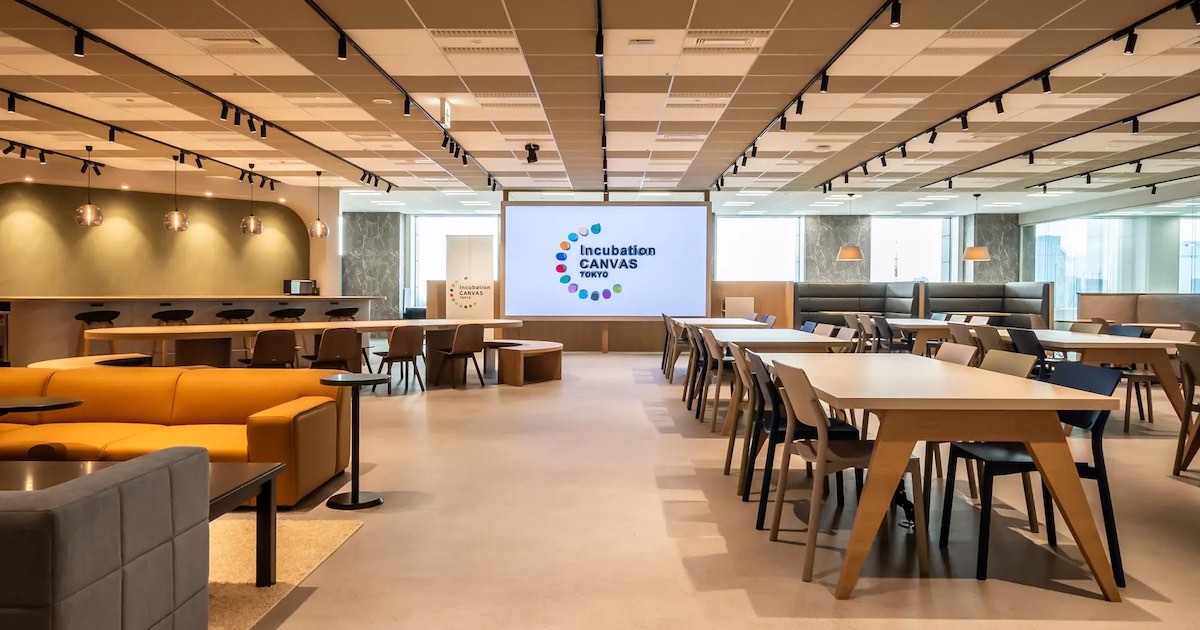
The keywords of Incubation CANVAS TOKYO, which aims to become a place where information and people from all over the world gather regarding cutting-edge material technologies, are "materials" and "global.
The reason why materials was chosen as the keyword is based on the company's original experience. There are many events where business companies and start-ups meet, but the probability that a materials/chemical company will meet a company with which it could immediately collaborate is very low.
Since other companies in the same industry were facing the same challenges, as well as startups, universities, and research institutes with seeds in materials and chemistry, they felt the need for a community specializing in materials and chemistry. Therefore, they created a place that would be known globally as the center of innovation specializing in materials.
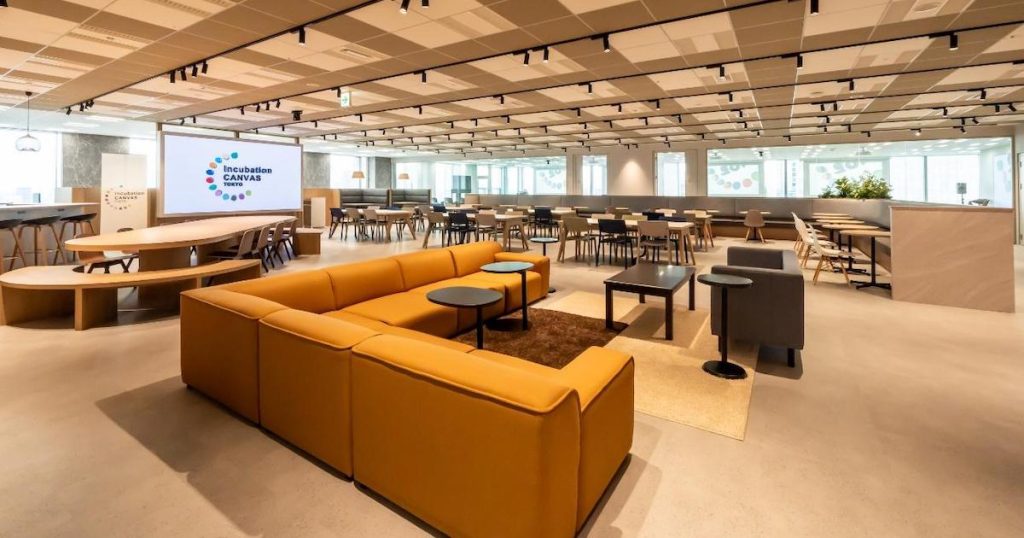
The facility is characterized by its membership system, which provides access to the world's most advanced technologies, information, and human networks centered on materials and chemistry (as well as the ability to disseminate information), and innovator training programs offered by partner companies. The company also has seminar rooms, co-working space, meeting rooms, and private web booths, as well as access to artience's company cafeteria for inexpensive meals.
Business partners can move in for as little as 40,000 yen per person per month, and start-ups can move in for 10,000 yen per person per month, making it a very inexpensive facility.
Significance of sensitivity values derived from art and science
Shu Yamaguchi, Representative of Leibniz Corporation
Art is usually used in the realm of art and painting, but I see art as a broad concept that can be very rational as a strategy, or very efficient as an engineering design, or beautiful from an ethical and moral standpoint.
About 10 years ago, around 2016, executive education programs to nurture business leaders started by art institutions became popular around the world, and I saw this as a small germ of social change. At the time, MBAs were the leading executive programs for nurturing business leaders, but the number of applicants to business schools continued to decline, and then a crossover occurred, with graduate programs in the fine arts gaining popularity.
And at the same time, the acquisition of design firms by large consulting firms occurred. Because the relative value of correct answers derived from logical thinking and problem-solving orientation was declining. More and more clients had knowledge of business administration, and research that could not be done without the use of a research firm's computers could now be done easily on a computer that everyone had at hand. In other words, clients no longer paid high prices for consultants, and the abilities and definitions of those who were considered excellent have changed dramatically.
This is where the liberal arts, which are rooted in the humanities and provide consulting services to clients, gained attention. Literature, philosophy, history, psychology, and those who have achieved advanced academic achievement in these areas have become more valuable.
Technology is not a weapon without the ability to propose and conceive.
The reason why liberal arts will be dominant in the digital world is because technology is no longer a differentiator. Technology becomes a weapon only when one has the ability to suggest things that everyone else in the world overlooks, and to think of new ideas that might be better. No matter how much technology a person has, it will not create value if he or she does not have the ability to come up with new ideas.
For example, the Segway, which was said to be the most revolutionary product since the invention of the personal computer, never made a profit and the company went bankrupt. It is true that the technology was wonderful, but there was no concept or proposal of how they wanted to change the world. On the other hand, Airbnb can be cited as a business that changed the world. Airbnb's proposal to utilize the world's vacant rooms, or underutilized social capital, has been accepted around the world and has now become the world's largest lodging business by market capitalization.
The founder of Airbnb is a designer, and when he went to a design conference, he was faced with the problem of not being able to get hotel reservations. He felt that it was not beautiful to build new hotels to solve this problem, and that if you look back in history, travelers usually stayed in vacant rooms in the places they went, and that it was strange that the experience of staying in a hotel had become the norm. Therefore, Airbnb was born as a proposal to restore the cultural diversity that travel inherently possesses.
I think this is what characterizes the companies that have started up in the 21st century and have established a large presence. People who have proposed something different, saying, "This is not beautiful," in response to what the world thought was "that's the way it should be, and it can't be helped," have created great value.
Science and art are the basis for business decisions and daily life.
What is required in management and what we base our decisions on in our daily lives are truth, goodness, and beauty. There are two positions to correctly judge these. One is to stand on science. If we think logically based on data and facts, we can correctly judge truth and falsehood. If we base our judgment on past precedents and laws, we will not misstep on right and wrong. If we research and understand the market and other companies' case studies, we can figure out what moves people's hearts and minds. -This is the idea of science.
The other is the concept of art. Judgments of truth and falsehood are based on intuition and sense, judgments of right and wrong are based on moral, ethical, and historical views, and judgments of beauty and ugliness are based on sensitivity and aesthetic sense. There are three reasons why we are now required to use this science and art approach at a higher level. The first is that we have changed from an era in which it was sufficient to give the correct answer to an era in which we need to raise issues. What is happening in the world today is the scarcity of problems.
In the past, there were many problems, for example, it was hard to do laundry outside in the cold, food could not be stored in the house, and so on. Refrigerators and washing machines were introduced to solve these problems and became widespread. In other words, the "dream life" of the 1950s has been 100% realized today.
On the other hand, consider the issues of our time: declining birthrate, aging population, and depopulation in rural areas. Many people think these are problems, but if you were asked to pay 1 million yen to solve the problems, would you pay it? Most of the people would buy washing machines and refrigerators, but they would not pay to solve the low birthrate and aging population. In other words, they are just talking about it as a problem, but it is not a problem.
Why Japan's cell phone industry disappeared and Apple became the world's largest company by market capitalization.
A classic example of trying to force a solution to a world problem that is no longer a problem is the Japanese cell phone industry. 2007, Japanese manufacturers were selling a series of similar cell phones. The reason why they were so similar was because they had done thorough market research and marketing. The more precisely these things are done, the more similar the final output will be.
What happened here was price competition and the introduction of new products at high speed. From the buyer's point of view, at first glance they all look the same, so they buy the newest model. So a state of high-speed market research, making and selling products was created. So people were slaves to marketing.
This is a state in which humans are so driven by rules, processes, and mechanisms that they have created for their own good that they are unable to ask the question, "What do I want to do?
In addition, another major problem was that Japanese cell phones were objectively made based on evidence from market surveys. We knew from that time that the age of touch panels was coming, but we did not make them because they were not well received in market surveys. As a result, the cell phone industry, which had been fighting with objectivity, disappeared.
On the other hand, Apple, which has been making things subjectively, invented the iPhone and became the world's largest company by market capitalization.
Who was more customer oriented, a Japanese company that listened to its customers and made what they wanted, or Apple, which made things based on subjectivity? The answer is Apple. Because they are customer oriented, they do not listen to their customers' voices. Taking care of customers is not the same as listening to customers.
For example, suppose an elderly couple visits a French restaurant that offers a dinner they will remember for the rest of their lives. When they are shown to their table and tell the staff that they do not know much about the French menu and would like to try the recommendations, the staff just keeps asking, "What would you like to eat? The elderly couple, who were at a loss, came to the conclusion that "when it comes to luxury food, steak is probably the way to go," and they ended up having steak. Would you say that this is taking good care of the customer?
The same thing was happening to cell phone operators. Customers did not understand technology, had no knowledge of design, and had no idea what the cell phone of the future would look like. They were making products for these customers by asking them incessantly, "What do you want? There is no customer orientation here. As the Japanese character for "aspiration" indicates, it is important whether or not the mind moves toward the target. Did our hearts really move during the process of incorporating the results of market research into technology and design?
True customer orientation means thinking about what kind of life you want your customers to lead, how you want to change their lives, and how you can provide the kind of joy and wonder that lies outside of their own thinking.
It is not about offering something good within the framework of what the customer knows, but about being able to make a proposal that will enhance the QOL of the person you are facing. I believe that this is where love and empathy are ultimately needed.
Value in the world depends on "meaningfulness" rather than convenience.
Value in the world is enhanced by usefulness and meaning. For example, a car commonly driven in Japan is useful but has little semantic value. On the other hand, German luxury cars are useful and meaningful. Furthermore, supercars and vintage cars are not useful, but they have semantic value. The highest priced of these are the useless ones. The price of useful but meaningless things is the lowest.
This is a phenomenon not seen in the 20th century. At that time, the most sophisticated and high-performance products in the market were sold at the highest prices, but now that structure has broken down.
To raise prices in this era, it is important to add semantic value to useful things. Moreover, while there is only one useful thing in the world, the things that have semantic value are diversified. For example, if you go to a convenience store, you will find that there are so many kinds of useless alcohol and cigarettes, but only one kind of stationery such as scissors and staplers. One kind of useful thing is enough.
Even in the innovation phase, we tend to talk about raising the level of usefulness and flying cars into the sky, but it is better to create innovation in the semantic realm, because you can raise the price of a vintage car than a flying car.
To innovate in the semantic realm, it is important to declare the ugly and the beautiful. For example, the British cosmetics brand Body Shop declared in 1976, "Our products are not different from those of other companies, but we never test on animals in the research and development of our cosmetics. This is where the semantic value was born.
Consumers who came in contact with the message would think, "Was the cosmetic product I have been using doing animal testing? Will animals continue to be harmed by continuing to buy this product?" and other companies that failed to take a meaningful position began to have a negative connotation.
So why is Apple's iPhone so strong worldwide? What makes it different from other smartphones? It is often said that its strength is its design, but there is not much difference in design between it and other smartphones. The technology is not that different either. Design and technology are major themes in the context of innovation, but this is not a winning condition. Design and technology are not a winning condition, because they are easily copied. But semantic value is not so easy to copy. Because it is created by the accumulation of information.
In 1984, Apple declared itself "the enemy" in a TV commercial announcing the launch of the Macintosh. Then, more than 10 years later, they made a TV commercial declaring "friend". Enemies and allies are two sides of the same coin. When people understand what a brand or company is affirming and what it is denying, and what kind of worldview it is aiming for, they feel a semantic relationship with it.
Sensitivity, aesthetics, and art are involved in raising issues and creating semantic value. I believe this will be an important perspective in the world to come.
[3-way dialogue session].
Serendipity-Driven Open Innovation
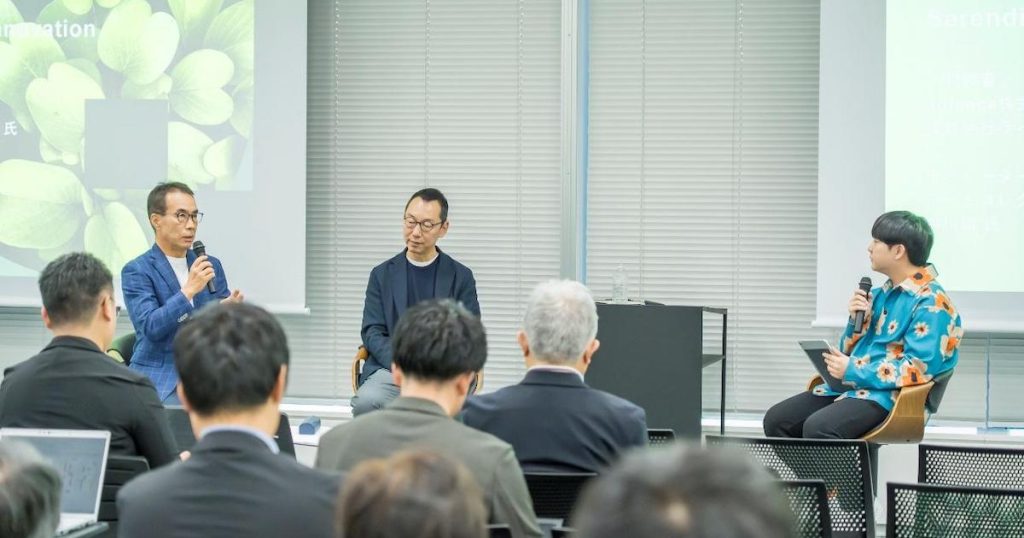
Speaker
President and Representative Director, arience, Inc. Satoru Takashima
Shu Yamaguchi, Representative of Leibniz Corporation
Moderator
Curator, Art Collective ALT Ei Nakagawa
middle course How do you think self-righteous value is created?
Yamaguchi I think it is important not to crush rather than nurture self-righteous values. For example, Elon Musk and Steve Jobs are people who "don't like what they don't like" and "can't stand what they can't stand. On the other hand, Japanese education teaches people to accept the status quo and give up, so I think it is more important not to crush rather than to nurture.
middle course Everyone has his or her own sense of right and wrong or pleasure and displeasure, and it is more difficult to cherish them.
Yamaguchi Yes, I think it is. I think it is important to have joy, anger, sorrow, and happiness moving through my work. For example, Recruit's Study Supplement business was started by a mother from a single-parent family who was moved by the story of how hard it was for her to have to tell her child to give up the junior high school entrance examination because she could not afford to send him to a cram school.
I felt sadness when I heard the mother's story and anger at the fact that the government was not acting and the educational gap was widening. When I started the business, I felt joy when I received many letters from people on remote islands and from economically challenged families, and I began to enjoy my work. I believe that an organization in which joy, anger, and sorrow move through work is strong.
middle course I believe that the science in the company name "artience" includes logical thinking and advanced technology of materials, but did you encounter any opposition, doubts, or anxiety in the field due to the change of the company name?
Takashima (city) During the last two years of traveling around the bases, one engineer said, "I don't believe in sensibility. I go by science," he declared. I received several other e-mails saying, "We take pride in our manufacturing. But I was glad to hear that.
Yamaguchi So, you are choosing to go with science because of your sensibility. You love science, and that is a sensibility. Your love of science is truly art, isn't it?
Impulses come from one's roots, and rather than rationally thinking that if I do this, I will be praised, or if I do that, I will gain, I believe that what drives a business is what compels it to move, what compels it to do, what compels it to watch, what compels it to endure. Just as Steve Jobs and Elon Musk are both driven by impulse, I think the restoration of impulse will be a major theme.
middle course Incubation CANVAS TOKYO" can be described as a place where serendipity is born. Please tell us about any original experiences where something new is born from chance encounters or connections with different people.
Takashima (city) When I was in my 30s, I spent a little less than eight years in the U.S. I was in charge of selling our company's products exported from Japan throughout the United States. At the time, all I could think about was work, whether I was asleep or awake. I took the technical manager from Japan around and told him about the situation in the US. Then innovation was born from that. I think the requirements for serendipity are thought, passion, and working together.
Yamaguchi If you want to create innovation, you have to go to bat anyway; 90% of projects are healthy enough to fail, so you need a place where you can strike out a lot anyway.
It is meaningful to face the same problem with people who think, feel, and have different knowledge than you do, and it does not help the organization if people with the same experience and knowledge face the same problem. In other words, chemical reactions occur in a diverse organization.
When we think of diversity in Japan, we tend to think of gender, but I believe that age plays a big role: the founders of GAFA were an average of 24 years old when they founded the company, and most of the innovators and initiators of interesting things in companies around the world are in their 20s. In Japanese companies, however, people in their 20s have little say, and their authority increases with age: in their 30s they are on their own, in their 40s they become front-line leaders, and in their 50s they become management leaders. This makes it difficult for innovation to occur.
Different ages feel differently, and if we consider the lack of experience and knowledge as one diversity in itself, it becomes a strength in itself. I believe that the key to creating groundbreaking businesses that will change Japanese society in the future lies in people in their 20s.
| name of company | arience corporation |
| establishment (of a business, etc.) | January 1896 |
| Establishment | January 15, 1907 |
| Head Office Location | Kyobashi Edogran, 2-2-1 Kyobashi, Chuo-ku, Tokyo 104-8377, Japan |
| representative | Satoru Takashima, President and Representative Director |
| Business Overview | Planning of group strategies as a holding company and supervision and management of each business company |
| uniform resouce locator | https://www.artiencegroup.com Incubation CANVAS TOKYO:https://incubation-canvas.tokyo/ |





 JA
 EN
