


Promoting recycling agriculture of local resources in Miyazaki and Kagoshima Prefectures by evaluating the effectiveness of "biochar.
In recent years, the growing awareness of the effects of climate change, biodiversity, and the SDGs, as well as other environmental concerns, has led to the need to make society as a whole more sustainable. Against this backdrop, the Ministry of Agriculture, Forestry and Fisheries (MAFF) is promoting the "Green Food System Strategy" in order to achieve both increased productivity and sustainability in the food, agriculture, forestry and fisheries industries through innovation, and has set forth measures to reduce environmental impacts, such as reducing greenhouse gas emissions associated with agriculture, forestry and fisheries, and the use of fossil fuel-based fertilizers.
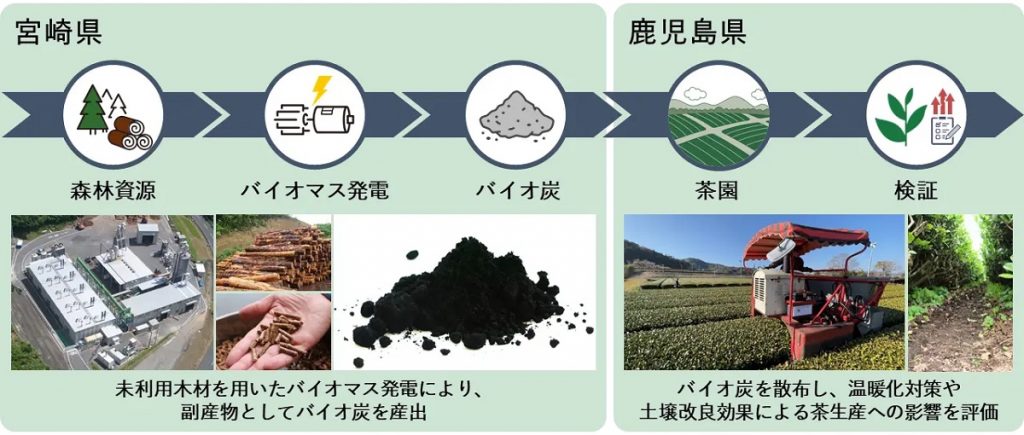
With the aim of establishing environmentally friendly agriculture through the recycling of local resources, ITO EN, Shin Energy, Kushima Woody Biomass, Horiguchien, and Kagoshima Horiguchi Tea Manufacturing have jointly started a test to evaluate the effect of biochar, a byproduct of biomass power generation using unused wood in Kushima City, Miyazaki Prefecture, on global warming by spraying it on a tea garden in a tea-growing project in Shibushi City, Kagoshima Prefecture, adjacent to Kushima. The five companies, Horiguchi En, Kagoshima Horiguchi Tea Co., Ltd. and Miyazaki Kushima City, Miyazaki Prefecture, began a trial in the spring of 2023 to evaluate the effect of biochar on global warming.

In this test, biochar, a charcoal containing persistent carbon produced by Kushima Woody Biomass at the Ohsei Kuroshio Power Plant in Kushima City, Miyazaki Prefecture, will be applied on a trial basis to a 50 ha tea garden in Shibushi City, where Horiguchi-en and Kagoshima Horiguchi Tea Co. are operating, to evaluate its impact. In addition to its anti-global warming effects, the project will also evaluate its effects on tea harvest and quality through soil improvement effects (water permeability, water retention, fertilizer retention, air permeability, etc.) in the tea gardens, and verify that it contributes to improved tea productivity.
The application of biochar to farmland is an initiative promoted by the Ministry of Agriculture, Forestry, and Fisheries in its "Green Food System Strategy," which promotes the development of farmland application technology as a method of global warming countermeasure. Through this initiative, the five companies involved aim to promote resource recycling in the region and realize sustainable tea farming through the establishment of environmentally friendly agriculture.
(*) Charcoal and bamboo charcoal fall under this category, and are specifically defined as "solids produced by heating biomass at temperatures above 350°C under controlled oxygen concentrations at noncombustible levels." (based on 2019 improved IPCC guidelines).
Features of Biochar
Biochar is carbonized by heating biological resources (biomass) such as wood and bamboo. The CO2 absorbed by the biomass resource is trapped in the charcoal, thus reducing its emission into the atmosphere. Biochar is also porous, so when mixed with compost or other materials in the soil, it can be used to promote the growth of crop roots and increase the amount of fertilizer absorbed, thereby improving the soil.
Summary of Global Warming Prevention Effectiveness Tests of Biochar Spraying in Tea Plantations
Kushima Woody Biomass produces biochar, charcoal containing persistent carbon, as a byproduct of biomass power generation using unused local wood (cedar, cypress, etc.) at the Oo Kuroshio Power Plant in Kushima City, Miyazaki Prefecture. The company is also working with Shin Energy, which operates and maintains the plant, to apply the biochar to farmland.
ITO EN will play a central role in this test by spreading the aforementioned biochar on a trial basis at Horiguchi-en, located near the power plant, and at a tea farm in Shibushi City, Kagoshima Prefecture, where Kagoshima Horiguchi Tea Manufacturing is developing a tea production area development project, to evaluate its effectiveness in combating global warming in the tea farm. We will also examine the effects of fertilizer application and secondary effects, aiming to realize sustainable tea farming through the establishment of a recycling system for local resources and environmentally friendly agriculture.
Outline of the five companies involved
ITO EN
As a leading tea company, we aim to spread technology that contributes to sustainable tea farming through our tea growing business.
Kushima Woody Biomass
The company operates the Oo Kuroshio Power Plant in Kushima City, Miyazaki Prefecture, which generates electricity by extracting combustible gas from unused wood, and produces biochar as a byproduct.
thin energy
The company is responsible for the construction and maintenance of the Oio Kuroshio Power Plant, located in Kobe City, Hyogo Prefecture, and for promoting the use of "biochar".
Horiguchi En and Kagoshima Horiguchi Tea Manufacturing Co.
Located in Shibushi City, Kagoshima Prefecture, ITO EN's contract farmers operate large-scale tea gardens. Both are located about 30 minutes by car from the Oo Kuroshio Power Plant.
【【Reference] ITO EN's efforts in technological development of tea farming
ITO EN has established a roadmap for the development and diffusion of technologies that contribute to sustainable tea farming.
Tea Production Area Development Project Website "Technological Development of Tea Farming".
URL:https://www.itoen.co.jp/tea_producing/tech/
| name of company | ITO EN Co. |
| Establishment | Aug. 1966 |
| Location | 3-47-10 Honcho, Shibuya-ku, Tokyo |
| representative | Daisuke Honjo |
| uniform resouce locator | https://www.itoen.co.jp/ |






 JA
 EN
