


Project Background and Objectives
In recent years, Japan's crop production environment has been severely affected by damage caused by pests and diseases, and this trend is increasing*1 due to global warming and other factors.
Under such circumstances, the "Integrated Crop Pest Control System R&D Platform" was established in August 2021 under the Ministry of Agriculture, Forestry and Fisheries' "Place for Accumulation and Utilization of Knowledge® Industry-Academia Collaboration Council," with NTT East serving as the representative.
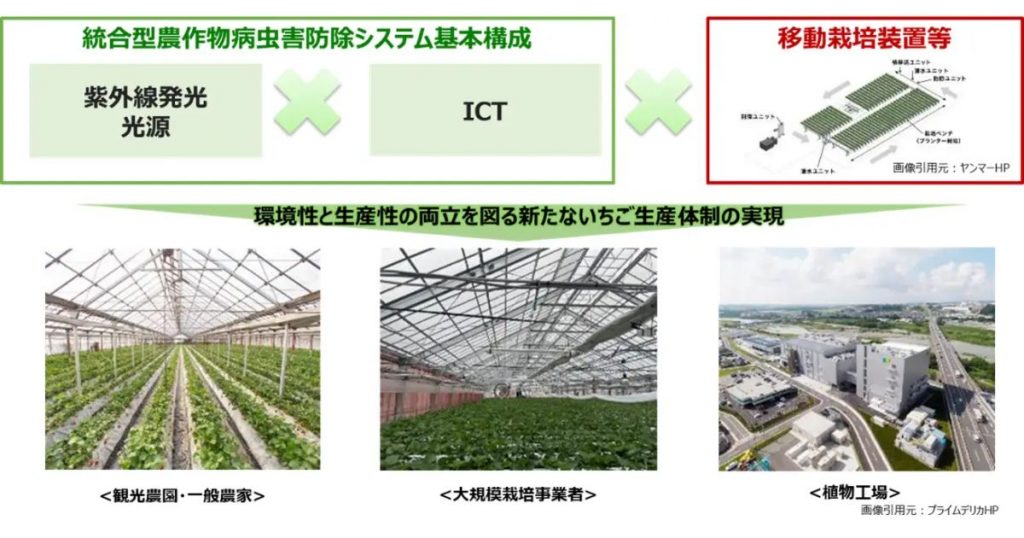
In this initiative, Prime Delica, Yanmar Green System, and other companies and academic institutions that possess leading-edge technologies in various fields have been working to establish and socially implement a new pest control technology that is expected to be realized by combining the "ultraviolet light source," a physical pest control technology that replaces conventional chemical pesticides, with ICT, automated cultivation equipment, and other advanced technologies. The project has been working toward the establishment and social implementation of disease and insect pest control technology.
1 The number of prefectures that feel that climate change, such as global warming, is causing changes in the occurrence and damage of pests and diseases in production sites is 46.
Reference: Ministry of Agriculture, Forestry and Fisheries, "Measures for Prevention, Eradication and Prevention of Spread of Pests and Diseases" (2021)
Demonstration Overview
The project will be conducted at a field owned by Prime Delicatessen in Kumamoto Prefecture, where next-generation production equipment, centered on the strawberry mobile cultivation equipment*2 provided by Yanmar Green System, has been introduced as a demonstration field.
In this demonstration, NTT East will acquire and analyze various test data using the "ultraviolet light emitting source," which is expected to be used as a physical pest control technology, at the field in question. Through this demonstration, NTT East aims to establish a next-generation smart pest control technology for the production and stable supply of safe and secure strawberries*3 with reduced use and risk of chemical pesticides, with the goal of reducing environmental impact and realizing sustainable agricultural production.
Specifically, we will irradiate the leaves of several varieties of strawberries with ultraviolet light emitting light sources in order to quantitatively understand and confirm the effectiveness of the control of the mite*4 , which is increasing its damage due to global warming.
In the future, Prime Delica, Yanmar Green System, NTT East, and NTT Agri-Technology will collaborate to establish a new technology that can control not only the mite, but also other pests such as thrips and other diseases in an integrated manner, and to automate strawberry production operations. We aim to implement smart pest control technology in plant factories and other facilities.
2 Strawberry upland cultivation system that achieves both "increase in number of plants" and "labor saving".
Strawberry planters, not workers, are moved to the bench, thus improving operating efficiency during maintenance and harvesting, and maximizing the area available for planting by reducing the number of aisles for work inside the greenhouse. In addition, irrigation (nutrient solution) and pest control can be automatically performed when the bench is moved horizontally.
Reference: Yanmar Green System Company HP:https://www.yanmar.com/jp/agri/products/facilities/other/cultivation_harvest/movecultivation_bench.html
3 Among the crops produced by horticulture in Japan, this crop was selected as a target because it is one of the most representative crops in Japan, ranking high in terms of value per unit shipment, value of shipments, and value of exports, as well as being the source of many brands in each prefectural region.
Reference: Ministry of Agriculture, Forestry and Fisheries: Production Value and Composition of Major Agricultural Products (2019)
Ministry of Agriculture, Forestry and Fisheries of Japan: 2019 Agricultural, Forestry, Fishery and Food Products Export Value (Preliminary Figures) by Commodity (2019)
4 Widely distributed throughout Japan, it causes damage not only to strawberries but also to many other crops. The mite parasitizes the undersides of strawberry leaves, causing numerous white spots and wounds, which in turn lead to leaf scorch and leaf flesh collapse, resulting in death, as well as the spread of these symptoms to other seedlings in the field, resulting in increased damage. Existing methods for controlling spider mites generally combine biological pesticides with chemical pesticide sprays by releasing natural enemies (cabbage mites), but the rapid turnover of spider mites from generation to generation causes them to develop resistance to chemicals, which increases the amount of chemical pesticides used and the resulting economic burden.
Ref: Gyobu, Tanaka, Kantou et al. Physical control of spider mite (UV method) using UVB lamps and light reflecting sheets (2017).
<Image of implementation
Roles and Aims of Participating Companies
<Prime delicatessen
(Role) Production of strawberries, quality (appearance and taste) evaluation, and market evaluation through processing and distribution
(Aim) Production and stable supply of safe and secure strawberries with reduced risk of pesticides
<Yanmar Green System Co.
(Role) Introduction and operation of next-generation production equipment, including strawberry mobile cultivation equipment
(Aim) Value-added improvement by incorporating pest control technology using UV light emitting light sources
<NTT East Japan
(Role) Overall project management as well as acquisition and analysis of empirical data
(Aim) Creation of a new business that supports operations related to crop pest control in the ICT field
<NTT Agri-Technology Corporation
(Role) Establishment of environment for smart pest control facilities
(Aim) Study for commercialization of smart pest control system
Project implementation period
November 2022 to early June 2023 (planned)
Exhibit at the Agribusiness Creation Fair
The "Integrated Crop Pest Control System R&D Platform" will exhibit the following
Fair: "Agribusiness Creation Fair 2022" (https://agribiz.maff.go.jp/)
Location: Tokyo Big Sight
Dates: Wednesday, October 26 - Friday, October 28, 2022
Exhibits: Research and demonstration results by platform members
Seminar Speaker
■Wednesday, October 26, 16:15-17:00 @ Main Stage
Innovation and social implementation that does not end with research and development! Innovation and Social Implementation Born from the Accumulation and Utilization of "Knowledge""
*Ministry of Agriculture, Forestry and Fisheries, Secretariat of Agriculture, Forestry and Fisheries Technology Council Seminar
■Friday, October 28, 13:00-13:15 @ Seminar Room A
Development and social implementation of an integrated crop disease and pest control system using optical technology






 JA
 EN
