


Businesses, government, NPOs, universities, etc... I want to improve the local community from all angles.
--Professor Hayata, please tell us about your background.
I have been involved in business development, organizational development, and corporate planning at NEC for about 25 years, including 6 years on secondment to the Cabinet Secretariat, where I worked on regional development and digital policy. As an individual, I have been involved in NPO activities aimed at regional revitalization, and as a researcher and faculty member at the University of Tokyo and Keio University, and have been preparing for the establishment of Eikei University while teaching at a business school in Hiroshima Prefecture since 2019.
The new businesses I have worked on at NEC are diverse, and I have focused on organizational development and human resource development while practicing in a wide range of layers, including sales and marketing, local government, healthcare, R&D, business development from a corporate planning perspective, and open innovation.
At the same time, we continue to support local cities to innovate by providing policy support mainly in Hiroshima Prefecture, including training for next-generation female leaders, serving as advisors for the promotion of mountainous areas and smart agriculture promotion projects, and working with banks on entrepreneurship development and with developers on urban planning. He is also involved in entrepreneurship development with banks and urban planning with developers.
Common to all of these activities is the need to work with diverse entities, including businesses, governments, and NPOs, to improve the local community. We believe that universities play an extremely important role in achieving this goal.
From "knowledge specialist" to "knowledge integration. Eikei University fosters human resources to solve social problems
--Please give us some background on the opening of Eikei University in Hiroshima City in 2021.
The economic environment surrounding Japan has changed dramatically over the past 30 years, resulting in a society where the future is uncertain and there are no answers as an extension of existing businesses. In such a society, Japan's economic growth has been sluggish, and Japanese companies have disappeared from the top of the global market capitalization rankings due to changes in the industrial structure.
The major issue behind this current situation is Japanese education, which has not changed since the Meiji period. The existing education system, which fosters individuals who are capable of organizational behavior, uniform and adaptable, diligent, and capable of processing information, was suitable for an industrialized society, but it cannot compete in today's society, where a paradigm shift has taken place in the economy and business.
What is needed in today's society is to develop leadership, thinking, and problem-solving skills to innovate. I was keenly aware of the problem of the need for a new place to learn for this purpose.
It was at this time that Hiroshima Prefecture adopted a policy to promote educational reforms for "human resource development" to create value. What was born from this policy was an MBA, a global integrated junior and senior high school, and Eikei University to nurture human resources who will create a new society in the future.
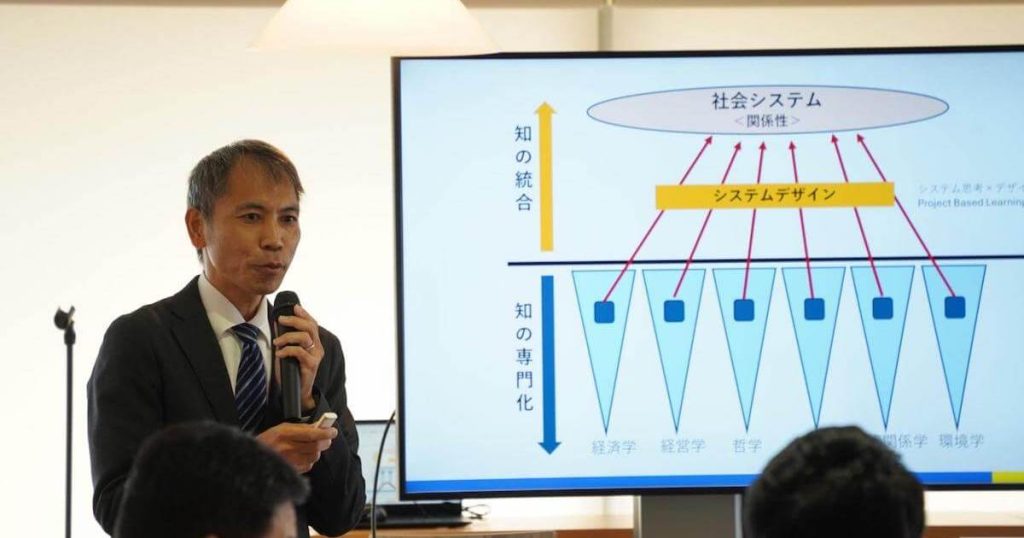
Social problems cannot be solved only with knowledge specialized in some field. It is necessary to use a variety of knowledge such as economics, business administration, environment, and agriculture to solve problems, but it has been difficult to teach such knowledge at conventional universities, which train "knowledge specialists.
The main feature of Eikei University is the "integration of knowledge" after learning all kinds of specialized knowledge. By integrating knowledge, we provide education to discover and solve actual social problems.
We want to circulate the growth of students and the growth of local companies and communities.

--I understand that Eikei University is promoting the "Co-Creation Project" through industry-academia collaboration. What is the purpose of this project?
First, let me explain the curriculum of Eikei University. During the four years, students study a wide range of liberal arts subjects, such as economics, humanities, social sciences, and environmental studies, in an active learning format. Then, students are required to use this knowledge in a project-based learning program in which they work with three companies or organizations to discover and solve corporate problems by the time they graduate.
The reason for this curriculum is that we want to create a spiral cycle of student growth, local company growth, and local community development by using the local environment to nurture students. In order to achieve this, we have formed partnerships with all the local governments in the prefecture, approximately 180 organizations, and local businesses, and are currently working to "develop people" and "develop things.
However, since this curriculum is an education-focused project, we thought it necessary to have a project that focuses on creating value for companies, so we launched the "Co-Creation Project.
The objective is for companies and universities to work together to create new value. The university is a partner in discovering and solving problems faced by companies and developing new businesses.
--How long will the project take?
This is a six-month project, with the first three months spent consulting and meeting with faculty and staff to help them visualize the essential issues, problems, or unspoken concerns of the company in order to create value for the company.
Once the theme has been established to some extent, students are invited to participate in the latter half of the three-month period to promote a project to solve the company's problems.
Example of co-creation: Contributing to solving the succession problem of rice farmers and the paper cup recycling problem
--What are some specific examples of "co-creation projects"?
We presented a co-creation project between Act Chushoku, a food wholesaler in Hiroshima, and Shingi, a plastic manufacturer, at the September 2025 debriefing session, and would like to share the details of that project with you. Act Chushoku worked with Eikei University on a "new business proposal to support the succession of rice farmers' parents and children, which was born from interviews with small and medium-sized rice farmers.
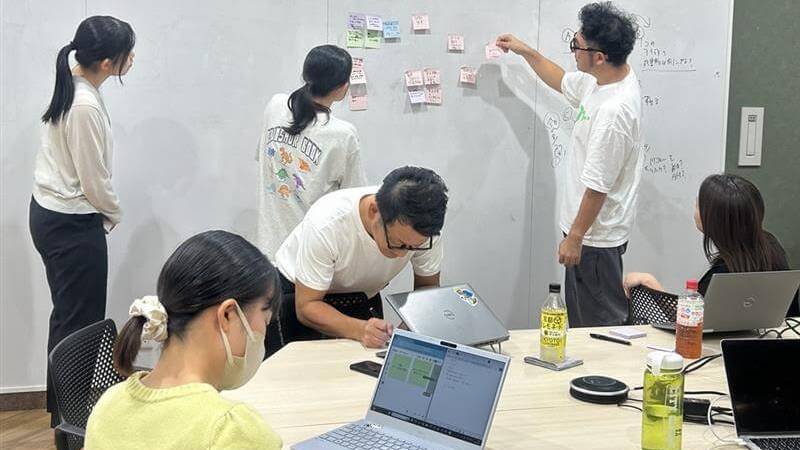
Currently in Japan, a string of rice farmers going out of business has developed into a major social problem. Students interviewed small- and medium-sized rice farmers to investigate their problems, identified the common issue of the difficulty of becoming a new rice farmer, and worked to develop a solution.
We identified structural problems to solve the issues, analyzed what interventions could be made to address them, and finally proposed four ideas. One of these ideas was created as a prototype.
We worked with plastics manufacturer Singi on the issue of paper cup recycling and demonstrated how to create a recycling model for paper cups, a major theme that has been slow to take off.
Specifically, we interviewed companies that provide paper cups about hurdles and problems in recycling, found where structural problems exist, and drafted a plan for a business model that would lead to a solution. Based on this, we are conducting proposal activities.
In any case, our activities are based on solid research and analysis of problem awareness with social impact, identifying issues, coming up with solution ideas that lead to solutions, and conducting a series of interviews and verifications.
Instill learning about new business, organizational development, and human resource development in the community.
--What kind of learning and chemical reactions have been created through co-creation between companies and students?
For the students, the realization that what they are learning in their daily classes can be used in the world and that what they learn at the university can lead to the creation of added value for the company, not only boosts their confidence, but also leads to the search for higher resolution solutions.
From the perspective of local companies, there are few people who have learned how to start new businesses within their own companies, so by co-creating with students who are learning design thinking and systems thinking as required courses, I think this provides an opportunity to learn the process and methods of creating new businesses through students.
In many cases, companies are developing their businesses as an extension of their past values and successes, so the essential questions from the students make us "psyched" and lead to the realization that we may have been bound by past successes.
Furthermore, students will not hesitate to jump in even in unfamiliar places, and they will lead the team by asking essential questions about the issues. In other words, I believe that companies can learn not only from new business development, but also from organizational development and human resource development.
On the other hand, what we, the management of the program, have noticed is that the need for highly specialized human resources increases as companies seek to further advance their projects after co-creating with the students.
Therefore, we have launched a new "Value Shift Program" in which professional human resources in the Tokyo metropolitan area who desire new growth opportunities are invited to participate as university researchers, who then enter local companies to create new value.
Essential issues are not seen in an office conference room, but on the ground in the community.
--I understand that you will also be involved in activities to connect companies in the Tokyo metropolitan area with the local community. Please tell us about the value and potential of co-creation between Eikei University and companies in the Tokyo metropolitan area.
Eikei University has the advantage of having members who are capable of project management and corporate consulting as faculty members. Furthermore, Eikei University has a track record of co-creation activities in collaboration with various stakeholders in the community, including financial institutions, government, media, sports organizations, and NPOs, as well as local businesses.
Although business plans can be created in offices in the Tokyo metropolitan area, the truly acute customer and social issues can be seen more clearly in the local community. Various problems such as welfare issues, education issues, environmental, agricultural, and tourism issues are happening on the local scene.
We would be happy to work with companies in the Tokyo metropolitan area that wish to utilize the regional field to create new business and human resource development, as business development that leads to essential problem solving and the human resource development necessary for such development can only be realized in the field.
I believe that the only way for companies to create new value in a rapidly changing society is to solve universal social issues. That is why there must be value in a field that allows us to discover problems together with the local community and to try to implement solutions in society. By adding the "community" field to our usual corporate activities, we would like to link it to the growth of the company, society, the community, and Japan.
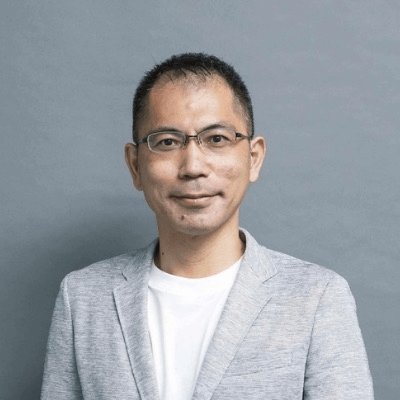 Yoshinobu Hayata Director, Center for Industry-Academia-Government Collaboration and Research Promotion, Eikei University / Professor, Faculty of System Design / Professor, Graduate School of Business Administration (HBMS), Hiroshima Prefectural University
At NEC, he has been engaged in business transformation and new business creation for 25 years. Responsible for business development, organizational development, and industry-academia collaboration in sales, marketing, and corporate planning divisions. He has served in various positions, including head of a division. During that time, he was twice seconded to the government (Cabinet Secretariat), where he was in charge of regional revitalization policy and ICT policy. In 2019, he will become a full-time faculty member at a university. In addition to working on education for working adults at a business school (MBA), he is leading the creation of a public university as a new educational model. His goal is to realize an innovation platform that is centered on social issues, with the university at its core. D. in System Design and Management.





 JA
 EN
