


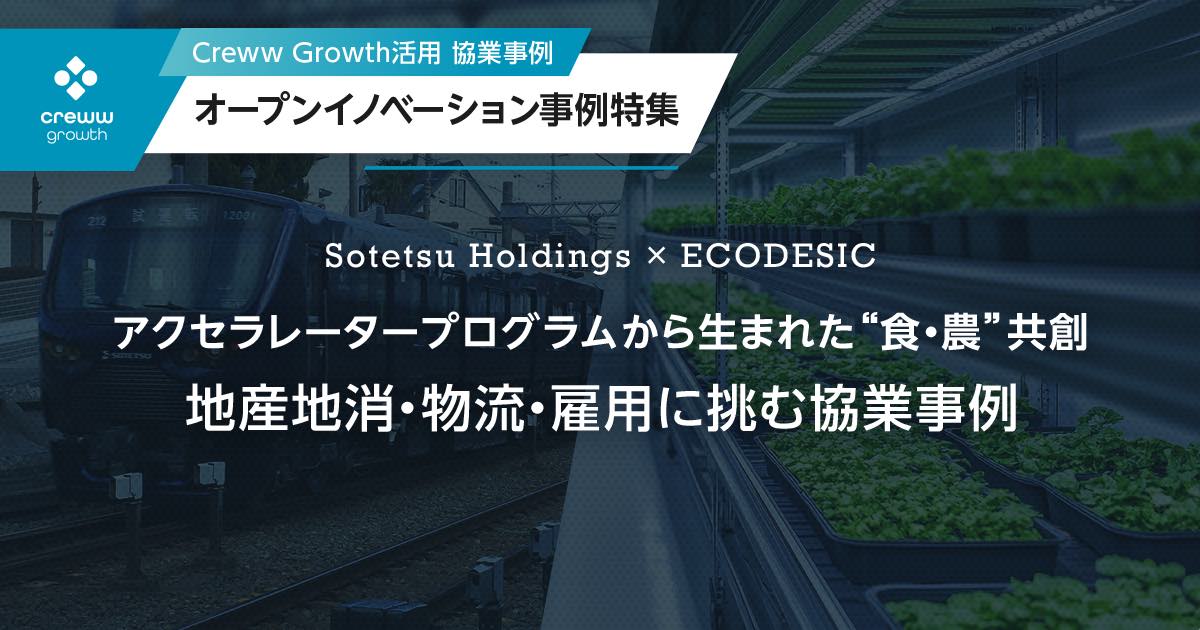
What is the "urban plant factory" created by the co-creation of Sotetsu and Ecodesic?

Medium- to long-term collaboration that began with the Accelerator Program
--Please give us an overview of the "Demonstration Project for an Urban Plant Factory for Local Production for Local Consumption," which was started in collaboration with Ecodesic.
Suzuki The collaboration with Ecodesic began outside of the program, as the company was a finalist in the Sotetsu Accelerator Program in 2022, but found it difficult to verify the program within the program period.
What is the business plan that you have drafted?Utilize Sotetsu Group's idle facilities and landand then the Ecodesic Inc.Producing leaf lettuce, basil, and other vegetables in a small plant factory and selling them at Sotetsu Rozen supermarkets located along the Sotetsu Line.The company is to The transportation of vegetables over short distances by utilizing our railroads,It also solves the problem of labor shortages in logistics, reduces transportation costs, reduces CO2 emissions, and improves the freshness of vegetables.The following is a list of the most common problems with the
tall tree Ecodesic's strength is its ability to reduce the number of days it takes to grow vegetables by promoting growth two to three times faster than normal plant factory vegetables.high speed stable cultivation" and a large variety and small quantity of ".Simultaneous Cultivation Technologyis that there is a "there" there. There.By combining the Sotetsu Group's idle assets, railroads, supermarkets, and other assets, we are trying to create various synergies, such as increasing the attractiveness of areas along our rail lines and solving social issues by using Sotetsu's unique brand of vegetables.The following is a list of the most common problems with the

--why did you decide that you wanted to collaborate even if you had to spend time outside of the program?
Suzuki We highly evaluated this project as a business plan that would contribute to the theme of "food and agriculture" that would lead to the resolution of social issues. In addition, we made the decision to collaborate outside of the program because commercialization of the project would require cooperation with multiple business companies within the Sotetsu Group.
We spent about a year developing a cooperative scheme, considering which assets would come alive for the Sotetsu Group in the plant factory business, what needs exist in the areas along the railway line, and what should be done to create maximum synergy with Ecodesic.
--What motivated Ecodesic to apply to the Sotetsu Accelerator Program?
Koto. In general, plant factories are recognized as an important technology for the future cultivation of green vegetables due to various social problems such as abnormal weather and aging farmers, but existing large-scale plant factories located in suburban areas are struggling. This is because the main costs of plant factories, such as electricity, transportation, and labor, have skyrocketed, making overall cultivation costs high and making it difficult to secure customers.
So there,We have developed cultivation methods that thoroughly reduce costs such as electricity and depreciation.We did, but that alone would not solve the problems of securing customers and places to sell our vegetables, nor would it solve the soaring transportation costs. As a way to solve all of these problems, we had been seeking collaboration with a private railway company with transportation infrastructure, affiliated supermarkets, and real estate before applying to AXELA.
Since railroads have free time outside of the morning and evening rush hours, if vegetables can be transported to affiliated supermarkets near stations during these times, no new CO2 emissions will be generated during transportation. Furthermore, if a plant factory could be built in an idle facility near a station owned by a private railway company, transportation costs would be almost nonexistent.
After brushing up these hypotheses and applying to the Sotetsu Accelerator Program, the Sotetsu Group, which is proactive in creating innovation, decided to collaborate with us beyond the framework of the Accelerator Program to commercialize the plant factory, and a medium- to long-term collaboration was decided.

Potential for regional innovation brought about by plant factories

Overcoming the "barrier" of constraints to a new business with high expectations
--Did you encounter any obstacles in the process of commercialization?
tall tree Legal issues have become a barrier. There is an image that plant factories can be easily created by utilizing idle land and idle facilities owned by our company, but there are restrictions on the use of such land and facilities. So we had to research the optimal conditions that avoided the restrictions and had numerous conversations with the government. It was not a simple process.
--So it was not a collaboration that could be done between two companies.
Suzuki Yes, we did. After the planning was done on the desk, we explored the feasibility of the project in concrete terms and came up with a number of issues. We are currently overcoming them and building a factory production line, and once the factory is completed, we will move on to the test sales phase. Then, I believe many challenges await us there as well.
--What are the group's expectations for the plant factory?
Suzuki I believe that there are high expectations from the operating companies with which we collaborate. In rail transportation, we have not been able to take on the challenge of "freight consolidation," in which people and freight are transported at the same time in the same vehicle and by the same means of transportation,Looking forward to the challenge of working to improve logistics and transportation efficiency to solve regional issues and reduce costs.The company has been
Sotetsu Rozen, which sells the vegetables it grows, has high expectations for its ability to provide a stable supply of value-added vegetables in a fiercely competitive retail environment, as well as for its ability to offer "vegetables that can be eaten as is without washing," which has long been in demand. In the competitive environment of the retail industry, there are growing expectations for the ability to provide a stable supply of value-added vegetables and to offer "vegetables that can be eaten without washing.
-- Were there any difficulties in collaborating with Sotetsu Holdings, a major company?
Koto. There was nothing in particular that we found difficult. Rather, the staff in charge at Sotetsu Holdings was extremely enthusiastic and solved each of the issues that needed to be cleared in order to make this project a reality.
I remember that the original accelerator program was designed to promote collaboration with specific business companies within the Sotetsu Group. However, in order to realize the plant factory business, it will be necessary to collaborate with various business companies in the Sotetsu Group, including the real estate division for location, the railroad division for transportation, affiliated supermarkets for vegetable sales, and possibly affiliated hotels, restaurants, and bus companies.
Therefore, rather than collaborating with a specific business company, Sotetsu Holdings has decided to organize collaboration with multiple business companies and with the government.Impressed by their enthusiasm to work with us to establish new businesses that contribute to society, even at the cost of time and moneyThe first time I saw a start-up company, I was impressed by its high level of enthusiasm. This high level of enthusiasm may be the secret to success in collaboration between large companies and start-ups.
What I also realized through this collaboration is that the Sotetsu Group is seriously thinking about the areas and residents along the rail line. Not only will the plant factory provide better foodstuffs to the residents along the rail line, but they also envision that farmers in the suburbs will operate plant factories in the future. I am very happy that we were able to collaborate with the Sotetsu Group, which is thinking about the future of the region, and the plant factory, a futuristic form of agriculture.
Contributing to solving social issues through "food and agriculture" projects

-- What are your future plans and expectations for the project?
tall tree By making this initiative a success, we would like to expand our business by increasing the number of vegetable factories to a second and third plant, and contribute to solving a wide range of social issues.
Suzuki The plant factory business initiative will not only lead to the construction of logistics infrastructure related to "food and agriculture" and the promotion of local production for local consumption, but will also help to alleviate labor shortages in the logistics field and reduce environmental impact through mixed freight and passenger shipments.
In addition, since plant factories often require minor work, they should also be a source of employment for the elderly, people with disabilities, and others. As Takagi says, we would be happy if we can contribute to solving regional and social issues by growing our business.
The Sotetsu Group has a variety of assets, including facilities, land, transportation infrastructure, and retail, including idle assets.We would like to continue to actively work with startups that want to create new value by utilizing these technologies.We are also naturally considering medium- to long-term initiatives such as this one.
The reason why we were able to realize a mid- to long-term collaboration with Ecodesic this time is because Ecodesic, like our company, has always maintained a stance of wanting to collaborate with us based on social and regional issues from the very beginning to the present. We welcome startups that share the same passion, even if they cannot produce results in a short period of time, and we would like to continue to collaborate with various companies in the future.

--What is the future outlook for Ecodesic?
Koto. There are currently 50 Sotetsu Rozen stores, and if we wanted to provide vegetables to all of them, this plant factory alone would not be enough. Therefore, we will first build several plant factories along the Sotetsu line to provide vegetables to Sotetsu Rozen users, and eventually expand the plant factories to other supermarkets and restaurants as we increase the number of places we can provide vegetables.
At the same time, we are trying to build a different model in Chiba Prefecture from the Sotetsu Group, which, if realized, will make it easier to promote plant factories in urban areas throughout Japan. By presenting the "Yokohama model" of the Sotetsu Group and the "Chiba model" to be started in Chiba Prefecture like a showroom,Franchising of plant factoriesI hope to be able to realize the
| name of company | Sotetsu Holdings, Inc. |
| Establishment | December 18, 1917. |
| Location | Headquarters: 2-9-14 Kitasaiwai, Nishi-ku, Yokohama 220-0004, Japan |
| representative | Hideyuki Takizawa, President and Representative Director |
| Business Overview | Group Management Business |
| uniform resouce locator | https://www.sotetsu.co.jp/ |
| name of company | Ecodesic, Inc. |
| Establishment | December 26, 2016 |
| Location | Head office: 6-9-18 Kashiwa, Kashiwa-shi, Chiba 277-0005, Japan R&D Center] Tokatsu Techno Plaza, 5-4-6 Kashiwanoha, Kashiwa-shi, Chiba 277-0882, Japan |
| representative | Hideki Goto, Representative Director |
| Business Overview | Provide plant and consumables, cultivation and sales channels and training |
| uniform resouce locator | https://ecodesic.co.jp/ |
 Hiromitsu Suzuki In charge of Business Creation, Corporate Strategy Office, Sotetsu Holdings, Inc.
In 2022, he joined Sotetsu Holdings, Inc. as a career. Previously, he was engaged in consulting and marketing support in the fields of smart city and regional development for corporations and public agencies at a major general printing company, where he also led the development of new businesses within the company. After joining the company, he worked in the Corporate Strategy Office, where he was in charge of overseeing the group-wide community development and area management projects along the railway lines. He is also involved in the development of new businesses that will both solve regional issues and achieve corporate growth, such as "food and agriculture," "child-raising," and "urban development with sports at its core.
 Shinichi Takagi In charge of Business Creation, Corporate Strategy Office, Sotetsu Holdings, Inc.
After joining Sotetsu Construction in 1994, he transferred to Sagami Railway in 2005, where he was in charge of maintenance and management of station buildings, bridges, tunnels, and other structures as well as railway tracks in the Facility Management Division. Since July 2024, he has been working on area management and new projects.
 Hideki Goto CEO and Representative Director, Ecodesic, Inc.
In 2003, he founded ADS Corporation, and as an extension of the business related to smart agriculture and the energy business he conducted there, he recognized the importance of plant factories and founded EcoDesic, Inc. in 2016. By nature, he is an expert in opto-semiconductor devices called LEDs and semiconductor LDs, which are key components in plant factories, and he is developing innovative cultivation technologies by combining the knowledge of his employees, who are cultivation experts, with the development of LED lighting fixtures that are ideal for plant factories.






 JA
 EN
