


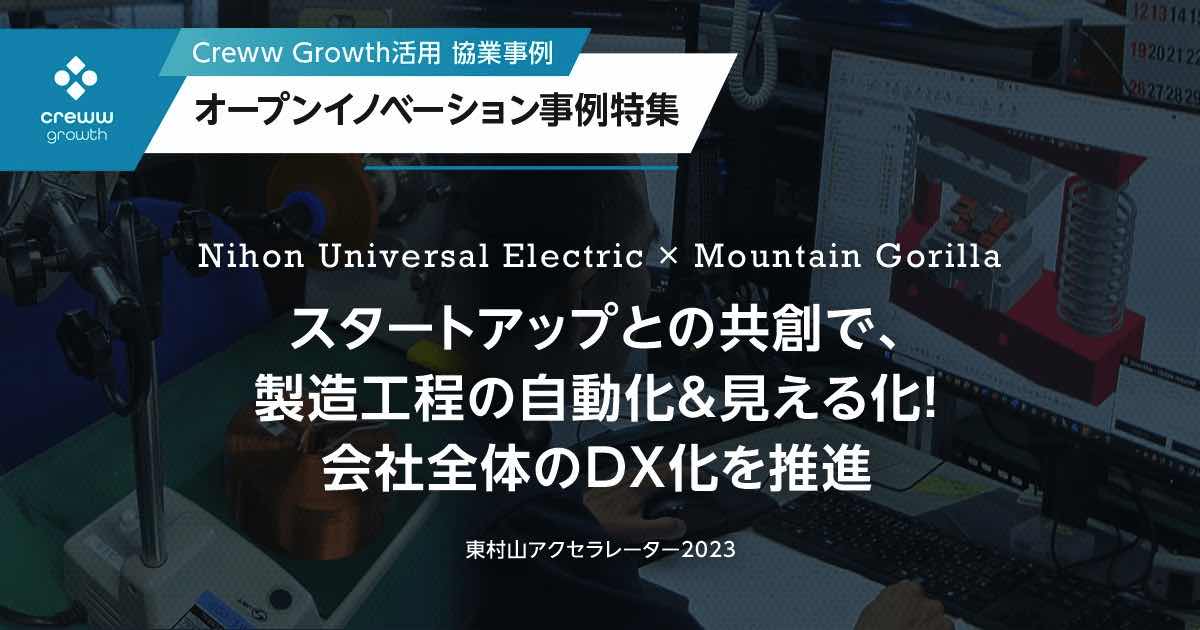

Digitalization and DX initiatives needed to permeate down to the shop floor level.

--Please tell us why you participated in the Higashimurayama Accelerator Program 2023.
Since our establishment in 1958, we have been engaged in the manufacture of coil winding and tensioning devices and electronic components used in aerospace, industrial equipment, and information and telecommunications.
For manufacturing companies, the creation of mechanisms for cost control and reduction is an eternal theme. We also believe that one of the keywords for the survival of small and medium-sized enterprises is the promotion of DX.
Therefore,We have also been working on the digitization and DX of our company with an awareness of the importance of digitalization. However, the issue is that it has remained at the managerial level and has not penetrated to each and every worker in the field.It was.
An example is the task of tallying manufacturing man-hours. At our company, the man-hours are totaled from workers' daily reports, but the calculation is complicated by such factors as the five-minute breaks in between each hour. Manual tallying is burdensome for both the workers and the tally operator, and leads to errors. Therefore, we wanted to simplify the input of manufacturing man-hours and have a mechanism for automatic calculation.
However, each company's area of expertise is different. In our case, we do not specialize in digitization or DXing. We wanted to further strengthen our company's strengths by leaving the areas where we are weak to other companies that have strengths in those areas and concentrating on what we are good at.
Participated in the Higashimurayama Accelerator Program 2023, believing that collaboration is needed to take advantage of the company's areas of expertise.I did.

--Please tell us why you selected Mountain Gorilla.
Our company isThe most suitable match for what we wanted to do and excellent cost performance were the deciding factors.Mountain Gorilla was asked to simplify the input of manufacturing man-hours with its business improvement system, Kakanai, and to create a system for automatic calculations.

We received applications from 21 companies for this program. By listening to the stories of various startups,I was surprised to see how much is possible in today's world! A fresh awareness of thisYou have gained a
If we were to collaborate again in the future, we would like to "unify our intentions on the structure we should aim for" at an early stage.

--What kind of internal structure did you have in place for the collaboration?
In our company,Appointment of four IT-savvy individuals to the projectWe had We had 5 members including myself to brush up.
Two of the members are specialists who create and manage our business management system: one is an engineer who does 3D CAD design, and the other is a sales planning executive with a bright IT background. Of all the brush-up members, I may be the least IT-savvy (laughs).
--Have there been any challenges in working with startups?
There were points that we noticed only after actually using the system, and there were also unexpected problems. We are still making adjustments to the system, communicating with Mountain Gorilla on a case-by-case basis as we make improvements.
Internal challenges and points of reflection that came to light as the collaboration progressedThere were also Although this program was basically a top-down approach, looking back, I feel that a thorough internal discussion was necessary at the beginning of the process.
For example, each department handles different customers, so the timing and specifications of orders differ slightly from each other. Since not all brush-up members had a detailed understanding of all departments, it took time to grasp the actual situation.
The ideal would have been to make the work processes of all departments uniform with the introduction of the system, but this was difficult because of the reality that each department had to deal with its own unique and irregular processes.
Because of the limited time available for launching the project, we ended up being pressed for deadlines each time (laughs). Early stage,Collaboration could have proceeded more smoothly if there had been a "unification of intent on the mechanism to be pursued" that took into account the actual situation within the company.I feel that the

We were able to participate in the creation of a cutting-edge system that does not yet exist in the world. I believe there are benefits for both companies in this collaboration.
--What advantages did you see in working with startups?
Being able to collaborate with a startup was a valuable experience in itself.Startups are trying to do things that do not exist in the world, and are, so to speak, at the forefront of the times. Collaboration with such startups is a valuable thing.I think it is.
The collaboration also led to the development of "Kakanai," a more complete business improvement system. As a result, we feel that both parties, the client and the startup, benefited from the collaboration.
In this collaboration, we made a variety of requests. I am sure that there were probably some unexpected problems that they had not imagined. I would be happy if the development of "Kakanai" with a higher degree of perfection as a result of your efforts to meet our needs and solve our problems would be an asset to them.
--How is the progress of the system implementation?
Current Status,Systems for the main business process are mostly built.We are able to do so. As I mentioned earlier, we have not yet been able to address the departments that have adopted their own production control methods. We are still in the process of making ongoing adjustments.Improvement by listening to the voice of the fieldWe will proceed with the following.

We want to improve the completeness of the system and set up a level of digitization that other companies can come and observe.
--What is the future outlook for your company?
From now on,To unify manufacturing management that differs from customer to customer and to be able to track revenue by productWe believe that this is a good idea. We are a manufacturing company,We want to make a company that can generate stable profits that are ultimately linked to cost, delivery, and quality, and that can eventually return profits to our employees.I think.
Specifically,Visualize the number of pieces of work, cost ratio, etc., and clarify issues, so-called "visualization.The goal is to create an environment in which not only managers but also all employees, including workers in the field, can share information. By creating an environment in which all employees, including workers in the field as well as managers, can share information, new issues will be identified and various opinions will be generated. As a result, I believe that we will be able to work as one toward achieving our goals.
Whether they are good at it or not, many people today are familiar with the use of smartphones. Even if you may be resistant or unable to use them at first, as the days go by, you will become more familiar with them in your daily life, and sometimes you may even realize that you can use them in such a convenient way.We want to do the same with the new system and digitalization, and we want to make it permeate every corner of the site so that it becomes the "norm" for all of our 165 or so employees.It is.
To this end, we would first like to perfect the "kakanai" system and establish a system so that other companies will come to visit us. I feel that it is necessary to proceed while listening to the voices of the field, rather than imposing the system on the field.
Since we are a manufacturing company, we are required to maintain a certain degree of secrecy in terms of technology, but we can show our clients the management and structure of our company. We want to be a company that our clients can feel comfortable entrusting their work to once they are familiar with our environment.

| name of company | Nippon Universal Electric Co. |
| establishment | November 1958 |
| Location | 5-21-25 Kumegawa-cho, Higashimurayama-shi, Tokyo |
| representative | Hideo Shimura, President and Representative Director |
| Business Overview | Coil prototyping, connector assembly, harnesses Assembly and wiring of equipment, LED lighting fixtures, board mounting, and other contracting Temporary staffing, job placement, LED installation work, design and manufacture of assembly jigs and tools Electrician Licensed |
| uniform resouce locator | http://jpuni.co.jp/ |
 Mr. Hideo Shimura Representative Director, Nihon Universal Electric Co.
Joined Nihon Universal Electric in 1978. Appointed as a representative director in 2000, acquired ISO9001 certification in 2004 and UL certification in 2005, and was certified as a management innovation company. In 2006, he was approved as a specified worker dispatching business, and in 2007, he was approved as a fee-charging personnel placement business. Up to the present.






 JA
 EN
