


Pioneering Ideas in Waste Management - The Possibility of Utilizing Waste Instead of Disposing of It
Waste, a resource for the future
Please give us an overview of Sanyu Plant Service's business, vision, and mission.
Masuda:We have been in the waste management business for 70 years. We are unique in that we are a one-stop solution company that handles everything from "consulting" to "collection and transportation," "intermediate treatment," and "final disposal" of industrial waste throughout Japan.
In addition, "Protecting the environment and resourcesThe company's management philosophy is to "make the world a better place to live and work,Waste is a resource for the futureWe have a vision of our company as a "food company". In our work with Starbucks Coffee Japan, we have created a loop in the food cycle, utilizing coffee grounds as feed for cows and returning milk from the farm to Starbucks again.
▶Realization of coffee bean dregs as animal feed SAIKAI PROJECT
https://www.sanyusoken.com/wp-content/uploads/2022/05/20220513-mannga.pdf
I want to create a world where supporting what you love makes life worth living.
Please tell us about MINT's business and mission.
Tamura:We are developing a cloud service for corporations that allows them to create customized loyalty programs or membership systems using tokens such as in-house currency in no-code or low-code.
This is a service that allows corporations to award points for "good behavior" by end users, such as "purchasing products," "introducing products to friends," "spreading the word on SNS," "writing reviews," etc.A service that allows users to earn gratitude points for any action that can be tracked online.The following is a summary of the results of the survey.
Another key feature is that this mechanism can be smoothly integrated with existing services, other platforms, etc., since it provides an API.
Our company has been working on the development of a "Create a world where supporting what you love is what makes life worth living.Our vision is to "do good" for others. We believe that the end-user, the general public, should be able to do something "good" for someone else and have their actions properly evaluated and approved,A world that makes life worth living for those who take action.We want to create a new service that will help people to make the most of their time and energy. We created this service with this in mind.
Contacts brought about by the Accelerator Program
Safe and proper disposal" has become a matter of course, and we are now moving toward "efforts aimed at circulation.
Q. Could you tell us about the background of the Sanyu Plant Service Accelerator Program?
Masuda:SDGs,Today, we are moving toward a recycling-oriented society.In the "recycling-oriented approach," the safe and proper disposal of industrial waste has become a matter of course.
A turning point in the creation of new businesses by looking at "discarded items" as resources and exploring how they can be reused.I believe that in the
The same is true for achieving carbon neutrality by 2050. The ability to respond with new ideas and technologies will be necessary, but internal resources alone will not be sufficient. To solve this challenge together through the method of open innovation,Accelerator program for a wide range of startup ideas and technologiesI did.
Lack of internal resources to generate new ideas and technologies
What were the deciding factors in adopting the MINT project?
Masuda:Sanyu Group has been entrusted with the long-term comprehensive operation and management of the North Ishikari Sanitation Center, an incineration facility for "garbage" generated by general households in Ishikari City, Hokkaido. The center has been experiencing problems with fires caused by garbage. The fires were caused by residents not separating their garbage and throwing away lithium-ion batteries, and similar fires have occurred at incineration facilities in other municipalities, making this a major social issue.
To solve this social issue, we were developing an application from the perspective of "how can we help residents sort garbage?
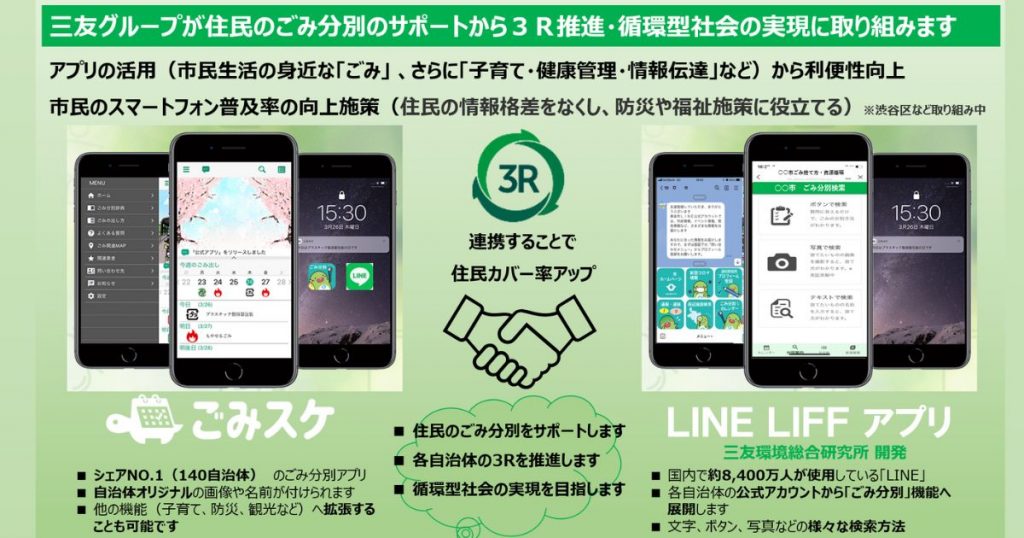
When I thought about what kind of application to actually develop, it was just as the local government was trying to increase the share rate to residents by utilizing an official application using LINE,We have also started development of the LINE LIFF application with the aim of encouraging more residents to change their behavior regarding garbage sorting.I made them do it.
For MINT,The ability to enable speedy application developmentand having a points program.Expandability for future commercializationWe are pleased to adopt Sanyu as a partner to work together to solve the issues that currently exist in Sanyu.
The ability to develop applications quickly and efficiently
Possession of point program technology and expected affinity with scalability of commercialization
Q. Could you tell us about the background of your application to the Sanyu Accelerator Program?
Tamura:Our service requires corporations to award points to end-users for their "good behavior. Therefore, developing corporate customers has always been a major challenge for us. In particular, we wanted local governments to eventually use our service, but we did not have many opportunities to connect with them.
For Mr. Mitomo,The fact that there are many connections with local authoritiesAnd also with regard to the granting of points,The fact that you can tell the same story as our companyI was so impressed that I decided to apply.
Corporate development
Collaboration with local governments
Developed LINE LIFF application for local governments
Demonstration experiment in which all employees worked together
Q: Can you tell us more about the products you are currently making?
Tamura:Make good use of LINE,Service to be included in each municipality as an application within LINEThe first two are to be To the citizens ofAn application that provides information such as "when and what garbage must be disposed of" and allows users to search for "how to dispose of garbage" and "how to separate garbage".It is.
In addition to searching the name of "garbage" by text, if you take a picture of "garbage" and upload it from the application, the image analysis technology can identify the "garbage" and guide you on how to dispose of it, or inform you of the "garbage separation method" in your municipality by answering a few questions. You only need to answer a few questions to be informed of how to sort your garbage.
ーーIs this project also conducting a demonstration experiment?
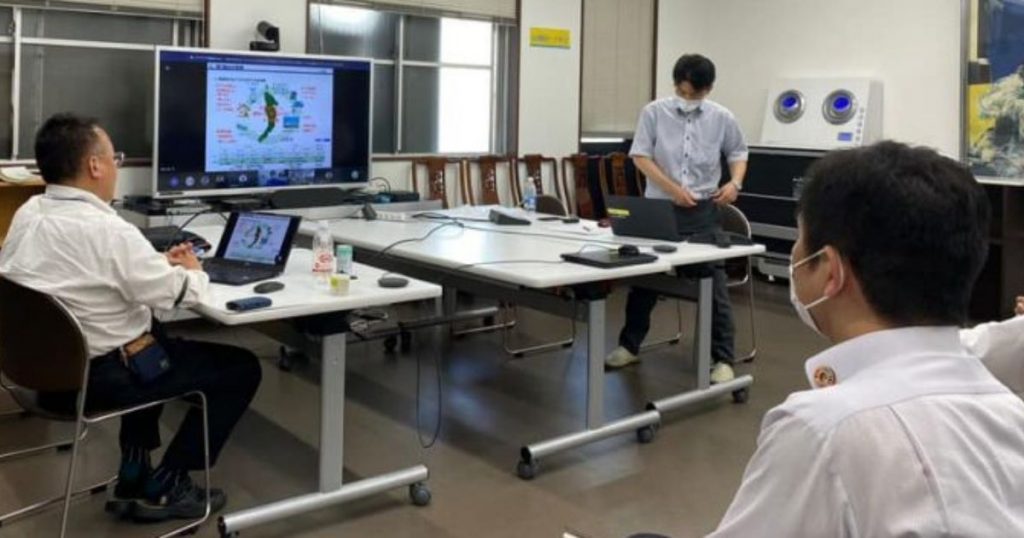
Kurihara:Yes, we have done this multiple times. First, as a small step, we asked about 60 employees at our headquarters to use a test version of the application we had developed.
Image analysis was one of the key aspects of the application development in enhancing the feasibility of the application. Given that the images taken and posted by ordinary users are not necessarily the beautiful images that can be found on the Internet, we obtained cooperation by having employees actually use and post realistic image data for learning.
After further verification, a demonstration experiment was conducted with 440 employees company-wide. Some employees were motivated to participate by placing advertisements for employees and announcing "how many images were posted" in a ranking format. All employees worked together on the experiment to create a good product while incorporating a game-like atmosphere.
ーYou have done a wonderful job of making it possible for people to actively participate in the experiment, such as by using a ranking format.
Tamura:That's right. Sanyu also conducted a demonstration experiment within the company, in which participants received points for correctly sorting and reporting the correct disposal of garbage.
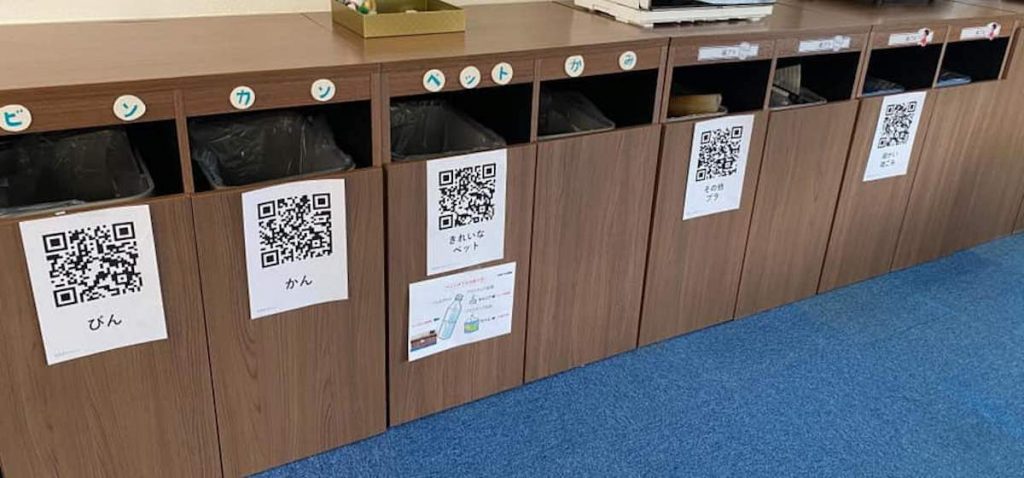
In the first method, a different QR code is attached to each trash can, and the user is asked to read the QR code for that trash can when he/she sorts and disposes of trash. The first method was to put a different QR code on each trash can, and ask people to read the QR code when they separate and dispose of trash.
The second method was an experiment in which a chip was implanted in a trash can and points were awarded simply by touching it.
At this stage, though, we are in the demonstration phase,In the future, each municipality will be offered services including a point systemWe hope to develop it so that it can be done.
Where did you feel the barriers to collaboration?
Struggles and adjustments to reach the accuracy you want to create
Q: Were there any situations in which you found it difficult to cooperate with each other?
Kurihara:Improving the accuracy of image analysis was quite difficult. We had originally studied image analysis with a company specializing in this field, but the cost and time frame did not match the accuracy we were looking for, so we had to find another method.
With the help of Mr. Tamura's consultation, I think we were able to develop the LINE LIFF application while maintaining a certain degree of accuracy by combining several existing systems.
Tamura:In the development of the application, I think it was difficult to find the point where our company and Sanyu's "what we want to offer" and the "needs as a product for sale" match, i.e., whether or not the actual customer, the local government, would want to introduce the application.
As for the point system I mentioned earlier, we cannot suddenly say, "Please give out points" when the need for such a system has not yet become apparent.
We have just taken the first step in making adjustments after introducing the system to local governments to see where we should start in order to eventually offer services that incorporate the point system.
Each other's norm is not the norm. What are the key points of collaboration between the two companies?
There may be differences in the business model and culture between startups and operating companies. Are there any points that mint is aware of in order to promote collaboration?
Tamura:I felt that there was a difference in the way large companies and start-ups proceed with creating products. There was a difference in the way they create products, such as whether they create products after deciding on the exact specifications, or whether they make improvements while conducting demonstration tests.
In the beginning, I think there was some halation because of our company's desire for startup-like manufacturing. I feel very grateful that Mr. Mitomo was able to gradually adjust to this situation.
I think the fact that Sanyu was able to negotiate with the local government and make changes to the specifications while making sales calls, which is not something that large companies can easily do, was a very important factor in the project.
I also feel that while the Corona disaster reduced the number of face-to-face meetings, and there were some aspects that were not fully communicated on both sides, the opposite was true, as going online allowed us to increase the number of meetings to a solid weekly frequency, which I feel was a very good point.
Q: What do you think is the point of collaboration for Sanyu?
Kurihara:Yes, I agree. A company that handles industrial waste and a system development company have different claims because what they do is different. What is natural to both parties is not natural to each other. Therefore, what are the key points in promoting collaboration?To understand that there is a difference in the level of perception.I think it is.
We are not a system development company, so as we go through meetings, unfamiliar words and technical terms frequently come up. On the other hand, the precautions regarding waste, the thoughts that are necessary to handle waste safely, such as "why we insist on image analysis" and "why we want to identify small home appliances," are probably unknown to Mr. Tamura, who is a system development company.
I think it is important to reconcile such differences in order to proceed with the collaboration. If we communicate abstractly through language alone, we will end up with something different from what we intended. I think we were able to proceed smoothly by communicating concretely and sharing images through photos and examples.
Steps on how to proceed in creating a product
The online system has increased the number of meetings and the frequency of communication.
Recognize that there is a difference in the level of recognition.
To communicate ideas concretely by sharing images in addition to language.
Toward the future you want to achieve
Aiming for apps with behavior change for citizens
Q: What are your expectations for Sanyu's collaboration with startups?
Masuda:We would like to continue to borrow the help of startups, as new ideas and technologies to solve problems do not emerge from within our company. I think that is what we are looking forward to the most.
Q: What is Sanyu's vision for the future with respect to the collaboration with MINT?
(historical) paddy administered directly by a rulerSanyu Group has introduced the system to Togane City, Chiba Prefecture, where the Sanyu Group has a base of operations and has concluded an agreement with the city to work toward a sustainable society.
▶Comprehensive Collaboration with Togane City and Starbucks Coffee Japan Co.
▶Initiatives for Resource Recycling, Regional Revitalization, and Citizen Service Improvement in Togane City|Sanyu Kankyo Soken Kenkyusho
In addition, the service will be introduced to Shibuya Ward in September. Shibuya Ward is switching from plastic to recyclable waste collection starting in July, and we have met the need to promote the service to ward residents. We have already received inquiries from other municipalities, so our immediate goal is to increase the number of municipalities that have introduced the service.
It is from these that peopleBeyond becoming aware of the need to separate "garbage," develop initiatives to make use of it as a "resource.I hope to do so.
While utilizing the point system, which is one of MINT's strengths, we would like to see the system developed into, for example, "carbon neutral points" and used not only by local governments, but also by commercial facilities and facilities that attract visitors who can watch sports games,Our goal for the future is to develop programs that promote carbon neutrality while changing people's behavior.It is.
ーーCan you also tell us about your vision for the future of MINT?
Tamura:As Mr. Masuda mentioned earlier, "behavior change," we need to increase the number of citizens who are willing to take "good actions" toward the goals of each municipality and to have them recognized and benefited by such recognition,Realize a world where people can enjoy doing what is good for Japanese society and the environment.I would like to do so.
 Mr. Mitsuhiko Masuda Executive Officer, Division Manager, Sustainable Innovative Design Division, Sanyu Kankyo Research Institute Co.
Joined Sanyu Plant Service in 2018." Work-Life Balance" I value connecting with people from various activities. My specialty is strategy building from marketing activities, and I have a reputation for my ability to realize from planning. Details:https://sanyusokenmasuda.sitte.page/
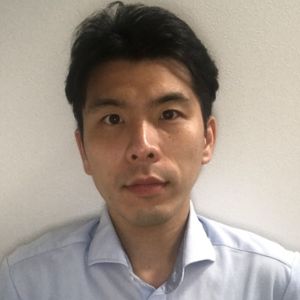 Mr. Daiki Kurihara Sustainable Innovative Design Division, Sanyu Kankyo Research Institute Co.
Since joining the Sanyu Group, I have been involved in a wide variety of business activities, including the incineration site, sales, technical department, and corporate planning. Details:https://sanyusokenkurihara.sitte.page/
 Mr. Kentaro Tamura Representative Director, mint inc.
Born in 1986. In 2007, while still a student, he founded Synapse, Inc. and has been involved in several businesses selling and distributing digital content. 2012, he invented the online salon system and developed and released the online salon platform "Synapse". 2017, after selling the company, he established mint, Inc. Currently operating the SaaS "mint" business, which supports the establishment and operation of membership systems. Engineer Entrepreneur.
| name of company | Sanyu Plant Service Co. |
| Establishment | June 19, 1948 |
| Location | 1-8-21 Hashimoto-dai, Midori-ku, Sagamihara-shi, Kanagawa 252-0132 |
| representative | Kazushi Komatsu, President and Representative Director |
| Business Overview | Environmental measurement and certification business; consulting services related to waste disposal; collection, transportation, and disposal of various types of waste; recycling and resource reuse of various types of waste; design, manufacture, and sale of environment-related equipment and facilities, as well as maintenance services for such equipment and facilities; and remediation of contaminated soil. |
| uniform resouce locator | https://www.g-sanyu.co.jp/ |
| name of company | Sanyu Environmental Research Institute Co. |
| Establishment | February 18, 1974 |
| Location | 1-8-14 Hashimoto-dai, Midori-ku, Sagamihara-shi, Kanagawa 252-0132 |
| representative | Kazushi Komatsu, President and Representative Director |
| Business Overview | To promote and propose SDGs to companies and local governments to realize a sustainable society in 2030, commercial business (wholesale, sales planning), system planning, operation construction and sales, consulting services, planning and activities of environment-related research, finding, partnering with, and investing in venture companies. |
| uniform resouce locator | https://www.sanyusoken.com/ |
| name of company | mint inc. |
| Establishment | November 30, 2017 |
| Location | Noah Dogenzaka 806, 2-15-1 Dogenzaka, Shibuya-ku, Tokyo 150-0043, Japan |
| representative | Kentaro Tamura |
| Business Overview | Providing SaaS "mint" to support the establishment and operation of membership systems |
| uniform resouce locator | https://themint.jp |





 JA
 EN
