


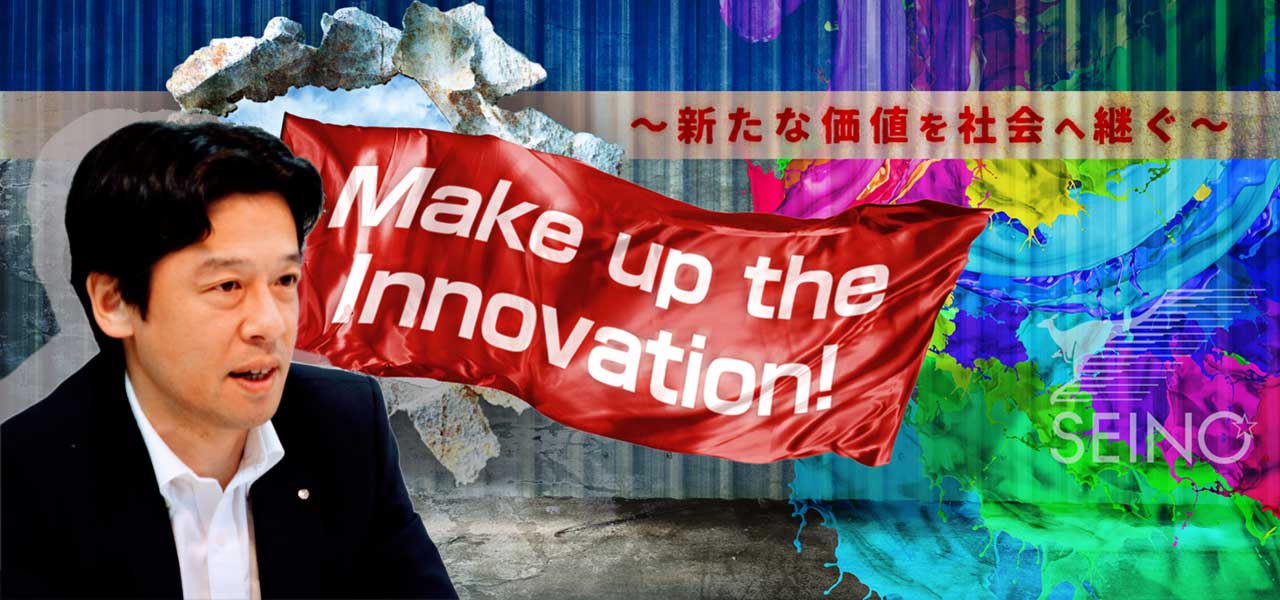
Creating a receptacle where people can try and fail and then try again.
In 2011, I established a company called Coconet as an in-house venture of Seino. This is a business that delivers groceries and watches over vulnerable shoppers who experience inconvenience in their "daily shopping". It is a company that solves problems related to the "last mile," the last section of the logistics process that delivers products to customers.
However, since there had been no examples of in-house entrepreneurship before, it was difficult to gain the sympathy of those around me, and it took a long time and a lot of hard work to get the company up and running. It took us a long time to get started, and it was very difficult. There were many challenges, such as, "That business doesn't fit our culture." It took about two years to start the company, and on top of that, we were in the red for the first two years, so it was quite a struggle.
If it is this hard to start a new business, there is a good chance that no one at Seino will follow suit and say, "I want to create a new business. In particular, those who have watched me struggle will not want to do the same thing, not even for a millimeter.
Nevertheless, the logistics industry has a mountain of issues to solve. For example, the shortage of truck drivers is an urgent issue due to the declining population caused by the falling birthrate and aging population, the last mile delivery problem such as increased re-delivery, soaring fuel prices, and global warming, to name just a few.
However, these issues could be solved little by little by combining our many assets with the technological capabilities of startups and other companies.
For example, it is calculated that the approximately 28,000 trucks we own run around the earth 16,000 times every year, and there are almost no accidents during that time. So, if we analyze all driving data, we may be able to contribute to a society with fewer accidents, and there are many other assets such as cabs, railroad containers, airplanes, ships, and diesel fuel.
Therefore, in 2016, we created the Open Innovation Promotion Office to create a foundation for collaborating with other companies to take on new challenges and a platform for returning and taking on challenges again and again, even if they fail. We also began creating intrepreneurs to encourage young employees to launch new businesses and start their own businesses within the company.
Projects are actively commercialized and managed by the employees assigned to them.
The Open Innovation Promotion Office currently has 15 members, all of whom are full-time except me. What is unique is that when I launch a project on my own, I have two choices: I can either establish a business company or take the project to a business company for hands-on nurturing. We are not working on projects that will somehow disappear within the company, but rather take a highly serious stance that will spin out of the company.
More than 10 projects have taken shape in the three years since 2016, and several have become subsidiaries. For example, a subsidiary called Seino Mentech, which was created at the initiative of our members, is working on disaster prevention and mitigation.
There are more than 1 million emergency power generation facilities in Japan, but because they are not adequately maintained, the problem of them not operating properly in an emergency is becoming apparent throughout the country. Moreover, in some cases, sudden operation can lead to fires. We launched Seino Mentech as a company that maintains such facilities.
This company has me as president as the person in charge, but in reality, a 32-year-old member of the team is leading the company as executive director.

Other projects include the "Children's Home Meal Project" in collaboration with Bunkyo Ward, GENie, a new company in business partnership with Seven-Eleven Japan, and the "Kotonoha Fresh Farm (Kotonoha Fresh Farm)," a vegetable factory business with integrated management from production to distribution, from Creww's accelerator program in 2017.https://kotonoha-ff.com/(a) also launched the "Mutual Aid Association (MAA).
This is a vegetable factory built in a distribution center in Toki City, Gifu Prefecture, in collaboration with Farmship, which has LED vegetable production technology. This is a revolutionary project that cuts various costs up to delivery, as vegetables are harvested, unloaded directly into the terminal by a vertical conveyor, and loaded onto trucks.

He also established "Moe Agri Farm," an organic alley vegetable farming corporation in Kumamoto Prefecture. It grows more than 30 varieties of vegetables on a vast plot of land the size of four Tokyo Domes. As a special subsidiary, it employs 30 people locally with a labor support organization, 15 of whom are people with disabilities.
This company is in the process of growing steadily, with a young 24-year-old employee who was interested in growing vegetables living on site and promoting collaboration between agriculture and welfare.
Accelerator program continues to increase the number of challengers within the company
Since the establishment of the Promotion Office, we have continued to hold the Accelerator Program every year. The reason for this is that we want companies and organizations outside the company to think of Seino first when they think of something new they can do in the field of logistics. We want to dispel the old, rigid image of Seino, and have people think, "Seino is a company that is doing interesting things one after another," and "Seino would listen to us.
I have participated in various events and communities related to open innovation, but I feel that the accelerator program is the most symbolic way to showcase Seino's efforts.
The continuation of the Accelerator Program has also begun to have a positive impact within the company. Many employees are aware of the efforts of the Promotion Office through media exposure, and some have begun to volunteer to be transferred because of this.
We accept all such employees, and some of them have come to Tokyo by themselves, having worked as truck drivers in Shiga Prefecture for 20 years but wanting to "try something new. There is also a mid-career employee who applied for a job at the promotion office after seeing information in the media.
Even if you want to do something new, it is risky to do it alone. However, we have a backup system that allows us to commercialize new projects within the company, and there are no restrictions on the areas we can try, such as agriculture, forestry, drones, and truck-related fields, so I would be happy if more people raise their hands and become active in these fields.
To bring back the DNA of innovative founders and produce intreprenuers
The reason I am putting so much effort into new business creation is because I had so much difficulty when I created my own company, and in addition to a sense of crisis that no one will propose new business unless we lower the bar, I also want to bring back the innovative DNA of our founder.
About 70 years ago, Seino's founder was the first in Japan to begin long-distance transportation of multiple companies' products in mixed trucks. The impetus came from the fact that Ogaki City in Gifu Prefecture, the founder's hometown, is a textile town, and he wanted to sell his textiles not only locally but also in Tokyo. Moreover, since most of the factories are small to medium-sized, it would not be profitable to rent trucks for individual companies, so he decided to transport the products of multiple companies in a mixed load.
However, at that time, trucks to transport goods over long distances did not exist, and there were no licenses or rules. So, the founder created them himself and proposed them to the government, and for the first time, he transported products from Gifu Prefecture to Tokyo by truck over the Hakone Mountains.
Because Seino has such a history, I thought that if we could regain the innovative mindset of our founder, which we had almost lost, we would be able to create businesses that would contribute to the world.
Currently, we are launching new businesses centered on primary industries, and we are also considering businesses related to fisheries and livestock production in the near future. We avoid taking on challenges in areas that are out of the ordinary, but if our assets can be utilized in logistics-related areas, we would like to take on the challenge without creating a framework. To this end, I would like to increase the number of people working in the promotion office to 100 or 200, and continue to solve social issues and create new value.
(Date of writing: November 7, 2019)
 Mr. Shuji Kawai seino holdings co.
General Manager, Open Innovation Promotion Office
After joining Seino Transport Co., Ltd. in 1997, he began his career as a truck driver, gaining experience in the trucking field. After working for Seino Holdings Co., Ltd. on business improvement, human resource development, and internal control projects, he established an unusual venture company, Coconet Corporation, in 2011 and later became its president. The company operates a nationwide social business that provides assistance to vulnerable shoppers, including asking for help, delivering groceries and boxed lunches, and watching over customers. Currently, he also serves as the head of Seino HD's Open Innovation Promotion Office, where he promotes the creation of new businesses and the development of intrepreneurs, while also working to solve social issues.
Representative Director, GENie Corporation
Representative Director, Vector One, Inc.
Director, Intents, Inc.
President and Representative Director, Seino Mentech Co.
Director, Futaba Kogyosho Co.
Director, Moe Agri Farm Co.
External Director, EPARK Sweets, Inc. Representative Director, LOCCO Co.
(Representative Director, Council for the Promotion of Measures for Vulnerable Shoppers
Director, Kodomo Homeshoku Ouen-dan (Children's Home Catering Support Group)
(Executive Director, National Disaster Prevention and Mitigation Equipment Inspection Council
Visiting Researcher, Institute for Service Innovation, Meiji University






 JA
 EN
