



On February 7, 2025, a kick-off event for the IBM BlueHub Program in Kyoto was held! Under this program, IBM Japan and Kyoto City collaborate to solve local issues in Kyoto with startup solutions utilizing cutting-edge technology, aiming for sustainable development of the local community and growth of startups. The purpose of this kick-off event is to deepen exchanges between participating startups and mentors and to solidify the goal image for the IVS2025 KYOTO Demo Day scheduled to be held in July.
*This article is a reprint of the kick-off event report.

Opening Session: IBM's Approach to Solving Social Issues
The event started with a greeting by Hideyuki Suehiro of IBM Future Design Lab, the organizer of IBM BlueHub. Mr. Suehiro introduced IBM as not just a technology company, but a company that has been working to solve social issues, explaining the history of the company as he went through it.
In particular, he mentioned how IBM has contributed not only to individual technological innovations but also to local communities and industry as a whole, and conveyed the point that this BlueHub aims to solve issues in Kyoto, a city with a rich history and culture.
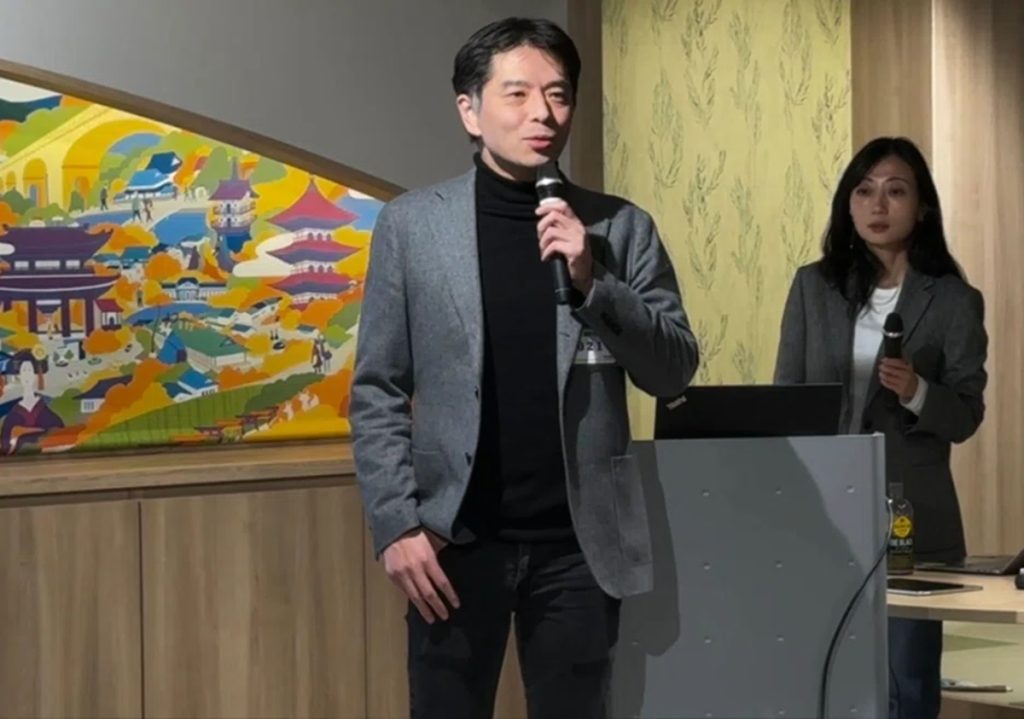
IBM BlueHub's approach to problem solving
IBM BlueHub is leveraging the power of technology and innovation to create concrete solutions. In this program, one engineer is always assigned to each of the five startup teams to provide practical technology support.
In addition, by leveraging IBM's network of more than 10,000 experts and matching each team with the mentor best suited to their issues and business, strong support is provided not only in technology, but also in business strategy and market development. And because the investor's perspective is also important, an investor will also run alongside as a mentor. The program includes mentors Shumpei Fukui of Archetype Ventures, Ken Horiuchi of Carbide Ventures, Shinsuke Hamamiya of 01Booster, Ken Asada of Salesforce Ventures, and Hikaru Fujimoto of Mitsubishi UFJ Capital, who will offer their perspectives on startup growth strategies and fundraising.
In addition, Yohei Azaue of Zebra & Company has joined the program as an advisor to help build a sustainable business model, adding a corporate support perspective that aims to balance social impact and profitability. Through these measures, the program aims to go beyond mere temporary support to promote ongoing collaboration even after the program ends, and to create an ecosystem in which startups can contribute to solving Kyoto's problems over the long term.
Five startups are participating in the "IBM BlueHub Program in Kyoto" that are taking on the challenge of solving issues in Kyoto in diverse fields. Creator's Next" aims to create new tourism experiences using art under the theme of art innovation. CONGEN" will fuse AI and traditional culture to create new values where tradition and modernity coexist. Tomorrow Never Knows" also aims to create an environment where travelers can obtain optimal information on the move by utilizing LLM AI for mobility. Simplee, which provides childcare services for tourist families, will offer a multilingual nanny dispatch service to meet inbound demand. Anacro is working to establish a sustainable management model for the forestry industry based on the theme of forestry-supportive asset management services.
This kickoff was the first step for the startups to gain a deeper understanding of the issues facing Kyoto City and to clarify their future direction with their mentors. a panel talk was held to address the issues in preparation for the IVS2025 KYOTO Demo Day scheduled for July, which will be presented later in this report. Although this session is a message to the participating startups, it should be of interest to many of you as you will learn perspectives on expanding inbound demand and the sustainable promotion of Japan's attractions.
Tourism Issues, not Overtourism - "IBM BlueHub Program in Kyoto" Kick-off Event, Panel Talk
Kyoto is an academic city, with students accounting for approximately 101 TP3T of its 1.4 million population, and the number of university-launched ventures has already reached 452. Tourism is also a major pillar of Kyoto's economy, attracting more than 50 million tourists annually, with more than 800,000 students on school excursions alone each year. Tourism spending amounts to 1.5 trillion yen, and one out of every five citizens is employed in tourism-related industries.
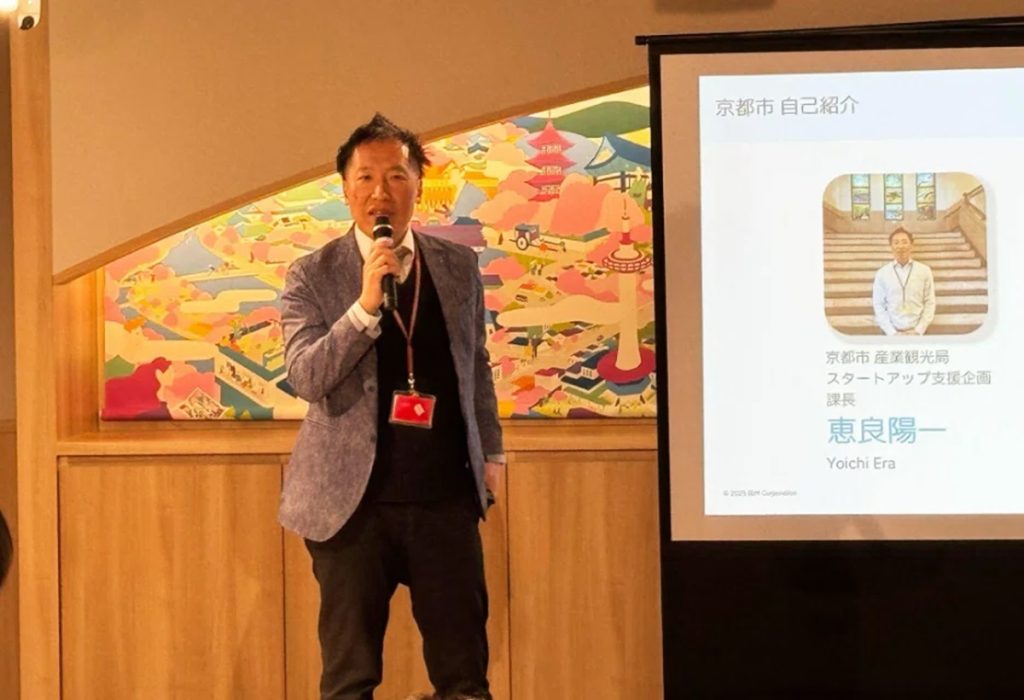
While the sheer scale of the tourism industry is an essential element of Kyoto's economy, it also creates challenges for the sustainable revitalization of the local economy and the succession of traditional industries. Yoichi Era, Director, Startup Support and Planning Section, Industrial Innovation Promotion Office, Industry and Tourism Bureau, Kyoto City, shared his perspective on how to coexist with economic growth while maintaining the city's attractiveness.
Mr. Era:Kyoto receives approximately 50 million tourists annually. Tourism is an important industry in which one out of every five people is engaged, but the problem is that people are concentrated in some areas, making it difficult for residents to make a living, and we believe it is necessary to encourage the dispersion of time, time, and place.
The seasonal nature of the area, with crowds in spring and fall, and the fact that there are so many attractions outside of the so-called famous tourist areas, such as the Nishiyama area, for example. However, it is not easy to promote decentralization, and that is what we would like to consider together with the startups participating in this IBM BlueHub program."
Mr. Tetsuo Nishizawa, President of Nishizawastay Inc., a Kyoto-based company engaged in the operation of lodging facilities and the optimization of tourism business, will also continue to speak as a panelist, turning Kyoto's challenges into possibilities.
Mr. Nishizawa:The number of tourists itself has not increased, but the number of overnight visitors has. This is contributed by the increase in lodging facilities. The current problem in Kyoto is that tourists are too concentrated in some areas due to the influence of TripAdvisor's Top 5 and Google Maps' route suggestions. To be specific, only the 206 bus line, which runs in a loop around Kyoto and allows tourists to visit many tourist attractions, has long lines.
I believe that tourism is supposed to create "exchange," but this is not happening at present. SIGHTS KYOTO, a project of our company, provides a place where tourists and residents can deeply interact with each other. At the same time, Kiyomizu-dera Temple is also promoting such an initiative. We believe that when local residents and tourists interact with each other, mutual understanding will improve, and this will lead to the elimination of bickering.
Yoshiyuki Kano of Kyoto Shinkin Bank, which is forming a new age community bank for the development of the region, will also share his perspective from a regional financial perspective on issues facing Kyoto City and his expectations for the startups participating in the IBM BlueHub.
Mr. Kano:As a regional financial institution, we listen carefully to the voices of the local community. For example, the Fushimi Inari Taisha shrine is crowded with tourists, but the surrounding sake breweries and shopping streets are not fully utilized. We would like to increase contact between tourists and the local community through sake brewery tours and other activities to provide more attractive content. In addition, many foreigners are expected to visit Osaka in 2025 for the Osaka-Kansai Expo, and we need to consider new tourism content while listening to their feedback.
Mr. Hideyuki Suehiro of IBM Future Design Lab, who gave the opening remarks, introduced a proposal to solve the above issues from a technology perspective.
Mr. Suehiro:We should also focus on those who are left out of the current tourism landscape. For example, solutions for the visually impaired are needed. IBM Japan, under the leadership of IBM Fellow Chieko Asakawa, is working with Alps Alpine, Omron, and Shimizu Corporation to develop an AI suitcase, and is conducting demonstration tests at the Osaka-Kansai Expo to be held this year. If this kind of technology becomes widespread, people with disabilities will be able to enjoy sightseeing more freely, which will ultimately improve convenience for able-bodied people as well.
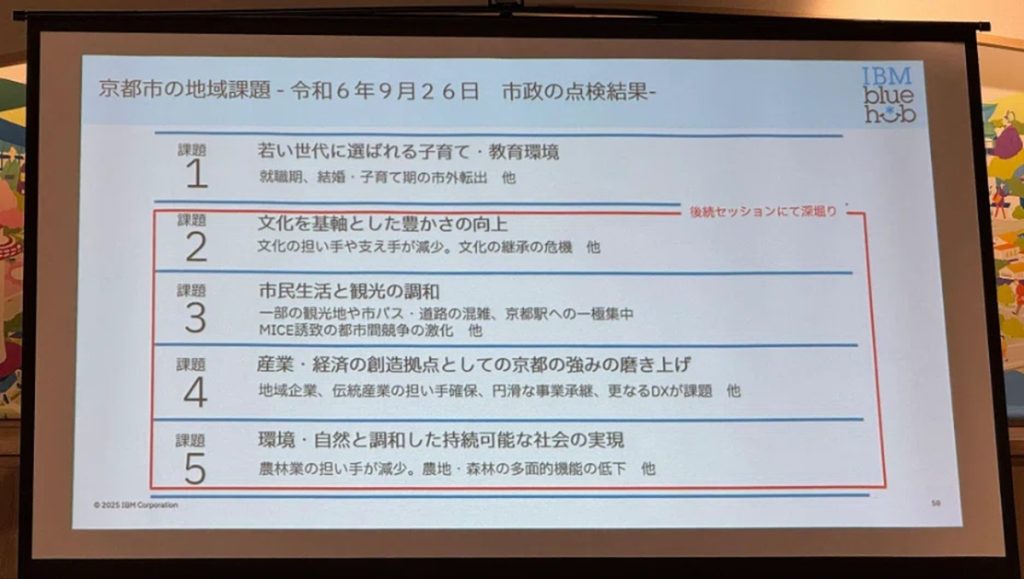
Culture-based enrichment
Tourism is a destination that attracts many people because of its history and culture. While Kyoto is gaining global recognition for its rich history and culture, there are also issues facing traditional crafts that need to be resolved. Currently, sales of crafts have dropped to one-fifth of their peak, and the number of people involved in the crafts is decreasing. However, 12% of the souvenirs purchased by inbound tourists are kimonos and folk crafts. The imbalance between supply and demand must also be resolved in the future.
Mr. Era:Tourism is built on culture, and it is something that can deepen one's understanding of culture. The desire to learn about the local culture and to experience the extraordinary leads to tourism. Traditional industries support this culture through manufacturing, and Kyoto has many traditional crafts that have continued for more than 100 years. But it is also true that the number of craftsmen is decreasing."
Mr. Kano:The challenge for traditional industries is low wages. Passion alone is not sustainable. Young artisans are seeking new avenues by partnering with other industries. They are also active in new endeavors, such as collaborating with animation. I believe that in the future it will be possible to create new value by combining AI and technology with traditional industries, and I have high hopes for the BlueHub program sponsored by IBM Japan."
Mr. Nishizawa:In order to protect traditional industries, it is important to convey the "heart" of the crafts. For example, a tea ceremony is not just an experience, but an opportunity to talk deeply with a tea ceremony master. In the case of ceramics, the value is not only in the technique, but also in conveying the spirit of the creator. In the case of Buddhist prayer beads, the company is exploring ways to reach out to a wider range of customers, such as by making bracelets out of Kyo-nenju beads. We must strike a balance between tradition and innovation.
Mr. Suehiro:The traditional style of succession, such as apprenticeship and master-disciple relationships, may not necessarily suit today's bearers." This system may be one of the reasons why the number of people involved in traditional crafts is decreasing. For example, the sake "Ottersai" maintains its quality by data-coding and reproducing the brewing techniques that were traditionally carried out by the toji (master brewer) based on his experience and intuition. In the same way, by utilizing data, the bearers of culture may be able to create a different form of inheritance.
Kyoto as an environmentally sustainable, industrial and economic creation point
Finally, a discussion ensued on whether Kyoto can fulfill its role as a creative center for industry and economy while balancing environmental considerations and sustainable development. While Kyoto has a rich history and cultural heritage, it also faces a shortage of industrial players and environmental conservation issues. In particular, the utilization of forest resources, the fusion of tradition and technology, and the revitalization of the local economy were emphasized as key points.
Mr. Era:Some people say that forest maintenance is hard work, but on the contrary, it can be called an asset. Kyoto City is taking steps to preserve and develop the culture of wood and to maximize the multifaceted functions of the forests.
Mr. Suehiro:In architecture, too, we should consider harmony with nature and promote the reuse of materials through the use of technology such as blockchain. For example, if we can ensure the traceability of old materials using blockchain, and if we can create a trend such as using wood used in shrines as the main pillar of a house, the story behind the old materials could add value and stimulate consumer demand."
Mr. Era:Small and medium-sized enterprises (SMEs) account for 99% of Kyoto's business establishments and play a major role in Kyoto's economic activities. Revitalization of SMEs is essential to improve the city's vitality. The shortage of human resources is a nationwide issue, but Kyoto has an advantage over other cities with university students accounting for 10% of the population. It is also important to promote DX, and I hope we can work together to solve these issues."
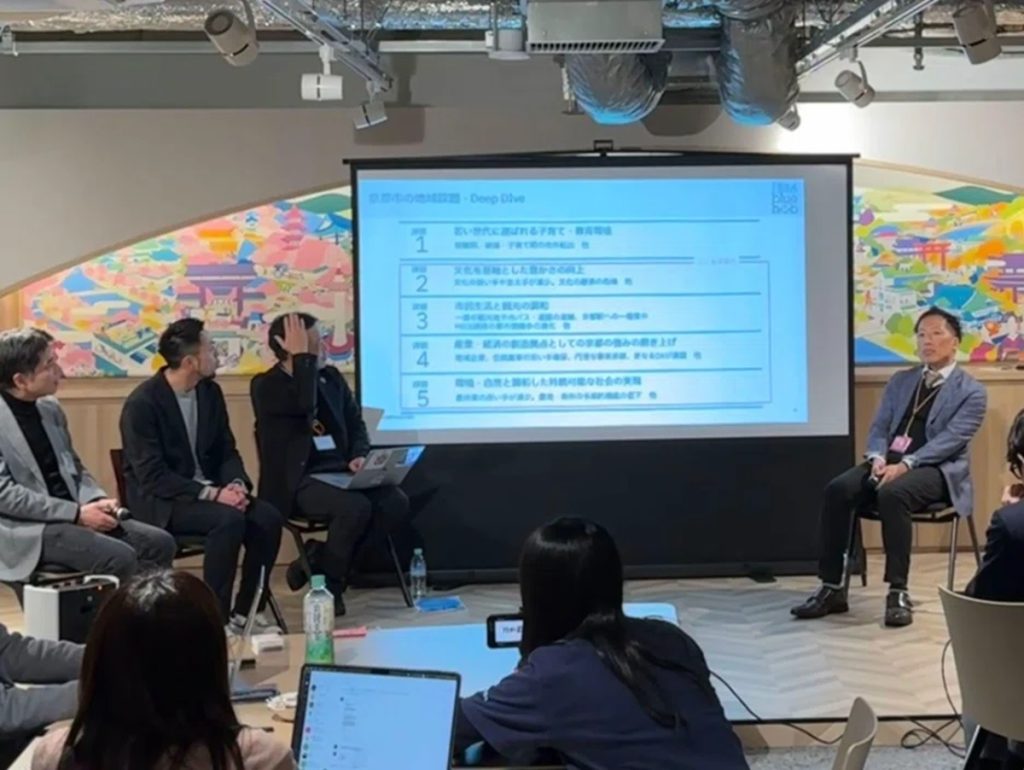
The new perspective of startups and the introduction of technology will provide solutions to the environmental, industrial, and economic challenges in Kyoto that were identified through this panel discussion.
The "IBM BlueHub Program in Kyoto" will provide concrete solutions to these regional issues from both technology and business perspectives, and will serve as a venue for collaboration between startups, local businesses, government, and financial institutions. This will undoubtedly accelerate Kyoto's sustainable development and industrial evolution.
Kyoto will continue to develop as a center for the creation of new industries and economies, while balancing environmental friendliness and sustainable growth. Expectations are high for the startups that will shape the future of the city and present their visions at IVSKYOTO 2025.






 JA
 EN
