


Therefore, we invited 75 promising startups from the "Seoul Startup Hub M⁺" and 8 out of 10 startups selected from startups across the city of Seoul to Japan to hold a pitch event in November 2023. This is the second part of a back-and-forth report on the content of the pitches.
CASE 5, Wayne Hills Bryant A.I., Inc.
Industry: Software and Information Processing
Industries we would like to collaborate with: banking, securities, etc., life and non-life insurance, mass media (agencies, advertising).
Based on A.I. and GTP, we are now offering "Generate" (Text To Service) service, an A.I. SaaS platform that automatically creates videos from test data and voice data.

We are a new business platform providing T.T.V (Text To Video) service, a solution to convert text data into digital video content.In 2017, we believed that "humans will get information from videos instead of books and other text," and we developed a generative AI-based SaaS service was developed.
Specifically, we use AI to convert into video the text of multi-page long texts such as policy clauses of insurance companies and securities firms, service descriptions of companies, various reports of financial institutions, and theses of universities and research institutes, as well as articles published by the media. We also produce videos for companies to sell their products on social networking sites.
By utilizing this service, a video of less than one minute can be produced for 10,000 yen. The unit price for general video production is 40,000 yen, and for advertising video production it exceeds 500,000 yen. Therefore, not only can the cost of video production be reduced by more than 90%, but also work that would have required 100 people to complete can be completed by a single person.
The company has received the CES Innovation Award 2022, the 2023 Edison Award Bronze Prize, and the 2022 K-Unicorn 200, and is currently a Microsoft Partner. We hope to create a new era of video, where anyone can easily create video by using generative AI.
CASE 6, Son One E&F Inc.
Industry sector: distribution, production and manufacturing
Industry sectors to collaborate: machinery, garbage and waste management, environment, production and manufacturing, sales and marketing.
We produce straws made from wood, which are easily recyclable and environmentally friendly without chemical process treatment, and after more than 4 years of research, we have developed an automated line with precision that includes advanced engineering methods and possesses unique technology that competitors cannot imitate in a short time in terms of production speed, accuracy, economy, and unit cost. We possess unique technology that is difficult for competitors to imitate in a short time in terms of production speed, accuracy, economy, and unit price.
We are a company that develops environmentally friendly wooden products and automated production solutions. 2015 saw the release of a video showing the removal of a plastic straw stuck in a sea turtle's nose, which raised awareness of the growing problem of marine debris and prompted countries around the world to enact policies regulating the use of single-use plastics. Policies have been enacted to restrict the use of single-use plastics in many countries around the world.
This led to the development of products to replace plastic straws. The typical product is the paper straw, but its carbon emissions during production are more than five times higher than those of plastic straws, and it cannot be reused. Furthermore, paper straws have been found to be harmful to the environment and human health, as evidenced by the detection of organic fluorine compounds in paper straws in Belgium, and the use of paper straws will be banned worldwide from 2024.
We have therefore developed high-quality, environmentally friendly wooden straws and wooden plates using wood as raw material. We have a 3,000 tsubo factory in Indonesia, which not only enables us to supply raw materials smoothly, but also developed the world's first automated manufacturing line that applies advanced engineering methods as a result of more than four years of research by a specialized group and cooperation between industry and academia. We are aiming to improve our technology by continuing our research and development until 2025.
Our goal is to create 100% recyclable products. The overseas market is very large, and we are in talks with Singapore to export 2.2 million units per day, and we are also in talks with Starbucks headquarters in the U.S. We expect sales of 33 billion yen in 2024 and 77 billion yen in 2025, and would like to make efforts to create products that contribute to ESG management, which will become essential in the future. We are determined to make efforts to create products that contribute to ESG management, which will become indispensable in the future.
CASE 7, Nine Watt Co.
Industry: Real estate, electricity, gas and energy, consulting, software and information processing, environment, local development and regional issues
Industrial fields of cooperation: construction and equipment, electronics and electricity, real estate, electric power, gas and energy, software and information processing, environment, local development and regional issues.
The company was founded by a graduate of Sungkyunkwan University's Smart City Lab, a U-City engineering major with a background of more than 200 environmentally friendly energy building design and consulting engagements. The company has a vision to solve climate problems by going carbon neutral in the building sector through building energy reduction solutions using information technology.
A common global challenge to become carbon neutral by 2050 is to improve the energy efficiency of public and private buildings and reduce carbon dioxide emissions. Policies are underway in Korea to improve building energy efficiency through green remodeling of existing buildings, in Japan to maintain energy efficiency in at least half of all homes and buildings, and in France to disallow leasing of buildings with low energy efficiency.
However, there are challenges such as whether it is really possible to weigh CO2 emissions and conduct expert energy efficiency audits of thousands or tens of thousands of buildings, and there are time and cost limitations to making this happen. To solve this problem, we have developed WATTI, a 3D map-based building energy analysis platform. This is a system that can diagnose and analyze a building's energy performance based on GIS, year built, use, etc.
Analysis modules and algorithms make visible the energy use, CO2 emissions, and energy efficiency of buildings on a city-by-city basis, allowing you to instantly find out which buildings are in need of renovation as a priority. So far, we have established a track record in South Korea, London, England, and Paris, France.
In Japan, too, the Tokyo Metropolitan Government has set a goal of reducing greenhouse gas emissions to 30% below 2000 levels by 2030. Of course, it may be difficult for a small overseas startup to expand into Japan alone, but if we work with Japanese companies and local governments, we believe we can update WATTI to a Japanese version. Let's work together to solve social issues.
CASE 8, Binding Inc.
Industry: Construction & Equipment, Electricity, Gas & Energy
Industry sectors you would like to collaborate with: construction and equipment, electric power, gas, and energy
We hope to leap forward as the new leader in the BIPV market with our zero-energy living data platform including transparent thin-film photovoltaic systems. Through our unique window-type transparent photovoltaic products, we will ensure space utilization, economic efficiency, stability, and acceptance by residents, and provide active building materials for construction companies to comply with the zero-energy certification requirements for apartment buildings.
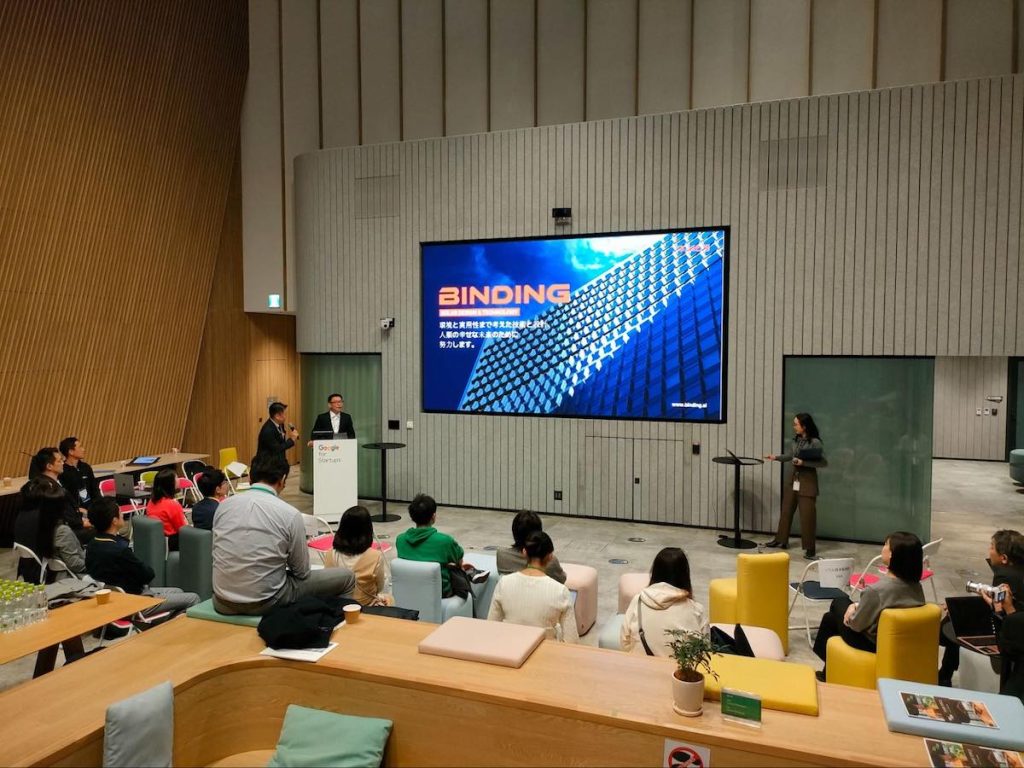
Industry accounts for 73.2% of global greenhouse gas emissions by portion. In Seoul, greenhouse gas emissions from buildings account for 68.7%. In Korea, we have been working for more than 10 years to create environmentally friendly buildings. Building on this foundation, our role is to develop and provide a diverse range of power generation equipment and products.
Specifically, we have developed a photovoltaic system that can utilize both the transparent (windows) and opaque (exterior walls) areas of a building, and have installed this system in Jungheung S-class condominiums, urban development projects, stations, laboratories, and office buildings in Korea. The installation of solar panels on building walls and windows is a new case in the world.
Zero-energy buildings will now be mandatory in Korea, and buildings will not be built unless they can achieve 20-40% energy self-sufficiency. Therefore, the BIPV market is growing rapidly, and we hope to leapfrog to become the new leader in this area.
We believe that Japan is no different and that a new energy market ecosystem can be created if transparent and non-transparent solar systems that integrate with buildings are incorporated into architectural design. By growing together with the BIPV market in Japan as well as Korea, we hope to contribute to a happy future for mankind.
[Editor's Postscript
Creww is developing global business with various regions including South Korea and Taiwan, as well as Western countries, and has realized multiple investments, MOUs, and collaborations. We hope to contribute to the region, society, Japan, and the world by continuing our activities to connect global startups and Japanese companies.
About [Creww's Global Open Innovation].





 JA
 EN
