


We want to create a unit of spiciness. A conversation over drinks turned into a project.

-- "unit of spicinessThe "spicy meter" is an interesting idea, but how did the spicy meter come into being?
A few years ago, I was having a drink with the film director, Kang Eguchi, and we were talking about work.Spicy food is difficult to understand because each restaurant has different descriptions of spiciness.You said, "I'm sure you're right.
One restaurant has 3 spicy, another has 5 spicy, another has 30 times spicy, and another has "hell," so I have no idea how spicy it is. It's all so disjointed.Unified indication of spiciness through collective knowledgeCan't we do that? If we could do that, we could use it as a "unit of measure.
I was shocked by this story and thought, "What a novel idea!
I don't know the technical details, but if it works, it may become a unit of measure used universally. I thought this should be realized, so I gathered professionals from various fields, including marketers, engineers, and designers, and began discussions.
--your conversation at the drinking table turned into a project.
That's right. A group of nice adults got together (laugh) and every time the discussion got heated: let's call it "spicy judge" to judge how spicy something is by eating it, let's call it "my spicy value" that is just right for me, let's use "KM (spicy meter)" as the unit, and so on.
The problem, however, was that each of us was busy with our day jobs, and it was hard to move forward. We talked a lot about the concept of the spicy meter, though,A large amount of spicy judge data and algorithms for analyzing it are necessary to incorporate it into concrete products.It is.
How to collect a large amount of data and how to pay for the development? It was at this time that one of our members found ITOCHU Corporation'sAccelerator ProgramIt was.
--you decided to increase the number of collaborators to make the spiciness unit a reality.
Yes, it is. However, there was no convincing material at that point to see if we could really create a unit of spiciness from collective knowledge, so we gathered all the "3 spicy" foods in the world and held a tasting session to rate the spiciness of each on a scale of 0.0 to 5.0.
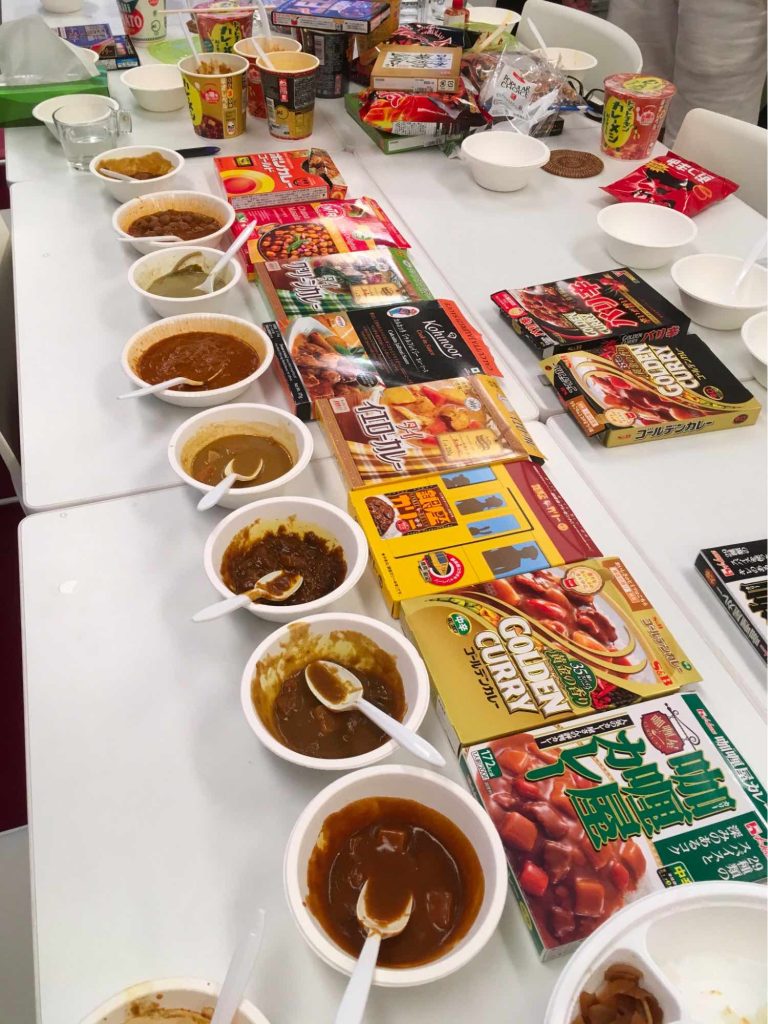
Then, even though each person's score varied, when the average was taken, they all came out to be satisfactory. Moreover, it was proven that even though the notation was the same "3 spicy," the spiciness of each product was completely different.
It's just the average that makes this convincing,Convinced that if we study algorithms, we can create units of spiciness from collective knowledgeI was very impressed with the presentation material. Based on this experience, I prepared my best presentation materials and went to ITOCHU's presentation.

Discrepancy between the description of spiciness and the actual spiciness, which was experienced during the presentation.
-In fact, what kind of presentation did you give?
At the time, we had no products to show, so to familiarize them with the concept of spicy meter, we asked them to try three kinds of commercial curry and rate their spiciness on a five-point scale.
In fact, all three curries were labeled "3-hot" by the manufacturer, but when we asked the participants to try them without knowing it, as expected, the evaluation figures varied. When we told them the truth, there was a stir among the audience.
From there, it is clear that there is a discrepancy between the notation of spiciness and the actual spiciness, that the units of spiciness in the world are a mess, and that thisI want to unify the disparate notation with "KM (spicy meter)".I appealed to the audience with high enthusiasm (laughter).
Then one of the ITOCHU people said to me, "You guys must have talked a lot over drinks," and "You thought seriously about something stupid. This was the highest compliment for us. We were very happy to hear that some of them said, "We should get to work on it right away.
Later that day, we received word that the project had been adopted, and we decided to proceed with the demonstration experiment.
--interesting. The actual experience was made more persuasive by the fact that the spiciness was described in different ways.
Yes, it is. Moreover, if the pungent meter is successful, there is a possibility that "grief" and "pain," which are similarly considered difficult to share a common understanding, can be quantified.
For example, we may be able to manage a person by saying, "You have a "difficulty" in living that exceeds 3.5, so you need to take a few days off. We are concentrating on creating a "unit of pain," but I think it would be interesting if other units could be developed from there.
ITOCHU CorporationIn-house Staff100 people judge 10 kinds of spicy menu items.
--What kind of demonstration experiments have you conducted with ITOCHU Corporation?
We created 10 spicy menus with the help of the employee cafeteria at ITOCHU headquarters and asked about 100 in-house staff members to judge the spiciness from 0.0 to 5.0 KM on a simplified version of the app from July to August 2019.
0.0KM is the criterion of not feeling spicy at all and 5.0KM is the criterion of not being able to eat it because it is too spicy.
We wanted the menu to range from moderately spicy to extremely spicy, so before the demonstration experiment, the spicy meter team tasted the curry and asked the chef to "make the curry a little spicier," and the first extremely spicy curry in the company cafeteria was born, with people saying "it was too hot to eat it all" at the actual event (laughter). (Laughs).
Looking at the current spicy meter, even products that claim to be very hot rarely exceed 3.0KM. But that very hot curry received a rating of 4.2KM. I could sense the chef's seriousness.
During the demonstration period, there were so many people who gave us spicy judges for all 10 menu items, and we are truly grateful to the chefs and of course to the ITOCHU in-house staples.
--Did you find any variation in spicy judging between those who were more and less tolerant of spicy food?
Even if there is variation, the collective knowledge will result in a satisfactory value. Moreover, it seems that after a few spicy judges, both those who are strong and weak in spiciness will come to understand the criteria for KM values. Then, for example, even those who are weak in spiciness will no longer judge 4KM spiciness against a 2KM menu. This was an interesting trend that we got from the demonstration experiment.
After that,We asked an associate professor at Kyushu University to brush up the algorithm many times, and we verified the large amount of data obtained from the demonstration experiment while developing the production application.The following is a list of the most common problems with the
--What was the timing of your incorporation?
This is the timing when the demonstration experiment was decided. We gathered professionals from all fields who shared our desire to create a globally uniform unit of spiciness, and incorporated the company in January 2019. Then, after the demonstration experiment,Official release of the application in January 2020I did.

New collaborations brought together by spicy food
-One idea took shape with the involvement of people around it and large companies. It is very dreamy, isn't it? What kind of efforts have you made since the release of the app?
At the time of its release, there were many hot and spicy events being held around the country that would attract 100,000 people a day, so we were planning to tie up with the events to attract more customers. But,Corona disaster scraps the plan.The following is a list of the most common problems with the
I was thinking about how to develop ...... until the corona was somewhat settled, but thankfully, the spicy meter was featured on TV. And on two prime-time shows.
We were surprised when the director of the program contacted us and said, "One of the actors in the show likes spicy food and wants to use the spicy meter in the show. As a result, the number of users increased dramatically.
Another person from House Foods, with whom I had exchanged business cards at a food-related trade show, contacted me and asked if I would be interested in a "Shiawase no Gekiho" (Happiness in a Hot Spot).Sales of collaborative projectsThe first time we reached this point, we were able to
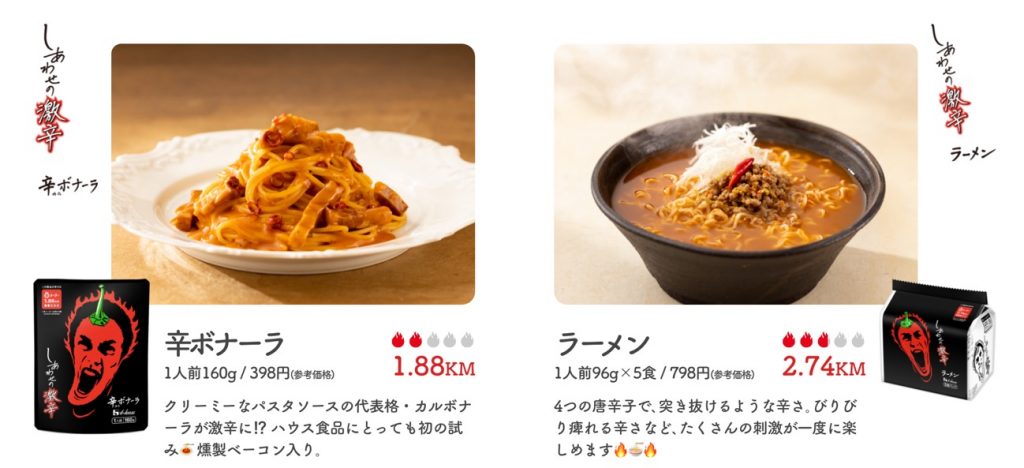
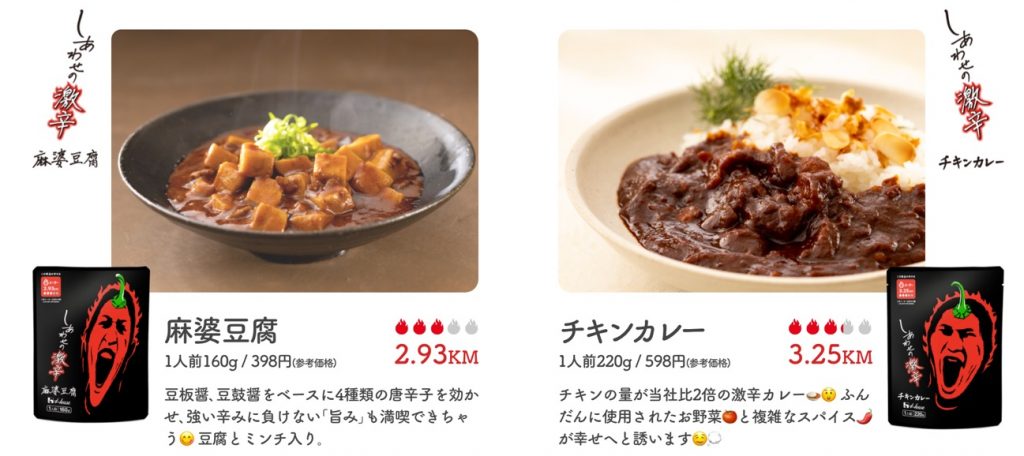
Most of the products that national brands claim to be "super spicy" are not spicy enough for those who love spicy food. However, when we talked about the idea of creating a truly spicy product, the spicy meter seemed to remind us of the spicy meter, and we were approached.
In both cases, we were very happy that they found the meter and contacted us, rather than us,Highly original ideasI thought that it was because of the
Increase the number of users and spicy judges to improve the accuracy of the unit.

-With the creation of the spiciness unit, it seems likely that collaboration will continue to expand.
I would be happy if that were the case.
We did not create the spiciness meter to make money, but rather to create a unit of spiciness that did not exist in the world, so we did not think much about monetizing it. However, in order to make the meter a unit of measurement used not only in Japan but also around the world, investment is necessary.
Right now, though, everyone is still involved on a hand-to-mouth basis,Eventually, we would like to increase the number of dedicated employees and develop various businesses, such as collaboration with other companies, marketing support using big data, super hot tours, and super hot certification tests.It is.
The fun of the spicy meter is that it can be used not only for daily use, but also to easily look up restaurants that offer the spicy food you like, even when you are traveling or on a business trip in a place you do not know the local area. For this to spread throughout Japan, the most important thing is that restaurants serving spicy food remain healthy.
Until the day returns when everyone can gather at a restaurant, eat spicy food, and smile, we will continue to contribute to the restaurants by increasing the number of users and spicy judges, while making steady efforts to brush up the UI and UX and improve the accuracy of the algorithm so that the spicy meter becomes a globally usable unit.
| name of company | Shinsen Meter Co. |
| Establishment | December 26, 2018 |
| Location | KH22 Building 5F, 1-15-6 Kego, Chuo-ku, Fukuoka City, Fukuoka 810-0023, Japan |
| representative | Tetsuzo Motoki, Representative Director and CEO |
| Business Overview | Operation of "Spicy Meter |
| uniform resouce locator | https://karameter.com/ |
 Mr. Tetsuzo Motoki Representative Director, Shin Meter Co.
After working as a magazine reporter and musician, he became a writer, interviewing over 5,000 people and producing over 100 books. He was awakened to spicy food when he visited Bangkok as a student. In 2017, he became involved in the activities of "Spicy Meter," and upon its incorporation in 2019, he became the president of the company.





 JA
 EN
