


The following is a report on a lecture given at the seminar by Mr. Ijichi, CEO of Creww Corporation, which operates an open innovation platform with startups.
Moved to the U.S. alone at age 15
Started his own business while attending California State University at the age of 21.
Established 3 companies and sold 2 (in the U.S. and the Philippines) in 7 years.
Returned to Japan in 2011 and founded Creww in 2012.
He has been involved in a wide range of activities related to the formation of startup ecosystems and the spread of open innovation, including serving as an executive board member of the New Economy Alliance and as a member of the J-Startup committee.
Background of the launch of Creww
Ijichi:I went to the U.S. by myself when I was 15 and went to high school and college. While in college, I created a company and then sold it. Then I went to the Philippines, built another company, sold it, and came back to Japan when the earthquake hit in 2011.
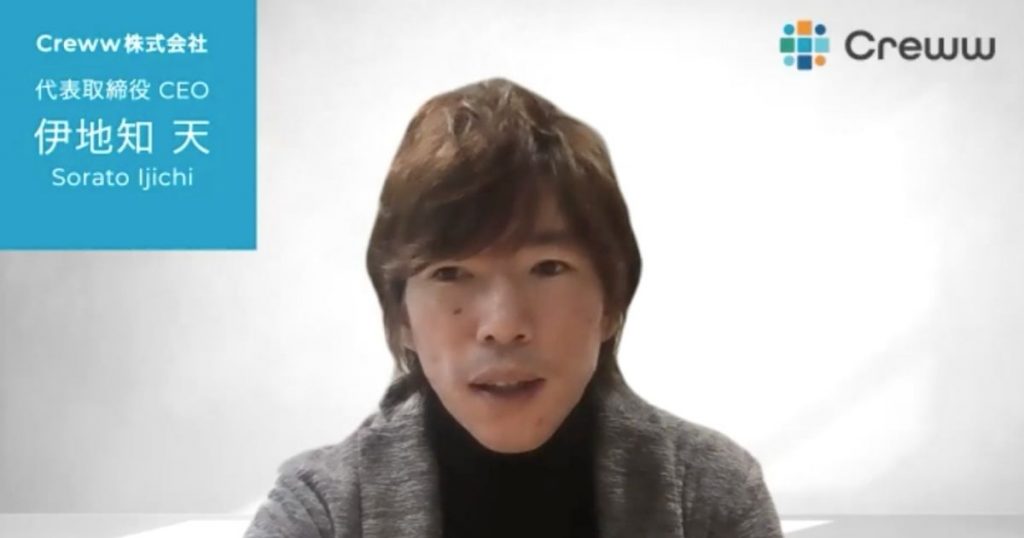
I came back to Japan and wanted to do something new, while the population was decreasing,We need to increase the number of people who create the next industry or take on new challenges.In 2012, we decided to support theCrewwThe company is called
Now.Creating a solid startup ecosystemorSpreading the word about open innovationI am also a member of the New Economy League, an economic organization led by Rakuten's Mikitani. I am also a member of the New Economy League, an economic organization led by Rakuten's Mr. Mikitani, and J-Startup, an organization run by the Ministry of Economy, Trade and Industry.
Startup services we are currently focusing on
Ijichi:Before I cut to the chase, let me share with you some of my personal favorite services.
First,Ecosia.This is a startup in Germany (Berlin), and they are planting trees. (There is a tree symbol in the upper right corner (of the service site), and if you search 40 times, the tree symbol turns to 1.
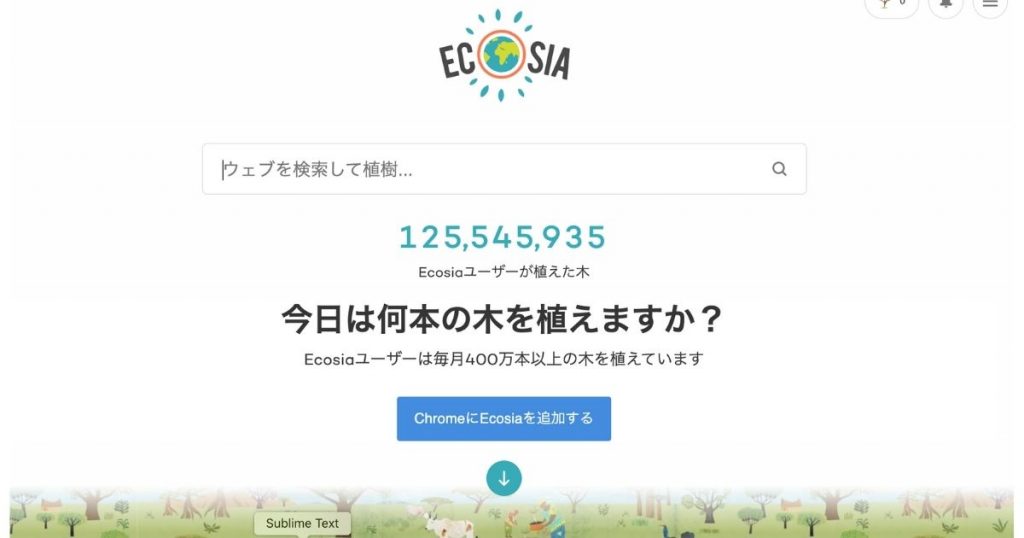
Europe is very environmentally conscious, so instead of using Google to search,Search "Ecosia" to plant a treeThis has been favorably received, and the number of trees already planted is currently 125,545,935.
It is well calculated that roughly 40 searches will result in the planting of one tree, so 40 searches will bring the result, "I will plant one tree on your behalf.
Until now, planting trees has been a volunteer activity, like donating money, but in their case, they make sales from advertising revenue and use a large portion of it to plant trees,We are creating a sustainable model.So.
When I thought about how to intertwine the SDGs with business,A world that spins without anyone having to put up with anything or anyone being forced to.We are focusing on the fact that this is a very useful case in which this kind of ingenuity is being used to create the "I'm not a fan of this kind of thing.
Another favorite is the "Smart Contact LensesThis is an American startup that is making a new product called "The first contact lenses". These are contact lenses that contain an extremely thin display.
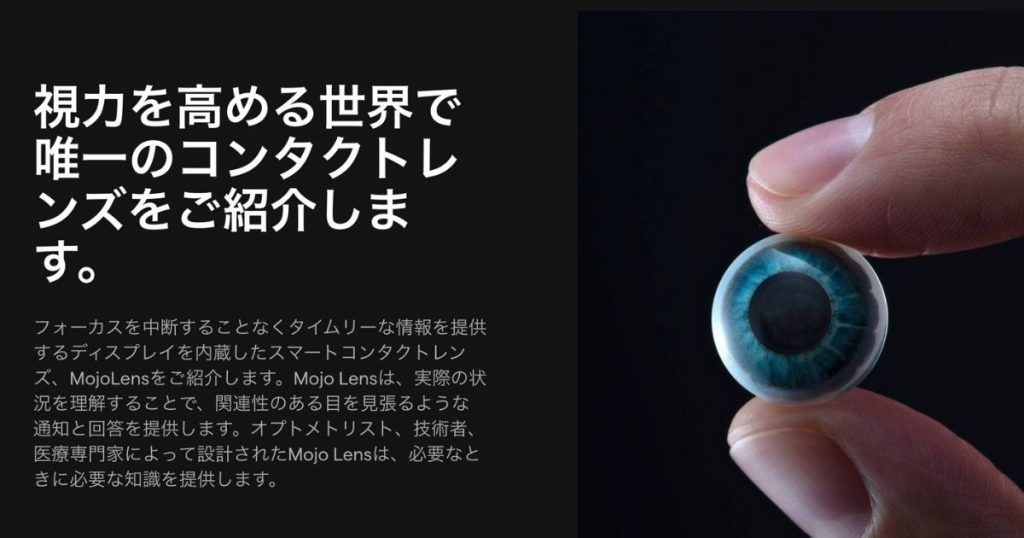
I'm talking about the so-called AR or VR realm, where a person's name appears the moment you meet them, or an arrow appears to guide you on your way,Lenses that make data appear to overlap with the real worldThe company makes
We are now moving forward with the commercialization of the contact lenses.Co-developed by Japan's MeniconI see that you are Mr.
The very same,Let's create a new market by combining the advanced services of overseas startups with technologies that have been cultivated in Japan.I think this is a very good example of what we are doing as a
Such initiatives are now taking place around the world. It is not necessarily the case that only large companies can participate in open innovation.Situation in which even small and medium-sized enterprises can participate in new initiativesHowever, it is also true that it is not easy to take the first step. I would like to talk a little about the thinking and psychological hurdles in this area.
Macro Trends in Innovation

Ijichi:In the midst of ever-increasing digitization,There is almost no organization or company that does not need to change.In other words, it is no longer the case that we can just continue to do the same thing for the next five to ten years and grow steadily. The point is that we are no longer in an era in which we can grow steadily by simply continuing to operate our existing businesses for the next five or ten years.
All companies and organizations areWe must be transformed by digitalization.is that it is a very natural and obvious thing to do.
Therefore, I believe that every company is working to improve internal productivity and efficiency, update existing businesses, and create new businesses through digitalization.
As for how to make that change, there are some companies that can promote it more and more on their own, but as for the majority of companies in general,Difficult to promote on your ownI think that is the reality.
This is due to the fact that there are not so many people within the company who are familiar with digital technology, and also due to the fact that it has been cultivated up to now,It is difficult to keep adding new things to an organization, values, and culture that has been optimized to conduct existing business.There is also the issue of
How to reliably promote DX and new business creation at low cost
In addition, if you are working with an outside party to promote digitization,It's not easy to get it right in an order-receipt relationship.It has been said that "the first thing to do is to know more about digital literacy. This is because, in the case of order receipt and delivery, the party placing the order who defines the requirements must first be familiar with digital literacy. In other words,Results depend on the digital literacy of the ordering party.The first is the
Bringing together each other's areas of expertise to create a win-win relationship, so to speak.Promoted through co-creationIf we can create a "digitalization" or "new business creation" system, it is no longer necessary to prepare a very large budget for digitalization or new business creation. By creating a framework that benefits everyone, it will be possible to promote the project at a low cost and without fail.
Short-term goals are fine, such as creating a new business in the next year or two, but what are the mid- to long-term goals to aim for?To create an organization that will enable us to create new things on an ongoing basis.It can be said to be.
To do so, we need toTo create a reproducible and sustainable model by accumulating proprietary know-how within the company.is important, and I believe it is the original meaning of open innovation and new business creation efforts for the company.
How to create a sustainable innovation system for your organization
In the process, we first create a new business in front of us, and then climb up the mid- to long-term staircase. I would like to talk about the differences between them.
The mindset of a company that works well is,How much progress are we making toward our mid- to long-term goals?In many cases, you have this in mind.
On the other hand, companies that don't do well are,New business creation and digitalization is a one-off event.For example, they decide whether or not they will be successful based on a decision axis such as whether or not they can create a business that will generate 5 billion in sales next year. For example, they decide whether or not they will be successful based on whether or not they can create a business that will generate 5 billion in sales in the next fiscal year.
Today, an increasing number of companies are working together with outside companies to promote digitalization and new business creation, which is difficult for them to promote on their own.Updating the company's organization itself over the medium to long term.Increasingly, the primary focus is on
What is a startup as a co-creation partner?

Ijichi:So, when it comes to who to work with for digitization and new business creation, there are several options.
The results of the "popularity ranking of co-creation partners for open innovation" survey are available in various places, but looking at the U.S. and other countries, it is clear that the following are the most popular70% are start-up companies.The company's sales accounted for
In Japan, there are really few examples of start-ups and new initiatives,Approx. 20-30%.The number of companies with which we are doing business is currently only about 1.5 times the number of companies with which we are doing business. So, where are you working with? Open innovation between companies and universities has been going on for decades.
It would be good if we could proceed as we have in the past, but considering the current situation in Europe and the U.S., where new industries are being created rapidly, it would be good if we could do the same in Japan,I would like to expand collaboration with startups a little more.I believe that this is the case.
Now we can ask, "What is a startup?" to review, the explanation would be that they are very advanced IT ventures. However, there are two types of venture companies: one category is start-ups and the other is small businesses.
This is a difference in style,Small business is starting a new business within an already established market.It is a venture business model that is growing slowly and steadily over the medium to long term. Examples include consulting companies, web production companies, design companies, SEO companies, and staffing agencies.
On the other hand,For startups, markets that are not establishedWe are competing on the basis of "the market. We believe that there is a market that we do not even know exists, and we create products and market them to the outside world.
Since many of them are doing almost unprecedented things, it is difficult for them to get bank loans. Instead, they give their shares to venture capitalists, angel investors, and recently, CVC by business companies to raise funds, conduct rapid experiments and verifications, brush up their services, and launch their products to the world. The model is that the product is released to the world, many people use it, and sales are generated for the first time.
We aim to go public or sell the business after several rounds of fundraising.
According to the Ministry of Economy, Trade and Industry (METI) website, the number of startups in Japan is approximately10,000-12,000 companiesIt is supposed to be about Of which,5,300 companieshave registered on the platform we are operating,About half of all startups are registered with Creww, which operates the website.The company will be called
Here are some examples of startups, for exampleW0TA."which sells disaster shower packages.
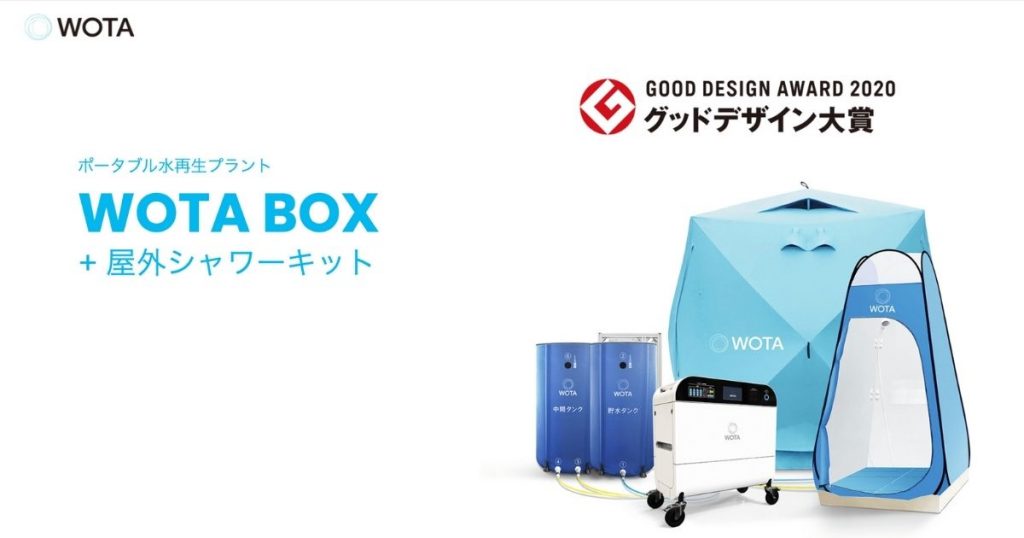
It has already been introduced in various governments, but this is a temporary form, the essence of their technology,A new type of filtration technology that uses AI and other machine learning techniques to recognize water contamination on the software side and regenerate water through repeated filtration.It's about having a
They are aware of the global issue that many people die from sanitary problems, and now they are making a product that allows you to take a shower about 50 times with 100 liters of water, but the truth is that "the shower is not a sanitary issue.The same water can be regenerated hundreds of times, eventually turning it into drinking water.The goal is to "solve the problem of water in space. More recently, we have been working with JAXA to "solve the water problem in space.
In order to realize the world they are aiming for, they have a temporary form now, and if, upon a quick glance, you think, "That's a shower booth company," you will no longer know how to collaborate with that start-up any more. If you take a closer look at what they are really aiming for and what the source of their technology is, you may come up with a new idea: "Can't we do something like this in cooperation with our company?
Thus, it is very difficult to determine the true value of a startup, but if you even know how to deal with it,Potential for many wonderful collaborations to emerge.It has the potential to
Startups have stages: seed, early, middle, and late. Currently, many startups are in the seed or early stage. When a startup reaches the "rater" stage, it seems that going public is just around the corner.
In many cases, companies that are working with startups for the first time will choose a rater that is already well developed and has already established its services.
As you get used to it, companies are getting more and moreDevelops discernment skills.Therefore, there are an increasing number of cases where companies are seizing early and seed stage companies, jointly developing them, and investing capital to create new markets with them.
By the company's own experience,It depends on which stage of startups you want to work with.I think it is a good idea.
Recently IPO (Initial Public Offering), business card managementSansanand you can create a store on the web.SASEand crowdfunding.Makuakuand accounting.freee%8 c1TP 3Te5%e 3At the beginning, some were skeptical that there was a real need for the service, but the company has raised funds, achieved results, gone public, and created jobs. However, they have raised funds, produced results, gone public, and created jobs.
The amount of funds flowing to these startups is increasing every year, and now it is about 400 to 500 billion a year. In 2012, when we founded the company, the amount was 65 billion.It has become easier to launch new startups.It can be said that
The U.S., on the other hand, is 7 to 8 trillion. Because of the difference in scale, one could argue that the startup ecosystem in Japan has yet to grow, but there is no doubt that it has improved dramatically over the past 10 years. One of the reasons for the steady increase is that business companies are spending more money on startups than before.
What is Open Innovation?
Ijichi:Open innovation is one of the means and methods of creating business. There are two main types of innovation: closed and open. Closed innovation is a completely in-house approach, so for example, there is an R&D research department in the company, and innovation is generated from there.
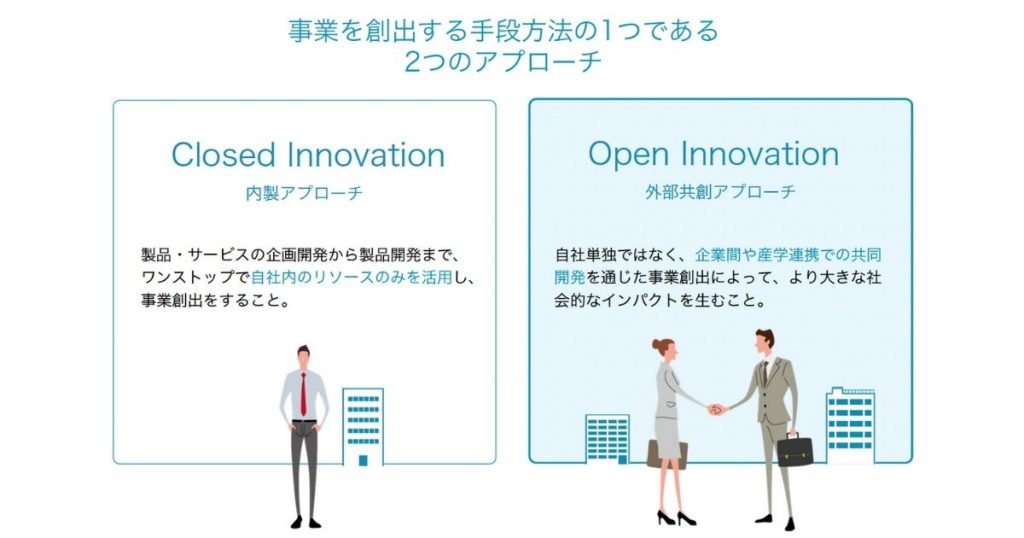
On the other hand,Open Innovation is a new business development and creation challenge, not by the company alone, but in collaboration with external companies, universities, local governments, and other companies, especially those in different industries.The idea is to
State-supported open innovation
Currently, we are in a situation where we can get support from the government for doing startups and open innovation,Very favorable tax treatmentThe "Municipalities" are being For example, starting last April, the "Open Innovation Promotion Taxation SystemWith a "+", your investment in the startup will bounce solidly back to the taxpayers.
Then, "theR&D taxation systemThere is also the "Open Innovation" and "DX Promotion". The Ministry of Economy, Trade, and Industry (METI) has also said that this can be applied to open innovation with startup companies, DX promotion, and R&D for new businesses.
We have dropped the cost of innovation by a factor of ten or less at a stroke, and have become a "Anyone can create a startup and a new business."Able to advance startup and internal DXWe accompany small and medium-sized companies and help them collaborate with startups through our activity called
For example, in Hiroshima Prefecture, we have combined 3-4 medium-sized companies with start-ups, and in Ehime Prefecture, we have a program that brings together local companies.
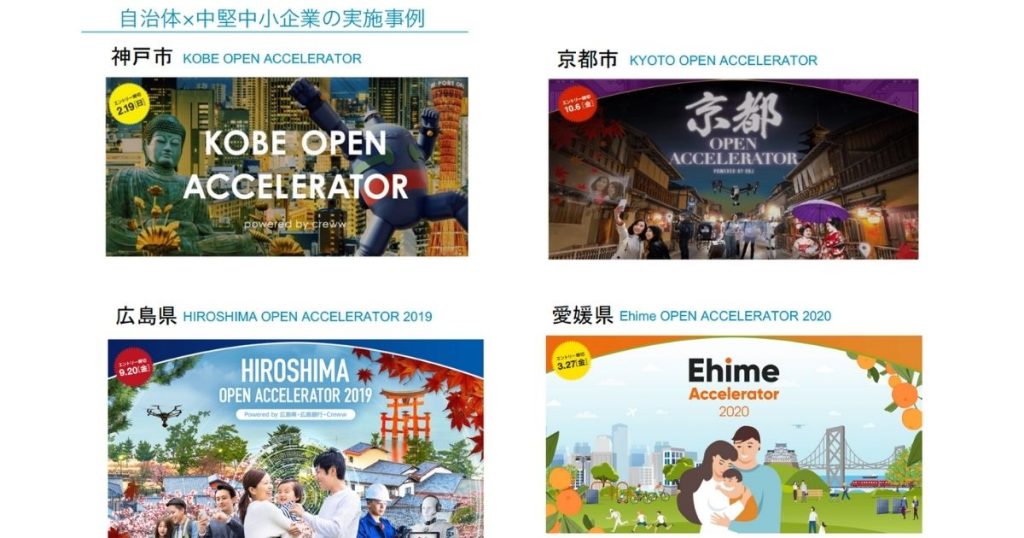
There is no doubt that Japan's treasures are found in the country's regions, and small and medium-sized enterprises (SMEs) also have wonderful technologies,Creating a new market from JapanI see potential for the future in this.
All over Japan for this kind of thing,47 prefecturesWe would like to expand the startup ecosystem and support the creation of DX and new businesses for companies throughout Japan.
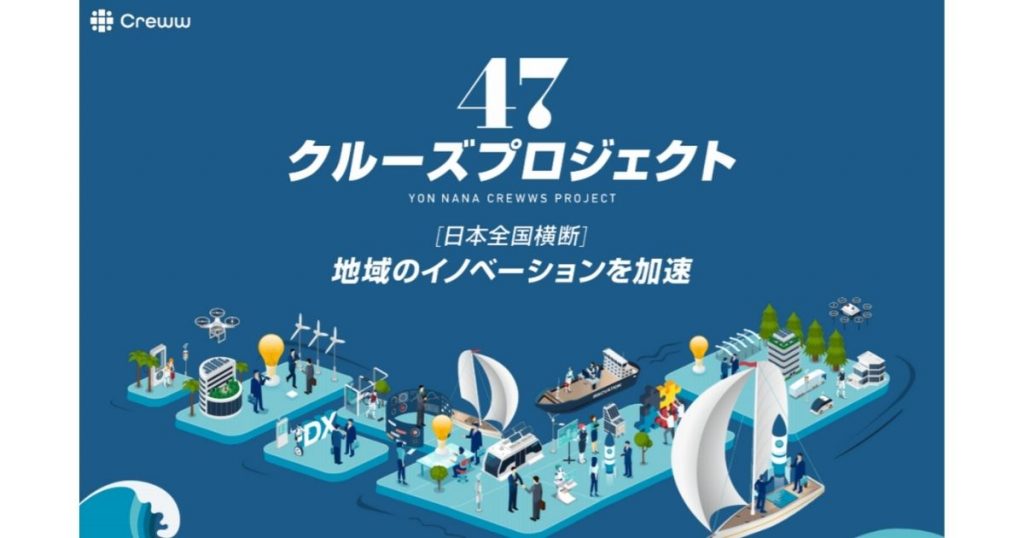
."Want to promote digitization"I want to create a new businessIf you have any questions or comments about the "What is the best way to get the best out of this project?Case studies based on successes and failures of the past 10 yearsPlease feel free to contact us for more information.





 JA
 EN
