


To solve these issues, Creww, a long-time leader in open innovation, has launched the "47 Cruises Project" to promote open innovation between companies rooted in local communities and startups nationwide. What does the "47 Cruises Project" mean for the future of Japan? We interviewed Creww President Ten Ijichi and Director Tomoyuki Mizuno about the background behind the launch of the project.
Open innovation projects to solve problems around the country

-First of all, could you give us an overview of the "47 Cruises Project"?
Alethea triandra var. japonica (variety of kangaroo grass) This combines ideas and technologies from small and medium-sized companies rooted in the community with startups from across the country,Open Innovation Program" for digitization, new business creation, solving regional issues, and revitalizing the Japanese economy.It is.
Until now, Creww has taken the lead in organizing this event, but in order to increase the speed and expand the innovation nationwide,Prepare an infrastructure that allows local governments, regional banks, consulting firms, etc. to take the initiative in holding "Open Innovation Programs" on the Creww platform.I did.
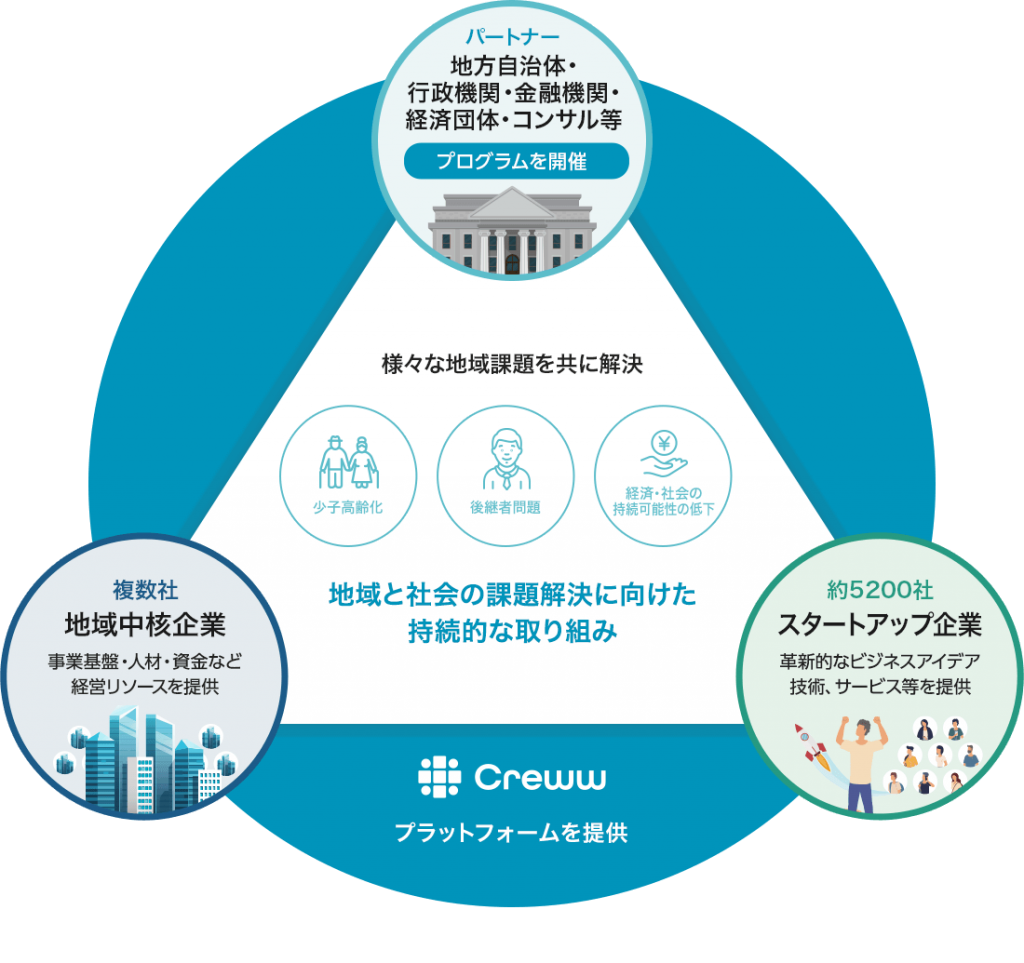
This is a system in which local companies and approximately 5,200 startups from across the country registered on the Creww platform participate.
By systematizing the open innovation know-how we have cultivated for nearly a decade and overwhelmingly compressing costs, we were able to create a program that anyone can hold and participate in.
➤Aiming to digitize, create new businesses, solve regional issues, and revitalize the Japanese economy
➤ Local governments, financial institutions, economic organizations, consulting firms, etc. can utilize the Creww platform to hold
Growing need for digitalization and open innovation in local companies due to the Corona Disaster
-How did the 47 Cruises project come about?
Alethea triandra var. japonica (variety of kangaroo grass) Creww has conducted several regional programs since 2016, including Kobe, Kyoto, Hiroshima, and Ehime. What we have keenly realized there is the need for open innovation between small and medium-sized regional companies and startups.
Moreover, the new coronavirus has bared its fangs at a time when the region was already facing a mountain of challenges, including the inability to stand on its own with existing businesses due to delays in digitization and the lack of human resources even if they wanted to digitally transform themselves. The Corona disaster has rapidly increased the need for digitization and open innovation in local companies. Further boosting the situation is the fact that teleworking is becoming more common.
pond snail (Viviparidae spp.) In addition, one of the triggers was that the Cabinet Office has set a national strategy to focus on the "formation of startup ecosystem base cities" in 2020, and local governments have begun to actively engage in open innovation.
However, it costs money and requires know-how for a region to put open innovation into practice.
That is why we have begun efforts to accelerate open innovation, with companies like ours providing know-how and databases, and local companies offering their management resources.
Alethea triandra var. japonica (variety of kangaroo grass) Yes, it is. Every local municipality in every region has a "To digitally transform small and midsize companies into companies that will be viable in the next generation." and "To create the soil for startups, entrepreneurs, and other people who create new industries.Two of the most urgent issues are recognized as being "the most urgent".
Matching local companies with startups is by far the most reasonable way to solve these problems all at once, and neither problem can be solved without the other.
If the number of companies in the region decreases due to the inability to respond to drastically changing social conditions, the local government and local banks will fall together. That is why we thought it was important to inaugurate a regional program, with the local government, regional banks, and consulting firms, which know the region well, as the main organizers.
Speedy demonstration experiments are realized by local companies.
-What are the benefits of collaboration between small and medium-sized local companies and national start-ups?
Alethea triandra var. japonica (variety of kangaroo grass) Open innovation is often thought of as an initiative between large companies and startups,Different partners to partner with depending on the startup phase and the IT literacy of the company.The first is that it is a very good idea to use the same type of equipment as the second.
For example, if a startup already has a product and just needs to make it known, it is best to work with a large company with a large customer base. On the other hand, for a startup that has a prototype but has not yet been tested, a targeted market and a sense of speed are far more important than a large customer base.
In the case of regional companies, there are many owner-presidents, and they can proceed with demonstration experiments quickly and with light footwork, which is a great advantage for both the startup and the regional company.
pond snail (Viviparidae spp.) If you want to spread your startup's service or product nationwide, it is effective to have a local company as an area partner. 80% or more of startups spread their services from Tokyo, but if you cannot collaborate with a large company that has a nationwide office, you need an area partner to help you expand your business nationwide. If you cannot work with a large company that has a nationwide presence, it will be difficult to expand nationwide without an area partner.
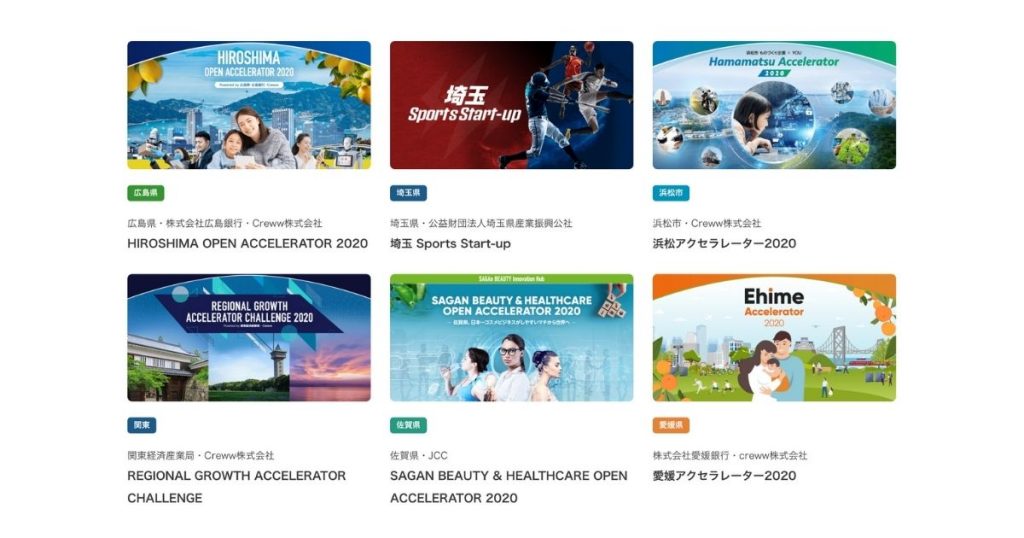
Alethea triandra var. japonica (variety of kangaroo grass) In the future, although there may be some institutional issues, I believe that the speed of innovation will increase even more if marginalized communities and other areas with pressing issues such as declining populations participate as demonstration test fields.
-I see, so it is effective for startups that are in the seed stage or considering nationwide expansion to work with local companies.
Alethea triandra var. japonica (variety of kangaroo grass) That is true. Besides, since many small and medium-sized regional companies have high technological capabilities with a single-minded focus, there is a high possibility that new value can be created through collaboration with technologies that lie dormant in the regions.
In order to revitalize the Japanese economy as well as to create companies and industries that will lead Japan's next generation, we intend to finalize the program in 20 of the 47 prefectures by July 2021 and realize the program in the remaining 27 prefectures in the next six months.
We would like to create a host player in each region and implement an ongoing program throughout the country, with a different face of local companies participating each year.
pond snail (Viviparidae spp.) This project is our very raison d'etre. We are a platform that supports the challenges of government, startups, and companies nationwide, and we have been working diligently for many years to support all kinds of companies, not just the big ones.
So, open innovation, which used to require high costs and know-how, can now be implemented nationwide with a low-cost, know-how-infused system. We would like to take advantage of this strength to seriously revitalize the Japanese economy.





 JA
 EN
