


(Head Office: Mito City, Ibaraki Prefecture; President: Masashi Noda; hereinafter "Ibaraki Kotsu"), Michinori Holdings, Inc. (Head Office: Chiyoda-ku, Tokyo; Group CEO: Jun Matsumoto; hereinafter "Michinori HD"), Hitachi City, Ibaraki Prefecture, Sumitomo Electric Industries, Ltd. (Head Office: Chuo-ku, Osaka; President: Osamu Inoue; hereinafter "Sumitomo Electric"), Pioneer Smart Sensing Innovations Corporation (Head Office: Bunkyo-ku, Tokyo; President: Haruhiko Takagi; hereinafter "PSSI"), Koito Seisakusho Co. (headquartered in Nagaizumi-cho, Sunto-gun, Shizuoka; Hitoshi Hirose, President; hereinafter "Koito Denko"), KDDI Corporation (headquartered in Chiyoda-ku, Tokyo; Makoto Takahashi, President; hereinafter "KDDI"), and KDDI R&D Laboratories, Inc. (headquartered in Fujimino-shi, Saitama; Hajime Nakamura, President; hereinafter "KDDI R&D Laboratories") plan to conduct an automated driving experiment using a medium-sized bus for 13 weeks from early October 2020 to early March 2009 (including the experiment preparation period).
This project was selected by the National Institute of Advanced Industrial Science and Technology (AIST), which was commissioned by the Ministry of Economy, Trade and Industry and the Ministry of Land, Infrastructure, Transport and Tourism*[1], to conduct a "demonstration experiment using a medium-sized automated bus" in FY2019, and is to be implemented. This is the second driving demonstration experiment following the "Demonstration and Evaluation of Last-Mile Automated Driving (Hitachi City)*[2]" conducted for two weeks in 2018, and will verify roadside sensors and remote monitoring devices that communicate with the automated vehicle.
The second phase of the Hitachi BRT*[3] extension was completed in March 2019, with a route length of approximately 9 km, including a dedicated road section (approximately 6 km) between Roadside Station Hitachi Osakana Center and Hitachi-Taga Station on the JR Joban Line, and is used by approximately 530,000 passengers annually.
In this year's demonstration experiment, the automated bus will operate on a new route that has been significantly extended from the previous route of approximately 3.2 km, with a timetable set in addition to the regular route bus timetable. By creating an environment in which the general public can widely use the buses, the aim is to encourage more users to use the buses not as a special means of transportation, but as a regular means of transportation, and to identify issues for full-scale commercial operation in 2022 and beyond.
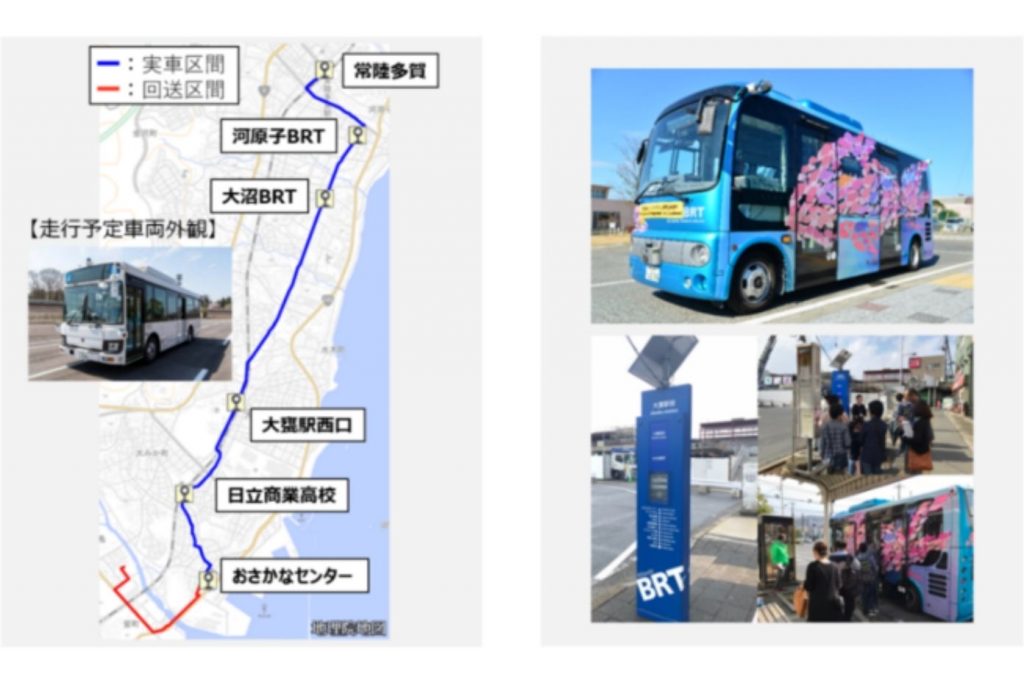
Key Points of the Demonstration Experiment
As part of efforts toward full-scale commercial implementation, the following two technologies will be introduced to achieve a high level of safety and stable operation in diverse environments.
(1) Cooperation with automated vehicles using roadside sensors
Roadside sensors utilizing various optical and radio wave sensors will be installed in areas that are difficult to see from the automated vehicle on dedicated road sections and public road sections, and will communicate with the automated vehicle to reduce the blind spots of the automated vehicle. By coordinating these roadside sensors with the signal coordination system verified in the previous verification experiment, the goal is to create a driving environment in which automated buses can run safely and smoothly on time. The roadside sensors will be installed in cooperation with Sumitomo Electric Industries, PSSI, Koito Manufacturing, and Koito Electric Works.
(2) Remote monitoring equipment
KDDI and KDDI R&D Laboratories will provide remote monitoring equipment and a communication environment for transmitting information remotely in order to support smooth operation of automated buses, including coordination with the roadside sensors and signal coordination system described above. In addition to checking the running status of the automated bus using camera images and various status information, the remote monitoring device will also monitor the operating status of roadside sensors installed outside the vehicle, and will verify how the operation of the automated bus will be managed when it is operated in the future.
For information on the status of preparations for the start of this year's full-scale demonstration, please visit the website of the MICHINORI Group's automated driving project (Japanese only).http://autonomousbus-project.com/ The committee decided to update the information as appropriate in the following section.
[1] Research, development, and demonstration project for social implementation of advanced automated driving, MaaS, etc.: Demonstration for social implementation of a terminal transportation system utilizing automated driving, etc. in a dedicated space
[2] For more information on this project, please see below.https://www.aist.go.jp/aist_j/news/au20180827.html
[3] Abbreviation for Bus Rapid Transit. The former site of Hitachi Electric Railway is used as a dedicated bus line.
| name of company | Michinori Holdings Co. |
| Establishment | March 16, 2009 |
| Location | head office Grant Tokyo South Tower 8F, 1-9-2 Marunouchi, Chiyoda-ku, Tokyo 100-6608, Japan |
| representative | Jun Matsumoto, Representative Director and Group CEO (Director and Managing Director, Management Co-foundation, Inc.) |
| Business Overview | Transportation related industries Optimization of public transportation network |
| uniform resouce locator | https://www.michinori.co.jp/index.html |



 JA
 EN
