


ASKUL, Kirin Beverage, Sugi Pharmacy, Nippon Paper Industries, and YKK AP will participate in the first lab. The goal is to share and analyze logistics big data among the companies to achieve joint transportation and delivery. Furthermore, the lab aims to build a sustainable logistics infrastructure by contributing to the realization of carbon neutrality and solving labor issues such as driver shortages.

Background of the establishment of the Logistics Big Data Lab
Japan's logistics industry is facing serious challenges. Under the "2024 Logistics Problem," there is concern about a shortage of transportation capacity due to the application of a cap on truck driver overtime hours. This is expected to cause logistics delays, and prompt countermeasures are required.
Under these circumstances, "joint shipping" is attracting attention as an effective solution. Joint shipping is a method in which trucks, containers, and other equipment are used to consolidate deliveries by multiple companies, which were previously carried out individually. This method is expected to solve multiple problems, such as alleviating chronic labor shortages and reducing CO2 emissions.
However, there are challenges in realizing joint transportation and delivery. In many cases, it is first implemented based on a one-time fixed data analysis. However, since the volume and frequency of cargo to be carried fluctuates with the seasons and other factors, a fixed sitting arrangement is not sufficient to cope with changes.
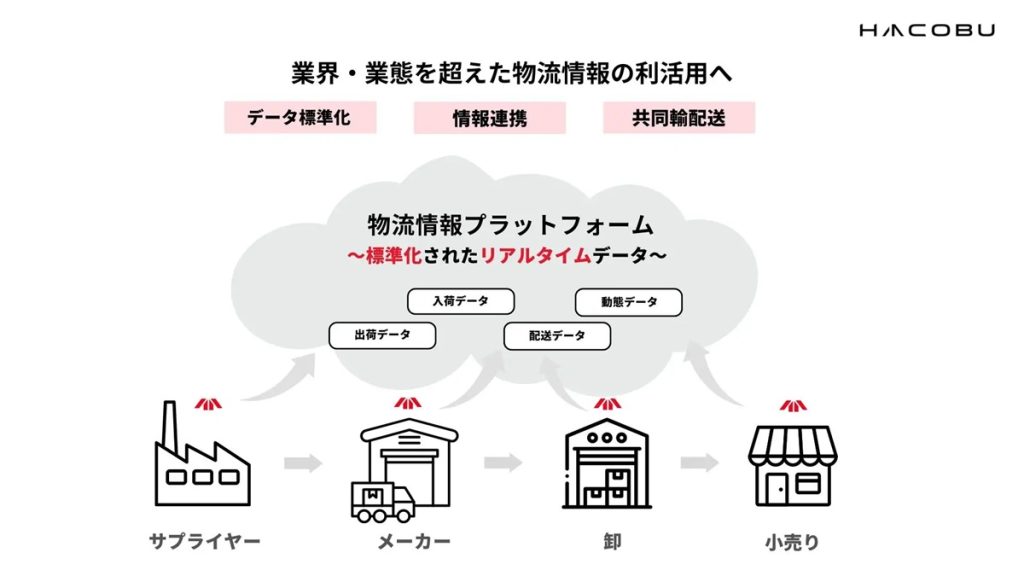
Hacobu has been promoting the construction of a "logistics information platform" that serves as a foundation for analyzing and utilizing logistics big data beyond the boundaries of individual companies, based on the belief that "data-driven logistics solves social issues. We are developing MOVO, a cloud logistics management solution that optimizes business-to-business logistics, and Hacobu Strategy, a logistics DX consulting service.
In June 2024, the number of business locations (*1) using MOVO exceeded 20,000, and the cumulative number of registered drivers (*2) exceeded 600,000, equivalent to about two-thirds of all truck drivers in Japan. As a result, the monthly volume of transaction data (*3) accumulated in MOVO, including "inbound/outbound information," "vehicle movement information," and "delivery case information," exceeded 1.7 million, creating the foundation for "logistics big data.
The "Logistics Big Data Lab" will make it possible to utilize transaction data accumulated in MOVO, which is already used daily by many users. This eliminates the step of each company bringing its own data for analysis, enabling faster and more efficient discussion and verification among companies for the realization of joint transportation and delivery.
Overview of Logistics Big Data Lab
The Logistics Big Data Lab aims to share logistics data among companies, transcending the boundaries of individual companies and industries, to solve social issues in logistics, and to realize joint transportation and delivery. The main objectives are as follows
(1) Realization of joint transportation and delivery through sharing and analysis of logistics big data among companies
(2) Spread of "data-driven logistics" to improve logistics efficiency
(iii) Contribute to society by avoiding situations where goods cannot be transported.
Hacobu believes that discussions and chemical reactions among various stakeholders are essential to solving social issues in logistics. We believe that the key to moving discussions forward and creating innovation lies in "data". We will promote "data-driven logistics" in this lab - constructive solutions are derived by looking directly at standard data generated on the same mechanism among companies.
An example of the use of logistics big data is the results obtained from the analysis of incoming data from MOVO Berth, a truck reservation acceptance service that is part of the MOVO series. This analysis revealed that 41.3% of all the operations that can be obtained by MOVO Berth on a given day have the potential for joint transfers and deliveries. This figure demonstrates the potential of this laboratory initiative.
○Reference: Press Release "MOVO's Logistics Big Data Reveals Feasibility of Joint Delivery in 41.31 TP3T of Daily Operations.https://hacobu.jp/news/6988/
The purpose of this laboratory is also in line with the "Government's Medium- to Long-term Plan for FY2030," which includes measures to "promote initiatives based on the Physical Internet Roadmap, such as the promotion of logistics standardization and data linkage, and promote joint transportation to improve loading rates and secure return cargo" (*4). (*4).
About Data Governance
We recognize that two main concerns exist regarding the use of logistics big data.
(1) Will the use of logistics big data undermine the confidentiality of the company's data?
(2) Will the company that accumulates logistics big data in its system gain an unfair advantage?
In April 2021, Hacobu formed the Logistics Big Data Governance Committee, which includes outside experts, in order to dispel these concerns and realize "data-driven logistics" that considers constructive solutions based on data. The committee has been working to develop guidelines for the use of logistics big data, incorporating third-party perspectives and opinions, and to improve the operational system.
Currently, following the discussions at the committee meetings, we are working on security measures in terms of technical and organizational aspects, while the Management Committee and the Information Security Committee are planning, monitoring, and verifying the measures. In addition, we have established a system under which these efforts are supervised and audited by outside directors and outside corporate auditors.
Logistics Big Data Governance Initiativeshttps://hacobu.jp/datagovernance/)
Security (security)https://hacobu.jp/security/)
Hacobu will continue to strengthen its data governance system to ensure fairness and objectivity.
Future Outlook
The Logistics Big Data Lab aims to transform logistics with short-term results and a long-term vision.
In the first year of the project, we will work to create examples of joint transportation and delivery based on logistics big data. In addition, we will discuss and verify a mechanism for both data expansion and continuity in order to realize joint transportation and delivery on more routes and maximize the social impact.
In the mid- to long-term, we will work to expand the number of participating companies and promote participation from diverse industries, while building a data utilization infrastructure for the era of automated driving. Through these efforts, we will contribute to the optimization of the supply chain in Japan as a whole.
Comments from participating companies
Takeshi Narimatsu, Executive Officer, General Manager, Logistics Division, ASKUL Corporation
The problem of labor shortages in Japan affects many industries, and the EC industry is no exception.
We believe that we can provide sustainable solutions to the structural issues facing the logistics industry while maintaining the basic values that our customers demand from EC logistics, such as low cost, high quality, and short delivery times.
The keywords for this are "DX" and "co-creation.
The "Logistics Big Data Lab" in which we are participating this time is a challenge to derive optimal solutions for logistics that straddle industries, business categories, and business relationships from data on a single platform, going beyond the collaborative network that we have formed individually up to now. We are very much looking forward to this new idea.
Masato Kakebayashi, Executive Officer, General Manager of SCM Department, Kirin Beverage Company, Limited
Kirin Beverage is taking on the challenge of various initiatives to build a sustainable and innovative supply chain. In particular, we believe that shifting from a world of individual company optimization to a world of industry-wide optimization is an important element from the perspective of sustainability in the logistics industry, and the use of big data can be a solution to this challenge.
By participating in the "Logistics Big Data Lab," we hope to work with Hacobu to solve social issues (i.e., optimize transportation) by researching new supply chain optimization approaches.
Nobuyuki Kitagawa, General Manager, Logistics Department, Sugi Pharmacy Co.
For us retailers, logistics is an extremely important part of our infrastructure. We expect that our participation in the "Logistics Big Data Lab" will enable us to conduct more advanced data analysis than ever before, thereby improving the efficiency of logistics processes, reducing costs, and ultimately realizing sustainable logistics. We are also convinced that improved logistics will also greatly contribute to the improvement of employee comfort and the work environment. As a retailer, we will do our utmost to realize sustainable logistics together with the participating companies of the Logistics Big Data Lab in order to provide products to our customers in a stable manner.
Tomomi Nojiri, Executive Officer, General Manager, Sales Planning Division, Nippon Paper Industries Co.
I am very pleased to participate in the creation of the Logistics Big Data Lab. For the logistics industry, which faces many challenges such as labor shortages and environmental concerns, we have felt that collaboration among multiple companies would be very effective in improving transportation efficiency and reducing environmental impact, but the collection of logistics data, which is the basis for consideration, has been a major issue. We feel that the "Logistics Big Data Lab" will not only solve the problem of data collection, but also has the potential to expand to cooperation among multiple companies, which we expect will lead to even greater results.
Minoru Iwasaki, Executive Officer, CLO (Chief Logistics Officer) and General Manager, Logistics Department, YKK AP Co.
We are very much looking forward to working with Hacobu and other companies to conduct advanced research through our participation in the "Logistics Big Data Lab". As a company with a policy of "contribution to the global environment" and "employee happiness management," improving logistics efficiency is a major reform on a national level, and is positioned as an extremely important issue in our business operations. Through the sharing and utilization of logistics data, we will make a significant contribution to improving productivity and reducing the environmental impact of the industry as a whole.
Taro Sasaki, President and CEO, Hacobu Co.
Why have we created a "logistics information platform" to "optimize transportation"? One of the answers lies in the creation of this "Logistics Big Data Lab". To optimize logistics, cooperation among companies is necessary. To do so, it is necessary to look directly at data among companies and envision the future. So, how can we look directly at data among companies? We are convinced that the best way to achieve this is to utilize data generated on the same system. We will co-create new open innovation based on data with each company to revolutionize logistics in Japan.
About Hacobu Corporation
| name of company | Hacobu Corporation |
| Establishment | June 30, 2015 |
| Location | 9F Mita 3-chome MT Building, 3-14-10 Mita, Minato-ku, Tokyo 108-0073, Japan |
| representative | Taro Sasaki, President and CEO |
| Business Overview | MOVO" series of cloud logistics management solutions and "Hacobu Strategy" logistics DX consulting services. In addition to providing cloud services such as "MOVO Berth," a truck reservation acceptance service with the largest market share (*5), "MOVO Fleet," a dynamic management service, and "MOVO Vista," a delivery case management service, and "MOVO Driver," a smartphone application that changes the way drivers work, we also provide logistics As a DX partner, we support the optimization of business-to-business logistics. |
| uniform resouce locator | https://hacobu.jp/ |
1 The number of offices using MOVO is the total number of IDs of offices that use MOVO in addition to the MOVO installation sites.
2 Cumulative number of registered drivers. Cumulative number of IDs of driver phone numbers registered by users when they use "MOVO Berth".
3 Sum of user transaction data associated with the use of each product in the MOVO series.
*4: Exhibit "The Government's Medium- and Long-Term Plan for FY2030"https://www.cas.go.jp/jp/seisaku/buturyu_kakushin/pdf/20240216.pdf
5 Source: "Actual Conditions and Outlook for Smart Logistics Solution Market [FY2023 Edition].https://mic-r.co.jp/mr/02960/Share of berth management systems market in terms of revenue and number of locations






 JA
 EN
