



This agreement will select private operators to launch satellites developed by JAXA's publicly solicited nano-satellite missions, and will support the commercialization of space transportation services by startups and others through launch order contracts. The Japanese government has proposed a policy plan (*1) to secure domestic launch capacity of approximately 30 launches per year by the early 2030s, utilizing national and private launch vehicles.

Obtained support for both R&D and launch contracts to realize low-cost private space transportation services.
This agreement was concluded based on the JAXA-SMASH (JAXA-Small Satellite Rush Program, a transportation/nano-satellite mission expansion program by industry, academia and government), in which nano-satellite missions are publicly solicited and launched by private transportation services selected by JAXA (*2). Interstellar Technologies was selected as "Launch Services Provider A," which will be given priority in future ordering contracts.
Based on the new Basic Plan for Space Policy approved by the Cabinet in June 2023, the Japanese government has set a goal that all domestic satellites, whether government or private, will be launched by national key launch vehicles or private launch vehicles from FY2028 onward, and that overseas demand will also be met. In September 2023, Interstellar Technologies was also selected for the "Small and Medium Business Innovation Research and Development Promotion Project (SBIR Phase 3)" (*3) by the Ministry of Education, Culture, Sports, Science and Technology, which promotes research and development by start-ups and others. The project will support both research and development as well as the ordering of launch contracts in order to realize low-cost, high-frequency commercial space transportation services in Japan as soon as possible.
*1 Space Policy Committee 109th Meeting Agenda https://www8.cao.go.jp/space/comittee/dai109/gijisidai.html
*2 JAXA-SMASH Web page https://aerospacebiz.jaxa.jp/jaxa-smash/launch-service/
*3 Press release dated September 29, 2023 https://www.istellartech.com/news/press/8289
Comments by Takahiro Inagawa, President and Representative Director, Interstellar Technologies Corporation
JAXA-SMASH is an opportunity to demonstrate innovative nano-satellite technology to break through these limitations. We are very honored to have the opportunity to contribute to this opportunity with our space transportation services. In the future, the opportunities for space transportation from Japan are expected to increase by an order of magnitude. We will continue to work hard on technology demonstration and business development so that we can continue to meet expectations in this era of change.
Competitive prices and dedicated launches are our strength.
ZERO is a small rocket targeting small-sized satellites, which have been driving the market expansion in recent years. The space transportation service provided by ZERO is competitive in price, with a launch cost of less than 800 million yen per launch vehicle (when mass-produced), which is achieved through an all-in-one development and manufacturing system, and in flexibility, with launches tailored to diverse satellite business models. Our strength lies in our "competitive price" of less than 800 million yen per launch (at the time of mass production), which is realized by our integrated development and manufacturing system, and our "flexibility" in launching satellites exclusively according to diversified business models. For satellite operators in Japan and other Asian and Oceania countries, the "convenience" of having a launch site close by and not having to deal with the hassle and cost of launching satellites is also a value that we offer.
Maximum satellite weight of 800 kg in LEO to establish a position in the Asia-Oceania market.
The weight of small satellites targeted by ZERO is in the 100 to 200 kg class, and in view of the recent trend, ZERO has increased its capacity to launch satellites weighing up to 800 kg into Low Earth Orbit (LEO) in order to meet strong domestic and overseas demand. The ZERO rocket is capable of launching satellites weighing up to 800 kg into low Earth orbit (LEO). This will contribute to the establishment of independent space transportation services in Japan and establish our position in the Asian, Oceania, and European markets.
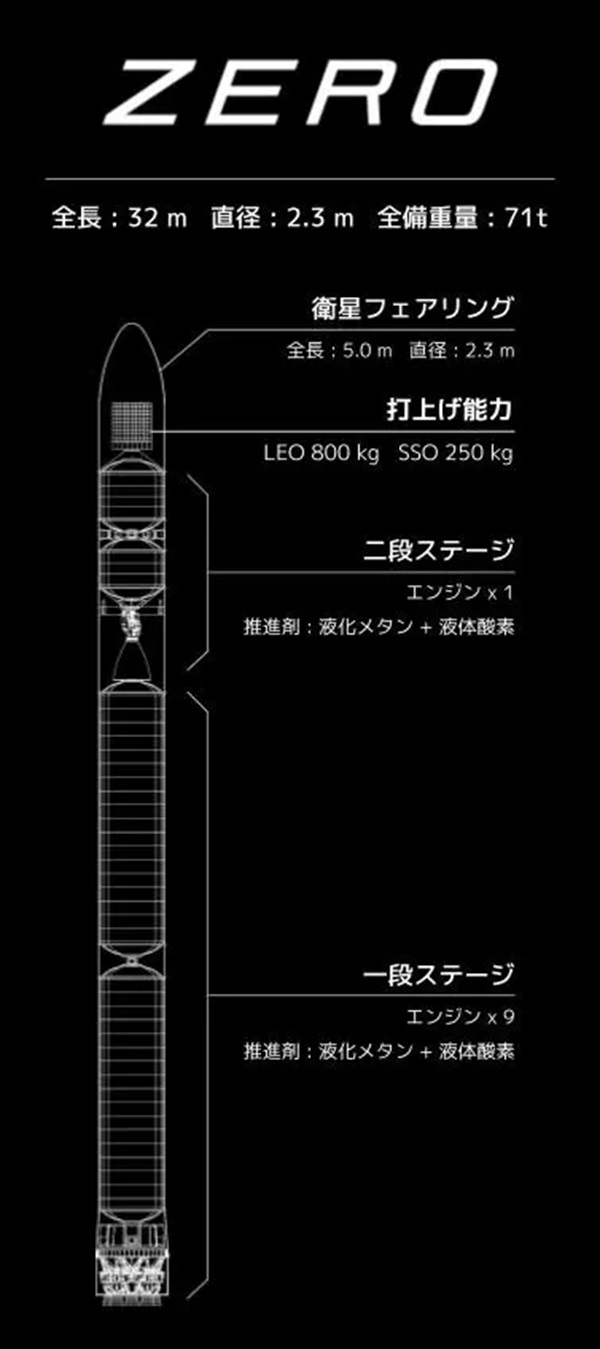
Rocket ZERO Specifications
Total length: 32 m
Diameter: 2.3 m
Total weight: 71 t
Number of engines: 9 for first stage, 1 for second stage
Propellant: Fuel liquefied methane (liquefied biomethane), oxidizer liquid oxygen
Launch capacity: LEO 800 kg / SSO 250 kg *Maximum future capacity
About Interstellar Technologies
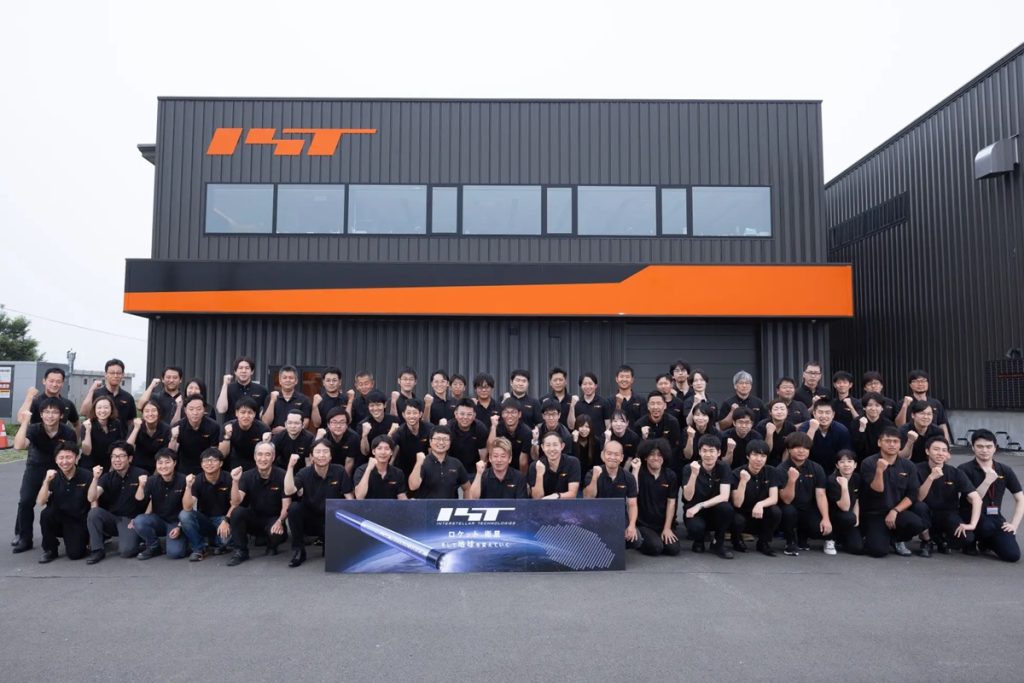
Interstellar Technologies is a start-up company that aims to realize a future where space is within everyone's reach by providing low-cost and convenient space transportation services. Headquartered in Taiki-machi, Hokkaido, the company is developing its products at four locations: the Tokyo office, the Fukushima office, and the Muroran Institute of Technology (at the Muroran Institute of Technology). The company has made a total of three space flights with the observation rocket "MOMO," the first and only Japanese private company to reach outer space, and is now in full-scale development of the next-generation small satellite launch vehicle, the ZERO. We are also involved in the satellite development business Our Stars, aiming to be the first vertically integrated service of rocket and satellite in Japan.
| name of company | Interstellar Technologies, Inc. |
| Establishment | Takahiro Inagawa |
| Location | 149-7, Aza-Mebu, Taiki-machi, Hiroo-gun, Hokkaido |
| representative | Takahiro Inagawa, President and Representative Director |
| Business Overview | Rocket development, manufacturing and launch services |
| uniform resouce locator | http://www.istellartech.com/ |






 JA
 EN
