




Culture test of microalgae gardieria using boiler exhaust gas
To achieve carbon neutrality, Galderia has received support from Hiroshima Prefecture to develop a culture method using photosynthesis in Galderia that utilizes the exhaust gas from the boiler, a currently unused heat source, and the CO₂ contained therein.
As a demonstration experiment with Mitsui Kinzoku Takehara Smelter & Refinery, we have succeeded in culturing photosynthesis of microalgae, Galdieria, directly using boiler exhaust gas, which is rare in the world.
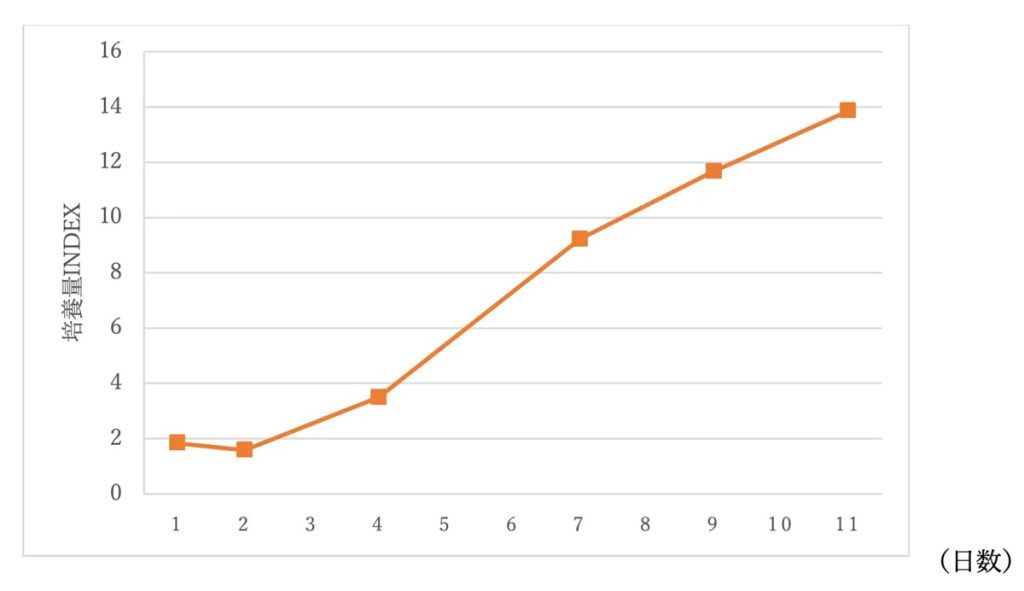
Galderia confirmed good growth in a photosynthesis culture experiment conducted from November to December 2023 using the in-plant facilities of Mitsui Kinzoku's Takehara Smelter and Refinery. The experiment used boiler exhaust gas generated in the Takehara Smelter and Refinery process, which contained approximately 200 times the atmospheric concentration of CO₂.
Galdieria, which inhabits sulfuric acid hot springs, has the characteristics of a microalgae with extremely high growth capacity under extreme conditions. In this experiment, photosynthetic cultivation in a solution with increased CO₂ concentration and acidity due to boiler exhaust gas was achieved with higher efficiency than under atmospheric conditions.
In the photosynthetic culture of microalgae, it is possible to increase the culture efficiency by moderately increasing the amount of CO₂ in the culture medium. However, purchasing and using high-purity CO₂ is not cost-effective, and if exhaust gas is used, growth inhibition may occur due to components other than CO₂. The Galdieria, as an extreme environment organism that lives in sulfuric acid hot springs, has high acid tolerance, the ability to survive in a 100% CO₂ atmosphere, and tolerance to nitrogen oxides (NOx) and sulfur oxides (SOx), and has the advantage of being able to utilize general exhaust gas that contains a lot of CO₂ as is.
Garidi area: Cultivation situation utilizing exhaust gas
What is microalgae gardieria?
The sulfotrophic hot spring red alga Galdieria is a 3-16 μm microalgae that specifically adsorbs valuable metals such as gold (Au) and palladium (Pd) on its spherical cell surface. It is also an extreme environment organism that can be cultured in harsh environments with medium-high temperature, high CO₂ concentration, and low pH.
Future Outlook
In general, there are very few examples of full-scale cultivation of microalgae using exhaust gas, and to the best of our knowledge, none have reached the practical stage. Based on the success of this experiment, we are planning to cultivate microalgae on a practical scale to reduce CO₂ emissions at the Takehara Smelter & Refinery of Mitsui Kinzoku.
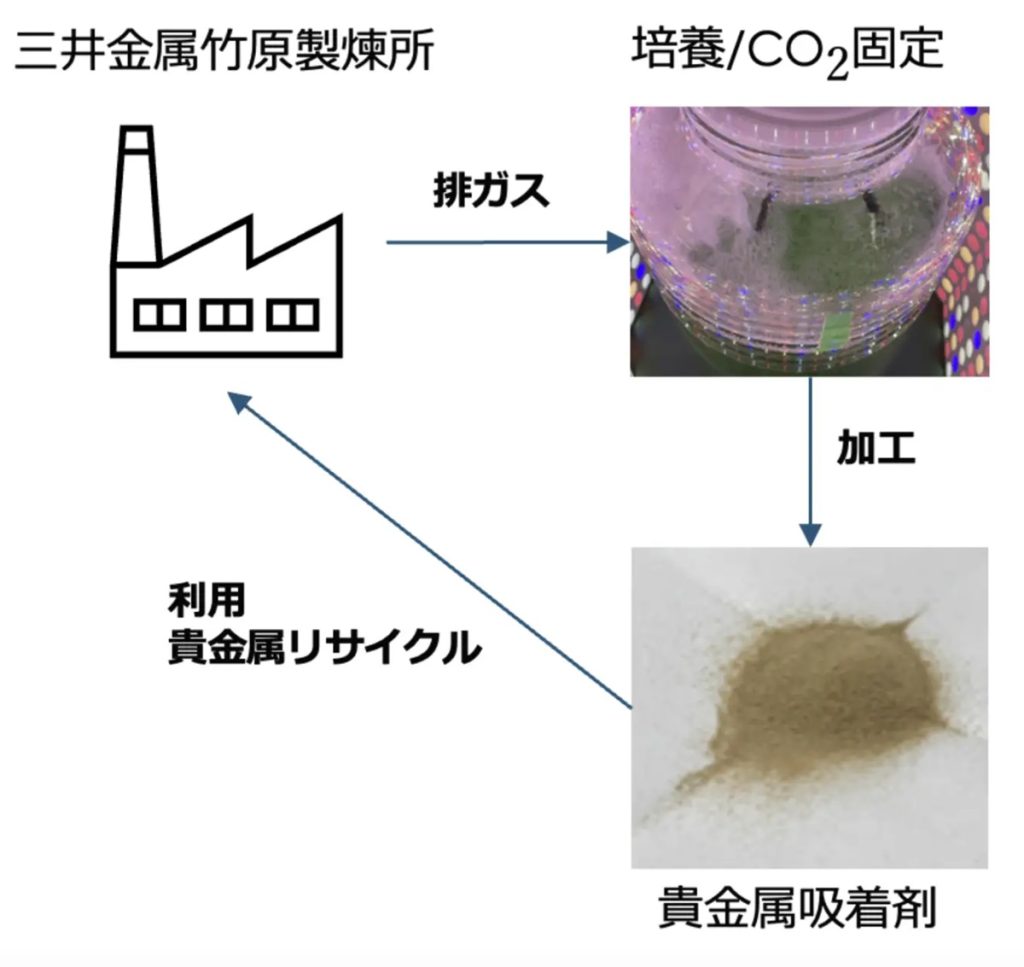
Furthermore, by utilizing the cultured gardieria to produce a precious metal adsorbent using our technology and utilizing it in the precious metal recycling process at Mitsui Kinzoku's Takehara Smelter & Refinery, we will simultaneously realize the recovery of trace amounts of precious metals in wastewater, which could not be recovered by conventional processes.
Collaboration with Mitsui Kinzoku Takehara Smelter & Refinery: Future Prospects
Comments from related organizations
Innovation Promotion Team, Commerce, Industry and Labor Bureau, Hiroshima Prefectural Government

We are very pleased to receive the report on the results of the experiment between Gardelier and Mitsui Kinzoku Takehara Smelter and Refinery, and again recognize that this is a very significant achievement, and we have high expectations for the future.
Hiroshima Prefecture has formulated the "Hiroshima Prefecture Carbon Circular Economy Promotion Plan" for the realization of a "Carbon Circular Economy," a social economy in which carbon resources are recycled sustainably, in 2022. The plan aims to strengthen demonstration and research of carbon recycling-related technologies, establish a "hub" for such research, and create a cluster of new industries centered on carbon recycling.
As a specific initiative, we launched the HIROSHIMA CARBON CIRCULAR PROJECT, a unique subsidy program for carbon recycling research, in FY2022, and are supporting the efforts of Gardelia and the Takehara Smelter & Refinery of Mitsui Kinzoku Mining Co.
We believe that the success of this culture test is an excellent result that will lead to the development of carbon recycling technology and reduction of CO₂ emissions of companies in the prefecture, and we look forward to further technological development, including scale-up in the future.
Mr. Nakayama, Technology Management Department, Metals Division, Mitsui Kinzoku Mining Co.
Although it is a small step, we are pleased with the result.
We have been conducting experiments on CO₂ fixation of our own exhaust gas using microalgae in collaboration with Gardelia.
We regard efforts to reduce our environmental impact as one of our most important management issues, and have been working to increase the processing of recycled materials and reduce our environmental impact in terms of waste, water pollution, and plastic usage in order to realize a recycling-oriented society.
This time, we have newly succeeded in cultivating microalgae using waste heat and CO₂ contained in boiler exhaust gas emitted from our plant.
Since Gardelia's microalgae adsorb precious metals, we expect to improve the recovery rate of precious metals contained in trace amounts in the wastewater from the process of recovering precious metals from recycled materials if we can recover them with this microalgae, and we believe that this will be an example of contributing to resource recycling.
We will continue to promote joint development with Galderia, and even recovery of precious metals using Galderia, in order to reduce environmental impact.
About Galderia
Galdieria is working to solve global social issues through research and development of Galdieria, a microalgae that lives in hot springs. By utilizing its overwhelmingly efficient cultivation ability compared to other microalgae and precious metal adsorption ability acquired through survival in extreme environments, we are working to realize a circular economy, improve the global environment, and solve food problems through safe and highly efficient recycling of precious metals in urban mines, replacement of mercury still used in natural mines, application of high-quality content in foods, and reduction of CO₂. We are committed to improving the global environment and solving food problems through the reduction of CO
| name of company | Galderia Corporation |
| Establishment | October 1, 2015 |
| Location | Head Office : 2-4-2-709 Nihonbashi Hamacho, Chuo-ku, Tokyo Tsurumi Lab: Room 106, Leading Venture Plaza 2, 75-1 Ono-cho, Tsurumi-ku, Yokohama |
| representative | Hajime Tanimoto, Representative Director and CEO |
| Business Overview | Production, research and development of microalgae such as the sulfate hot spring red alga Galdieria Development of technology for recovery of precious metals, rare metals, and other metals by Galdieria; production of adsorbents Research and development on the production of pigments and other metabolites from microalgae and their application to cosmetics and foods Development of environment-related technologies for plants and microalgae Business development for other biotechnology-related businesses |
| uniform resouce locator | https://galdieria.com/ |






 JA
 EN
