


We are pleased to announce the technologies selected for this year's Innovative Technologies 2023!

Experience the "new future" ahead of time with the adopted content technology
Since 2012, the Digital Content Association of Japan (DCAJ) has been conducting "Innovative Technologies" as a project to discover and disseminate technologies that are expected to make a significant contribution to the development of the content industry.
The 12th "Innovative Technologies 2023" has selected seven outstanding content technologies through deliberations by the Screening Committee. The selected technologies will be exhibited at "INTER BEE IGNITION × DCEXPO 2023" (November 15 (Wed.) - 17 (Fri.), 2023 at Makuhari Messe).
Innovative Technologies 2023" includes robots that allow people to experience the realistic stresses of childcare; systems that allow experiencers to "edit" their own bodies in real time with tactile feedback and electrical stimulation; displays that detect the user's line of sight for optimal 3D viewing A display that detects the user's line of sight and allows the user to see optimal 3D images; a communication device that uses body parts such as eyes and mouth that can be added to oneself or objects; a robot that enables communication with a bed of nuka; a system that allows the user to experience a body with an extra arm using a wearable robotic arm; a new sensory experience that allows the user to feel hard and soft changes in their hands; and a pen-type device. A pen-type device that allows users to feel the change in hardness and softness in their hands.
Innovative Technologies 2023 Adopted Technologies
Name of technologyNewborn Experience System CryingBaby
Adopted by] Kosaka Laboratory, Department of Information Media, Faculty of Information Science and Technology, Tokai University
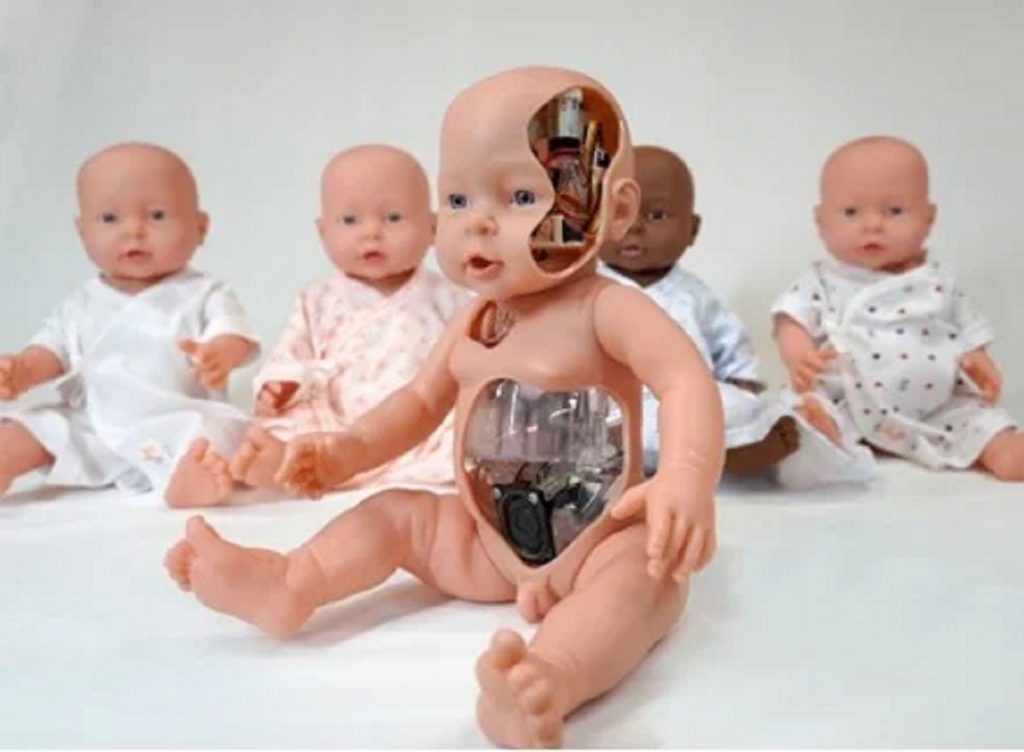
CryingBaby cries out for care such as "milk, diaper changes, and swaddling" in the same time frame as a real newborn. It drinks real milk and discharges it as urine. Diaper changes using real diapers are also possible. The color of the urine can be changed freely by coloring the sucked milk, for example, to express bloody urine.
There is no power button on CryingBaby. In other words, it cannot be turned off in the middle of the night for reasons such as "noisy" and will not stop crying until you "soothe" it, just like an actual newborn baby.
In this way, CryingBaby is a robot that places high parenting stress on the experiencer.
Critique
Airplane pilots take to the skies after ample training in flight simulators. Raising a newborn baby is a comparable difficulty, but young couples are suddenly put in the field. Devices that "put a strain on humans," such as this film, will become an important area in the future.
Nobumichi Tosa Member of the Committee President, Meiwa Electric Co.
Name of technologyMechanical Brain Hacking: Body Editing VR Cybernetics Simulator
Adopted by] Inami/Kadouchi Laboratory, The University of Tokyo

In this project, the experiencer wears a robot avatar with a broken body and attempts to repair the body system by editing the body control circuits in the avatar brain by themselves. Tactile feedback to the back of the head and the sensation of energization from electrical stimulation amplify the immersive experience of being a robot. Under the concept of "Editable Body," in which the body is edited by the user in real time, the user can explore the body as he or she wishes. This enables the application of human augmentation technology tailored to each individual.
Critique
First of all, just watching the video makes me want to try it. The experience of hacking one's own brain is fresh. It is both educational and entertaining. If we can experience the mechanisms of the brain and body in a realistic form, we can use it for more efficient image training in muscle training, brain training, and so on.
Daisuke Yanagisawa, Member of the Committee CEO, Kayac Entertainment, Inc.
Name of technologyDevelopment of ELF-SR2 Spatial Reproduction Display
Adopted by] Sony Corporation

Sony's unique gaze recognition technology detects the position of the viewer's eyes and generates images optimized for the left and right eye in real time. This enables a clear and colorful stereoscopic experience with the naked eye. The value of being able to display full-size images on larger displays has increased, providing a more lifelike visual experience than ever before.
Critique
This device has the potential to expand and remove the various restrictions that are attached to expression based on a display. As a creator, I was very intrigued by this revolutionary device, both as a medium for expression and as a tool to improve efficiency and reduce stress at production sites.
Commissioner Etsuko Ichihara Media Artist
Name of technologyjizai fish (Cercopithecus cephus)
Adopters] Shibaura Institute of Technology / The University of Tokyo / BuyByWorld Inc.

The "Jizai Face" is an artificial body part that can be played with at will. The "Jizai Eye," which is equipped with a wireless camera, has eyelids that flutter open and close. It is a device that can increase the number of its own eyes. The "Jizai Mouse," which has a built-in wireless speaker, also has a lip-opening/closing function. It speaks in place of your own mouth. When attached to your body, you can become a "monster" with many facial parts. Attach it to furniture and home appliances, and you can arrange things as if they were living creatures. Through this device, which embodies the metaphor of face parts that everyone has, anyone, young or old, male or female, can acquire a free and flexible "body.
Critique
Why is Fukuso fun? Perhaps it is because our visual perception is particularly sensitive to the shape and arrangement of the eyes, nose, and mouth. Each part was already discrete as a physical extension of the other: the camera was the eye, the speaker was the mouth, and the microphone was the eye! It's fun, and it's a question as well as a possibility.
Satoshi Endo Chairperson
Chief Researcher, Kadokawa Ascii Research Institute, Inc. / Advisor, MIT Technology Review Japan / Executive Advisor, ASCII STARTUP
Name of technologyNukabot
Adopted by] Ferment Media Research

Nukabot is designed as a tool to help humans communicate with the fermenting microorganisms in their bran beds on a daily basis, creating a better care relationship. The built-in sensor detects fermentation status, answers spoken questions, and prompts the person to stir the bran. The system uses GPT3 prompt engineering for voice speech, and the system itself "ferments" in response to interactions with its surroundings, as its voice color changes with the fermentation state of the bran bed and it learns the words used by the human.
Critique
Nukabot communicates with humans by encouraging them to stir the bran and to interact with the fermenting microorganisms. As the user uses Nukabot, a psychological connection is created with something invisible, such as a sensory grasp of the behavior of the microorganisms and a sense of attachment to them.
Junji Watanabe Commissioner
Senior Distinguished Researcher, Human Information Research Department, NTT Communication Science Laboratories
Name of technologyfree limb
The University of Tokyo Research Center for Advanced Science and Technology, Body Informatics Laboratory / Prototyping & Design Laboratory, Institute of Industrial Science, The University of Tokyo / Spline Design Hub, Inc.

Self-Limb is a wearable robotic arm system, consisting of a wearable base unit with six detachable parts and 1-4 detachable robotic arms, which can be worn to instantly experience a body with an extra arm.
This work was created to explore a future society in which digital cyborgs (cyborgs that do not require surgery using wearable robotic technology, information technology, etc.), whose bodies can be freely edited, are accepted. The free attachment and removal of the arm enables future social interactions, such as editing the body shape and exchanging arms between wearers.
Critique
The system design, which incorporates the theme of "digital cyborgs," a new relationship between humans and robots, is highly unique and novel, and is expected to lead to the creation of new creative activities by creators and the creation of a market.
Kanako Watanabe, Commissioner
Director, Content Industry Division, Commerce and Information Policy Bureau, Ministry of Economy, Trade and Industry
Name of technologyTranstiff: rod-shaped tactile interface with rigid-soft change joints
Adopted by] Aoyama Gakuin University

Transtiff is a hardness-softness change interface that can be applied to all stick-shaped tools. Normally, the hardness of tools handled by hand does not change, but by inserting a joint that changes hardness into a part of the tool, the tactile sensation transmitted to the hand can be controlled. In this device, a hard-soft joint that imitates an artificial muscle is inserted into the relay part of a stick to realize tactile changes by controlling the hardness and softness of the joint. As an example of application, we developed a pen-type device and writing application in which the joint at the tip of the stick changes dynamically from hard to soft. When the tip of the stick is hard, the sensation is similar to that of a hard brush, and when it is soft, the sensation is similar to that of a soft brush, allowing a single device to express multiple writing styles.
Critique
A stylus is the link between a person and a tablet computer. If this single stick suddenly becomes soft, how would the relationship between us and the world on the screen change? We hope you will enjoy the strange sensations created by this simple device.
Kota Minamisawa, Commissioner
Professor, Graduate School of Media Design, Keio University (KMD)
————————-
Innovative Technologies 2023: List of Adopted Technologies
What is the introduction of each technology?https://dcexpo.jp/i-tech/news/innovative-technologies-2023/ You can view it from the following page.
Innovative Technologies Website
https://dcexpo.jp/i-tech/
◆"INTER BEE IGNITION x DCEXPO 2023" website
https://www.inter-bee.com/ja/forexhibitors/conference/ignition/
What is "Innovative Technologies"?
Innovative Technologies" is a project to select, commend, and disseminate to Japan and the rest of the world outstanding projects from among candidates nominated by the public and experts, based on a broad public call for advanced technologies and content that are expected to make a significant contribution to the development of the content industry through innovation.
Innovative Technologies" started in 2012 as a project of the Ministry of Economy, Trade and Industry (METI) and has continued as a voluntary project of the Digital Content Association of Japan (DCAJ) since 2018, recognizing 168 cutting-edge content technologies from companies and universities by 2022.
Innovative Technologies Sponsorship Opportunities!
Innovative Technologies is seeking sponsors to support the adopters and to support the operation of this project. For more details, please click here.
https://dcexpo.jp/i-tech/innovative-technologies2023-sponsor/
*Innovative Technologies 2023 is subsidized by the Competitive Bicycle

Innovative Technologies 2023 is supported by the New Energy and Industrial Technology Development Organization (NEDO).
We invite you to come to the venue in November and experience a new future!





 JA
 EN
